





























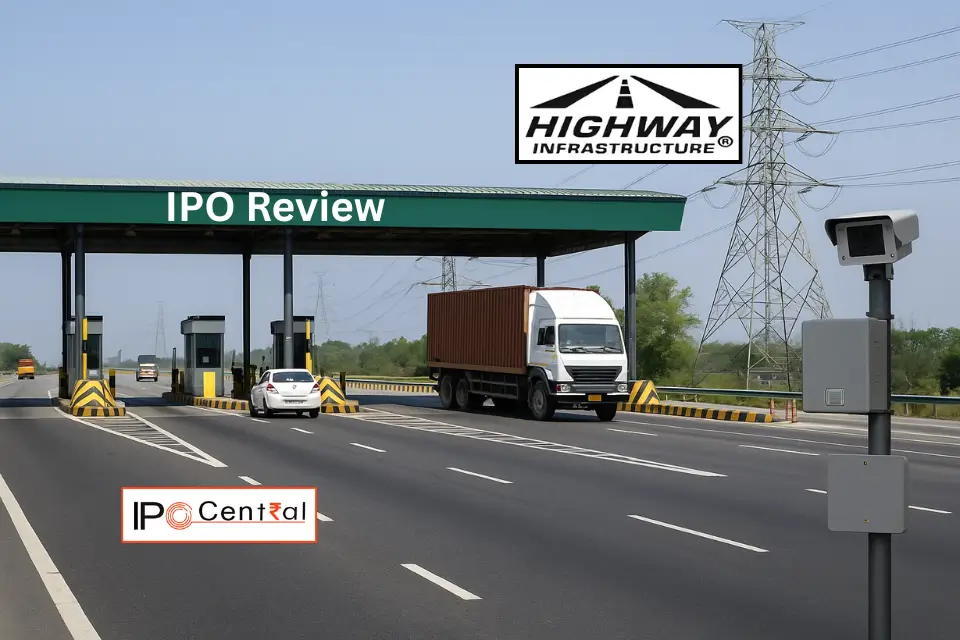
As India lays down concrete to fuel its USD 5 trillion dream, Highway Infrastructure arrives at the IPO toll booth. But can the Highway Infrastructure business model keep up with the fast lane of infrastructure growth?
India’s road and highway network isn’t just a means of transport — it’s the economic backbone of a country aiming to become a USD 5 trillion economy. With INR 10 lakh crore allocated to infrastructure in the Union Budget FY25 and the government aggressively pursuing public-private partnerships, the opportunity has never been bigger.
Over the past few years, infrastructure IPOs — from IRB InvIT to HG Infra — have found traction, reflecting investor appetite for long-term, asset-backed plays. In this context, Highway Infrastructure INR 130 crore IPO isn’t merely a fundraising event — it’s a bet on a new kind of infrastructure operator: one that thrives on toll annuity income, operational efficiency, and a light capital structure.
2. Inside Highway Infrastructure
🔍 Promoter-Driven, Regionally Anchored
Highway Infrastructure, headquartered in Indore, Madhya Pradesh, is promoted by Arun Kumar Jain, Anoop Agrawal, and Riddharth Jain. With decades of combined experience in civil infrastructure and road asset management, the promoters have built a lean, high-efficiency operation focused on toll collection and road maintenance.
The company currently operates and maintains multiple toll plazas across Indian states — particularly in central and western India — and generates recurring revenue from user fees, service charges, and maintenance contracts.
🧩 Key Identity Points:
- Focused on Toll-Operate-Transfer (TOT) and Operation & Maintenance (O&M) contracts
- No direct involvement in construction — asset operator, not asset builder
- Strategically placed in high-traffic corridors, benefiting from steady vehicular volumes
While exact toll project names are not fully detailed in the DRHP, the company has historically bid for NHAI-operated TOT bundles and state highways, aiming for medium-term (10–20 year) revenue visibility.
🧩 3. How Toll Collections Drive Steady Cash Flow
Highway Infrastructure derives the majority of its revenue — approximately 77% in FY25 — from toll collections, operating under the Toll-Operate-Transfer (TOT) model. Under this framework, HIL acquires operational rights to existing highways from the National Highways Authority of India (NHAI) or state authorities through a lump-sum upfront payment, and in return, it gets the right to collect tolls for a fixed concession period (usually ranging from 10–20 years).
Unlike EPC (Engineering, Procurement, and Construction) players, HIL does not engage in new construction or land acquisition, significantly lowering its capital risk exposure. Instead, its core strength lies in managing operational highways efficiently to maximize traffic throughput and, hence, toll revenues.
🛣️ Toll Operations and Network Footprint
As of May 2025, HIL operates 4 active toll contracts across 11 Indian states and one union territory, covering strategically significant routes including marquee assets like:
- Delhi–Meerut Expressway (high traffic density)
- Mokha Toll Plaza (critical linkage to key port infrastructure)
These contracts are typically awarded through competitive bidding and have an initial tenure of 12 months, often renewed based on performance, compliance, and traffic metrics. The short tenure reduces long-term exposure but requires consistent rebidding or requalification efforts to maintain revenue continuity.
💳 Multi-Channel Payment Ecosystem
HIL leverages the government-developed Electronic Toll Collection (ETC) infrastructure, especially the FASTag system (over 11 crore tags issued nationally), which supports cashless, contactless tolling. This not only aligns with India’s digital infrastructure push but also enables:
- Reduced congestion and tolling delays
- Lower technology capex (since infrastructure is government-provided)
- Multiple payment options: FASTag, cash, debit/credit cards, and UPI-based mobile payments
This positions HIL as a low-friction operator, enhancing both commuter experience and toll compliance.
💰Highway Infrastructure Revenue Streams
- Toll Collection (77% of FY25 Revenue)
- Directly linked to vehicle throughput
- Toll rates are indexed to inflation and traffic, offering a hedge against cost inflation
- Subject to traffic and operational risk
- O&M Services (Operations & Maintenance)
- Includes upkeep and compliance for both in-house and third-party road assets
- Potential for stable service-based recurring income
- Other Income
- Includes penalties, advertising/surplus lease revenues at toll plazas, and returns from investments
💸 4. Under the Hood: Financials and What They Tell Us
The company has shown consistent — if modest — growth, suggesting a business maturing toward cash-flow optimisation rather than high topline expansion.
📊 Financial Snapshot (in INR Cr):
| Metric | FY23 | FY24 | FY25 |
|---|---|---|---|
| Revenue | 455.13 | 573.45 | 495.72 |
| Total Expenses | 437.34 | 546.65 | 474.22 |
| Net Profit | 13.80 | 21.41 | 22.40 |
| EBITDA Margin (%) | 6.08 | 6.70 | 6.32 |
| Net Margin (%) | 3.03 | 3.73 | 4.52 |
| EPS (INR) | 2.03 | 3.28 | 3.40 |
| ROCE (%) | 19.47 | 24.45 | 16.56 |
| RONW (%) | 18.45 | 21.37 | 19.03 |
| Debt/Equity (X) | 0.85 | 0.69 | 0.61 |
🔍 What the Numbers Say:
- Margins are improving steadily, signalling operational efficiencies
- Debt is declining, reflecting discipline in expansion and repayment
- ROCE and RONW are impressive, in line with companies that run lean and optimise existing assets
- EPS growth supports the IPO valuation of ~22.4x, which appears fair relative to infrastructure peers
What’s missing? Topline growth acceleration — without more toll assets, the growth curve may flatten unless new projects are added.
🛤️ 5. What’s in the Bag: Order Book and Asset Base Breakdown
HIL’s consolidated order book of ~INR 666 crore is dominated by EPC Infra (INR 606.8 crore), showing significant future revenue from road, bridge, and civil construction projects mainly within Madhya Pradesh and neighbouring states. Toll contracts form a stable, recurring revenue base with INR 59.5 crore in the order book value.
Projects completed number 27 in toll and 66 EPC infra, with ongoing projects including 4 toll plazas and 24 EPC infra works such as residential colony developments and government infrastructure under key schemes.
🌐 6. What’s Fueling India’s Highway Growth?
India’s highway sector continues strong expansion, backed by:
- Bharatmala Pariyojana’s plan to develop 34,800 km of highways, many open to TOT auctions.
- The National Infrastructure Pipeline with over INR 111 lakh crore.
- NHAI monetisation programs that raised over INR 42,334 crores through TOT bundles through FY24.
- Increasing FASTag adoption (>98%) is improving toll efficiency nationwide.
- Growing commercial traffic from the e-commerce boom — particularly in Tier 2 and Tier 3 cities — aligns perfectly with HIL’s current footprint.
HIL participates in government-driven schemes beyond tolls (e.g., PMAY, Jal Jeevan Mission) through its EPC business, positioning it well in the broader infrastructure ecosystem.
📈 Sector Forecast:
- Toll collection to grow at 11–13% CAGR over the next 5 years
- Private road operators expected to manage ~40% of toll network by 2030
- Government expected to auction TOT Bundle 11 and more — potential targets for Highway Infra
🔗 7. Can Highway Infrastructure Ride the Industry’s Tailwinds?
HIL’s asset-light tollway operator model with strong technology usage sets it apart. It avoids construction risks by focusing on operation and maintenance, complemented by selective EPC infra projects. Steady recurring income from inflation-indexed toll collections balances operational costs and traffic risks.
Key strengths:
- Advanced ANPR and RFID ETC systems enhance toll plaza efficiency.
- Conservative leverage and a clean balance sheet enable financial flexibility.
- Focus on medium-term contracts on busy corridors to support stable cash flows.
Challenges include the limited scale of toll assets and dependence on winning future TOT bids amidst stiff competition. Expanding foothold beyond the current 4 toll contracts is critical for sustained growth.
🤝 8. Highway Infrastructure Against Peers?
To understand Highway Infra’s relative valuation and market appeal, let’s benchmark it against peers:
📊 Highway Infrastructure Peer Comparison Table
| Company | Revenue (INR Cr) | EPS (INR) | P/E | ROE | D/E | NPM (%) |
|---|---|---|---|---|---|---|
| Highway Infrastructure | 495.7 | 3.40 | 22.4 | 19.03 | 0.61 | 4.52 |
| IRB Infrastructure | 7,613.4 | 1.12 | 44.38 | 5.95 | 1.04 | 13.10 |
| HG Infra | 5,056.1 | 77.6 | 13.80 | 18.3 | 1.41 | 9.77 |
| Udayshivakumar Infra | 289.1 | -1.30 | NA | -4.20 | 0.36 | -2.49 |
📈 Takeaways:
- Highway Infra has high ROE and low debt, signalling financial discipline
- Its P/E (22.4X) is reasonable, priced midway between HG Infra and IRB
- Margins are modest but stable, in line with annuity-style income
- It’s smaller and more focused, which is both an advantage (nimbleness) and a limitation (scale risk)
📦 9. Highway Infrastructure IPO Structure, Pricing & Use of Funds
💰 IPO Details:
| Parameter | Details |
|---|---|
| Price Band | INR 65 – 70 per share |
| Issue Size | 127.68 – 130 crore |
| Fresh Issue | 97.52 crore |
| Offer For Sale | 46.4 lakh shares (~INR 30 Cr) |
| Lot Size | 211 shares (INR 13,715 min invest) |
| Retail Allocation | 35% |
| QIB / HNI / Retail | 50% / 15% / 35% |
🎯 Fund Utilisation:
- INR 65 crore towards working capital
- Balance towards general corporate purposes
- No debt repayment — indicating a focus on business expansion and bidding capability
This also reflects a moderately priced IPO, not a pure promoter exit. The OFS portion, though notable, doesn’t dominate the issue.
⚠️ 10. Risks That May Stall the Ride
Potential risks include:
- Regional concentration of toll assets, vulnerable to state policy shifts, elections, or protests affecting toll collection.
- Competitive bidding for TOT bundles may compress margins and require higher upfront capital.
- Toll contracts are generally short-term (around 12 months), raising renewal uncertainty and revenue visibility risk.
- Limited EPC/HAM business means a lack of backwards integration and exposure solely to asset operation risk.
- Scalability depends heavily on successfully acquiring new toll assets, which is capital-intensive and competitive.
Mitigating these risks will be key to maintaining investor confidence
11. Invest or Just Pass Through?
Highway Infrastructure IPO sits at the crossroads of a favourable macro theme and a conservative but functional business model.
✅ The Positives:
- Clean balance sheet and improving margins
- Recurring revenue model from tolling
- Industry tailwinds (Govt. infra push, e-commerce traffic, NHAI monetisation)
- Reasonable IPO valuation with scope for expansion
❗ Considerations:
- Limited asset base as of now
- High dependency on future TOT bidding success
- Low EPC segment exposure — not suitable for investors seeking construction growth
Investors should view this IPO as a yield-style infrastructure investment rather than a rapid compounding story. If you want a steady, indexed income with limited downside and are okay with modest growth, Highway Infra deserves a place on your radar.
📌 Disclaimer: This article is for informational purposes only. Please consult a SEBI-registered investment advisor before investing.