




































India’s capital markets are poised for a significant regulatory pivot as the Securities and Exchange Board of India (SEBI) released a consultation paper on 31 July 2025, laying out ambitious proposals to reform the framework for IPOs—with headline news being the planned reduction in the retail quota for issues above INR 5,000 crore. Sebi proposal on limiting retail quota, open for public comment until 21 August 2025, reflects the market regulator’s continued adaptation to the rapidly evolving landscape of Indian capital markets, where institutional participation is rising in the face of relatively flat direct retail investor engagement.
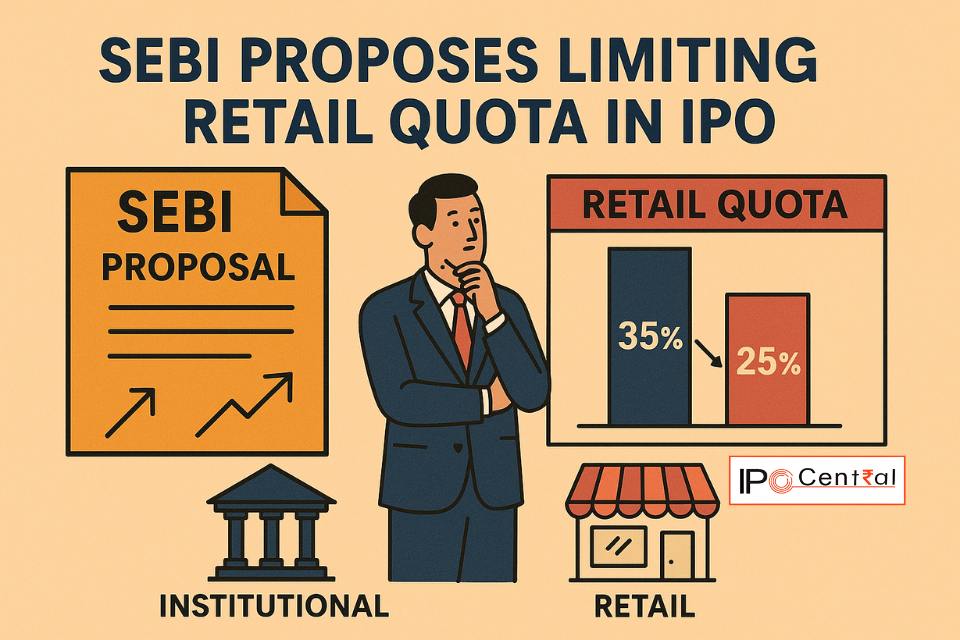
Why SEBI Proposes Limiting Retail Quota in IPO?
Over the past several years, the Indian IPO market has scaled new heights. The average deal size has consistently risen, especially for listings above INR 1,000 crore. Biggest IPOs—such as those for LIC, Hyundai Motors, Bajaj Housing Finance, and Vishal Mega Mart—have showcased the market’s growing ambition and maturity. However, regulatory analysis reveals that while mutual fund inflows and systematic investment plans (SIPs) have surged, direct retail participation in IPOs has plateaued—particularly for giant public issues. SEBI’s new IPO retail quota norms highlight that even large IPOs often see modest retail subscriptions:
- Hyundai Motors: Retail portion subscribed at just 0.4x
- Hexaware Technologies: 0.1x
- Afcons Infra: 0.9×1
The minimum retail application size (typically INR 12,000-15,000), coupled with the size of the retail portion (up to INR 2,800 crore for an INR 8,000 crore IPO), demands lakhs of unique bidders. For an INR 10,000 crore IPO, around 1.75 million retail applicants are required for a single-time subscription of the allotted quota—a huge logistical feat.
Details of SEBI’s Proposal on Retail Quota
Key highlights of SEBI’s new norms on retail quota in IPO:
- Retail investor quota: SEBI proposal on limiting retail quota from 35% to as low as 25%—applied in a graded manner for IPOs exceeding INR 5,000 crore.
- The first INR 5,000 crore of the offer would still allocate 35% to retail.
- For the portion above INR 5,000 crore, only 10% goes to retail, but aggregate retail allocation will never drop below 25% of the net offer1.
- Qualified Institutional Buyers (QIBs): Quota suggested to be raised from 50% to 60% for large IPOs, again in a graded fashion.
- This rebalancing is meant to ensure demand stability and foster issuer confidence during volatile market conditions, especially as institutions are better placed to absorb big issues and provide long-term stability.
- Non-anchor QIB Reservation for Mutual Funds: Raised from 5% to 15%—significantly boosting the share of IPOs available to mutual funds, a primary investment channel for the average Indian retail investor.
Illustration: Changing Quotas for Large IPOs
| IPO Size (INR Cr) | Existing Retail (INR Cr) | Proposed Retail (INR Cr) | Retail % | Proposed QIB % |
|---|---|---|---|---|
| 5,000 | 1,750 | 1,750 | 35% | 50% |
| 6,000 | 2,100 | 1,850 | 31% | 54% |
| 7,000 | 2,450 | 1,950 | 28% | 57% |
| 8,000 | 2,800 | 2,050 | 26% | 59% |
Effective retail participation will be maintained around 44-46% when including mutual fund routes—down from 46% for an INR 8,000 crore IPO only by a marginal nominal amount, since much retail demand is now directed through SIPs and mutual funds.
Anchor Investor Reforms: More Flexibility, Broader Participation
SEBI’s proposal on retail quota in IPOs also includes sweeping changes to the anchor investor allocation rules in IPOs:
- For anchor allocations above INR 250 crore, the number of permissible anchor investor allottees will be increased—from the current ten for each additional INR 250 crore, to fifteen.
- Category I and II for anchor allocation sizing will be merged, reflecting that smaller IPOs are now rare on the main board.
This overhaul is meant to accommodate more foreign portfolio investors (FPIs), who frequently manage multiple large funds with distinct PANs, which were previously stymied by line caps and allocation limits. The consultation paper’s impact analysis suggests that for an INR 10,000 crore IPO, the maximum number of anchor lines would jump from 125 to 180 (a 44% increase).
Expanding the Anchor Reservation: Mutual Funds, Insurers, and Pension Funds
SEBI’s new norms on retail quota in IPO will strengthen the long-term investor base:
- SEBI proposes raising the anchor reservation from 33% to 40% of the anchor book.
- Of this, 33% remains reserved for domestic mutual funds.
- 7% carved out specifically for IRDAI-registered life insurance companies and PFRDA-registered pension funds.
- Any unutilised portion may be allocated to mutual funds, ensuring effective utilisation of the reserved anchor book and strengthening listing stability.
Historical data shows insurance companies have already claimed 5-11% of anchor allotments in recent IPOs—this change formally recognises their growing role as stable, long-term investors.
Regulatory Rationale: Why Now?
- Market Maturity: India’s IPOs are larger than ever but rely increasingly on institutional demand. The high minimum requirements for fully subscribing to the retail quota make it impractical in larger issues unless retail enthusiasm is extremely high—a scenario only witnessed in a handful of megadeals like LIC and Bajaj Housing Finance.
- Growth of Mutual Funds: Retail money is flowing into equity markets via MFs—monthly SIP inflows hit a record INR 26,688 crore in May 2025, as industry AUM topped INR 70 lakh crore.
- Sense and Stability: With IPO sizes ballooning, ensuring full retail subscription has become challenging unless the issue has stellar brand appeal. Undersubscription dampens sentiment and could affect market perceptions around both the issuer and India’s capital market vibrancy.
“Direct retail participation has remained flat over the past three years. In large public issues, retail subscription levels have been particularly muted.” — SEBI Consultation Paper, 31 July 2025
Public Consultation and the Road Ahead
Stakeholders, market participants, and the public have been invited to comment on SEBI’s proposal on retail quota until 21 August 2025. The final framework, including amendments to SEBI’s ICDR Regulations, is expected to reflect both these insights and practical feedback from all quarters.
SEBI’s Proposal on Retail Quota: What Will Change for Investors and Issuers?
- Retail investors: Direct quota may shrink in large IPOs, but indirect access remains robust via mutual funds and SIPs.
- Institutions: Greater access, larger guaranteed quotas, and a clear push towards long-term domestic ownership—especially for insurance and pension funds.
- IPO issuers: More flexibility to attract stable, long-term capital via institutional channels, aided by expanded anchor investor pools and a rebalanced QIB-retail ratio, reducing the risk of undersubscription and negative sentiment.

Bottom Line
SEBI’s new norms on retail quota in IPO are a pragmatic response to contemporary market dynamics—one that balances the spirit of investor inclusion with the realities of India’s evolving capital market landscape. The focus is on ensuring robust demand, stable post-listing performance, and competitive allocation practices that reflect both global standards and domestic investor progression.
For more details related to IPO GMP, SEBI IPO Approval, and Live Subscription stay tuned to IPO Central.
