

































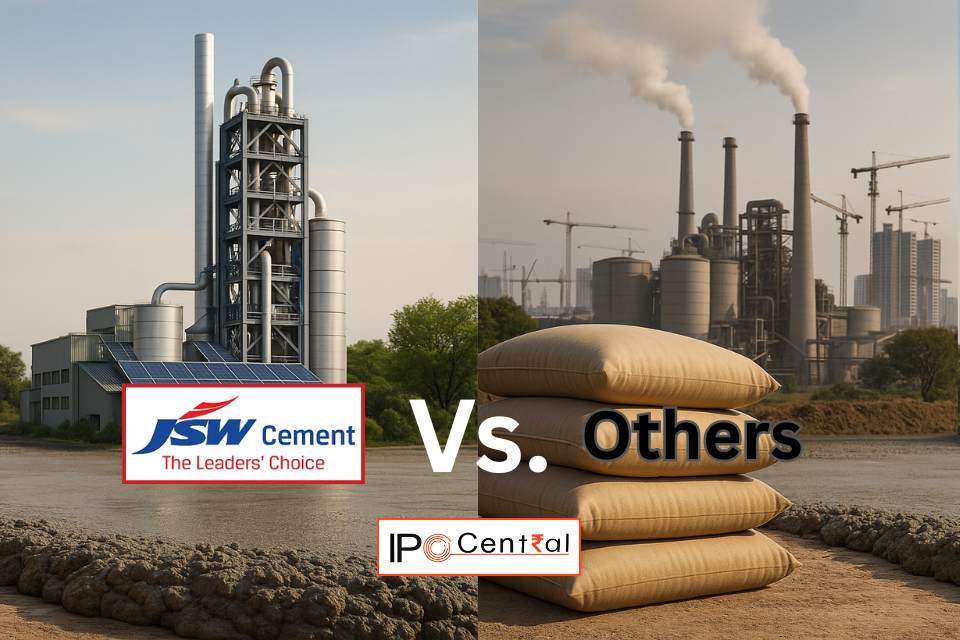
India’s cement industry is at the cusp of transformation, with themes of green manufacturing, efficiency, and scale defining the next decade. Amidst this landscape, JSW Cement is making its play, seeking to disrupt the industry’s established order led by giants like UltraTech Cement, Shree Cement, Dalmia Bharat, and others. Here’s a detailed, data-driven comparison of JSW Cement vs peers, and what makes it an intriguing outlier for both investors and industry watchers.
JSW Cement IPO Details
| JSW Cement IPO Dates | 7 – 11 August 2025 |
| JSW Cement IPO Price | INR 139 – 147 per share |
| Fresh issue | INR 1,600 crore |
| Offer For Sale | INR 2,000 crore |
| Total IPO size | INR 3,600 crore |
| Minimum bid (lot size) | 102 shares (INR 14,178 – 14,994) |
1. Growth: Outpacing the Industry
- JSW Cement is among the top three fastest-growing cement companies in India (CAGR FY15–FY25: 12.96% for installed capacity; 16.73% for volume sold), well ahead of the industry average (CAGR 4.77% for capacity; 6.15% for volumes). Recent years (FY23–FY25) saw JSW’s installed capacity and volume growing at 12.42% and 15.05% CAGR, compared to the industry’s 6.23% and 8.12%.
- Even as the mature leaders—UltraTech, Ambuja, Shree, Dalmia Bharat—expand incrementally, JSW’s expansion plans (targeting 41.85 MMTPA in the next few years, up from 20.6 MMTPA in FY25) mark it as a high-voltage growth story.
2. JSW Cement vs Peers: Product Mix and Sustainable Edge
- Green cement focus: Over 77% of JSW Cement’s sales are “green cementitious products” (mostly blended cements using GGBS, PSC, PCC), versus peers Shree, where blended’s share is roughly 20–35%.
- Clinker-to-cement ratio: JSW at 50.13% (FY25)—lowest among Indian peers; industry peer average is 66.43%. A lower ratio means fewer emissions, lower capex requirements, and less raw material vulnerability.
- CO₂ emissions: JSW’s per-tonne emissions are industry-low—258kg (FY25), about 52% lower than the Indian peer average and up to 54% lower than leading global cement players.
- Raw material advantage: Thanks to vertical JSW Group integration, JSW Cement sources slag (from JSW Steel), fly ash (from JSW Energy), and green power (solar, WHRS) at strategic cost advantages—unmatched among peers.
3. Regional & Capacity Positioning
- JSW Cement vs Peers: Installed grinding capacity (FY25):
- UltraTech Cement: 188.8 MMTPA
- Ambuja Cements: 88.90 MMTPA
- Shree Cement: 53.40 MMTPA
- Dalmia Bharat: 44.60 MMTPA
- JK Cement: 27.39 MMTPA
- JSW Cement: 20.60 MMTPA
- JSW Cement is not yet pan-India but is rapidly expanding into underpenetrated North and Central India, potentially breaking into the top five producers once ongoing projects are commissioned.
Read Also: Top Cement Companies in India
4. JSW Cement vs Peers: Financials, Margins, Efficiency, & Return Metrics
| Metric (FY25) | JSW Cement | UltraTech | Ambuja | Shree | JK Cement | Ramco | India Cements |
|---|---|---|---|---|---|---|---|
| Revenue | 5,813.1 | 75,955.1 | 33,697.7 | 19,282.8 | 11,879.2 | 8,518.4 | 4,148.7 |
| EBITDA Margin (%)* | 13.78 | 17.34 | 22.88 | 24.35 | 16.82 | 13.40 | -3.99 |
| RoE (%) | (6.90) | 10.1 | 8.73 | 5.29 | 13.9 | 1.38 | -8.83 |
| Debt to Equity | 2.55 | 0.24 | 0.01 | 0.05 | 0.99 | 0.63 | 0.11 |
| Current Ratio | 0.64 | 0.89 | 1.29 | 0.98 | 1.16 | 0.52 | 1.27 |
| PE Ratio | NA | 51.6 | 34.70 | 99.0 | 56.3 | 268 | NA |
| Price to book | 6.16 | 5.05 | 2.80 | 5.14 | 8.48 | 3.66 | 1.10 |
| Price to Sales | 3.45 | 4.59 | 4.03 | 5.74 | 4.16 | 3.19 | 2.69 |
*As of 31 March 2025
Based on TTM basis
Commentary & Peer Analysis
EBITDA Margins
JSW Cement’s EBITDA margin of 13.78% is lower than premium peers such as Shree Cement 24.35% and Ambuja 22.88%, reflecting the cost impact of aggressive capacity expansion and lower realisations in some markets. However, it remains competitive versus sector laggards like India Cements (negative margins) and close to the mid-tier average. As utilisation rates rise post-expansion, margins are likely to improve.
Return on Equity (RoE):
The current RoE of -6.90% is a result of high depreciation and interest costs during the ramp-up phase—a typical scenario for companies in heavy capex cycles. Leaders such as JK Cement 13.9% and UltraTech 10.01% are benefiting from more mature operations. As new plants become fully operational, earnings and RoE should normalise.
Leverage & Solvency:
With a debt-to-equity ratio of 2.55X, JSW Cement carries higher leverage than most listed peers. This reflects its aggressive expansion approach. While it increases financial risk, it also positions the company to unlock strong operating leverage benefits once capacity additions translate into higher sales volumes. IPO proceeds will be directed toward debt reduction, which should meaningfully strengthen the balance sheet.
Liquidity:
The current ratio of 0.64X is more conservative peers such as Ambuja’s 1.29X and JK Cement’s 1.16X. The cement sector generally operates with relatively lean liquidity due to its working capital cycle.
Valuation Perspective
While a PE ratio cannot be computed for JSW Cement due to negative EPS, other valuation metrics offer useful insight.
- Price to Book: Above UltraTech 5.05X and Ambuja 2.80X, and in line with Shree Cement 5.14X. This reflects market expectations for future growth and profitability improvement.
- Price to Sales: Below UltraTech 4.59X, Ambuja 4.03X, and Shree Cement 5.74X, suggesting that despite a higher P/B, the market may still be valuing JSW Cement conservatively relative to revenue potential. Together, these metrics suggest that while investors are pricing in JSW Cement’s growth prospects, there remains room for re-rating as profitability improves post-expansion.
JSW Cement vs Peers: The Growth Context
- Profitability Under Pressure: JSW Cement’s profitability is depressed in the near term, reflecting expansion-phase costs, not operational weaknesses. This phase is typical for companies aggressively scaling up: robust cash generation on operations, but thin or negative reported earnings due to accounting for new investments.
- Deleveraging in Sight: IPO proceeds are earmarked for debt reduction, which should improve future interest coverage and returns.
- Margins Momentum: As projects stabilize and utilization rates rise, both margin and RoE metrics are expected to tick upward, barring sector-wide shocks.
JSW Cement Vs Peers: KPI Comparison Table
| Particulars | UltraTech Cement | Ambuja Cement | Shree Cement | Dalmia Bharat | JK Cement | Ramco Cement | India Cement |
| Cement Saleable Production | 131.64 | 61.58 | 33.98 | 27.37 | 18.27 | 18.23 | 8.98 |
| Total Cementitious Saleable Production | 131.64 | 61.58 | 33.98 | 27.33 | 18.9 | 18.23 | 8.98 |
| Clinker Production | 93.3 | NA | 23.11 | 17.58 | 12.27 | 13.17 | 6.63 |
| Cement Volume Sold | 135.83 | 63.48 | NA | 29.4 | 19.05 | 18.17 | NA |
| Installed Grinding Capacity (MMTPA) | 188.8 | 88.9 | 53.4 | 49.5 | 27.39 | 24.44 | NA |
| Grinding Capacity Utilization (%) | 78 | NA | 68 | 63 | NA | 77 | 62 |
| Clinker to Cement Ratio (%) | 67.9 | 64 | 63.56 | 59.7 | 65 | NA | 72.2 |
| Green Power Consumption (%) | 27.8 | 28 | 55.89 | 36 | 51 | 36 | NA |
| Net CO2 Emission Intensity (Kg/T) | 549 | 555 | 552 | 538 | 565 | 578 | 637 |
| EBITDA Margin (%) | 17.34 | 22.88 | 24.35 | 17.59 | 16.82 | 17.03 | -3.99 |
5. JSW Cement vs Peers: Efficiency and Sustainability KPIs
- CO₂ emission intensity (FY25): JSW 258 kg/tonne vs. UltraTech 549, Shree 552, Dalmia Bharat 480 approx.
- Waste utilisation: JSW uses 64%+ industrial waste as raw material, industry peers average 23–25%.
- Green power usage: JSW’s green power (solar and waste heat) as % of total: 21.5% (FY25), rising quickly. Many peers are catching up, but JSW’s blend of captive and green power is a structural margin lifter.
6. Strategic and Distribution Levers of JSW Cement Against Its Peers
- Distribution: JSW boasts 4,653 dealers and 8,844 sub-dealers (FY25), a robust reach for a company of its relative size—but still behind Mega-players like UltraTech1.
- Product differentiation: JSW leads national sales of GGBS (market share 84% in FY25), with a strong portfolio of premium blended cement1.
- Institutional business: Heavy institutional sales, especially “green” cement for metro, highway, and government infra projects—an edge in winning high-margin, sticky contracts1.
What Sets JSW Cement Apart?
- Cost model driven by group synergy (raw material and power security)
- Sustainability-first portfolio (market leader in GGBS)
- Aggressive capex to tap growth markets (North and Central India greenfield expansion)
- IPO advantage (investors gain access during growth inflection, unlike mature leaders)
- ESG positioning is likely to become more valuable as regulations tighten
Risks to Watch
- Debt load during expansion, though being addressed with IPO proceeds
- Execution risk in timely expansion and securing regulatory clearances
- Reliance on group entities for raw material and power (commercial realignment risk)
- Regional market dependence, though declining with national expansion

Final Take
JSW Cement is not just another cement story—it is India’s most focused “green cement” platform, with integration-driven cost advantage, sector-leading growth, and a balance of risks and rewards more akin to a fast-scaling industrial startup than a stodgy infrastructure major. In an industry where scale and sustainability increasingly determine who thrives, JSW Cement stands at the intersection of both.
For investors, the JSW Cement peer comparison tells a story of operating discipline, margin headwinds of a company in its high-growth phase, powerful synergies, and massive sustainability tailwinds—with future valuation re-rating likely as margins and profitability catch up to the sector over the next few years.
For more details related to IPO GMP, SEBI IPO Approval, and Live Subscription stay tuned to IPO Central.