





































When an IPO hits the market, the temptation is to focus on the grey market premium, oversubscription numbers, and listing-day fireworks. Yet, in sectors like agro-processing — where commodity cycles, operational efficiencies, and capital intensity can make or break fortunes — real insight lies in comparing the new entrant with its listed peers.
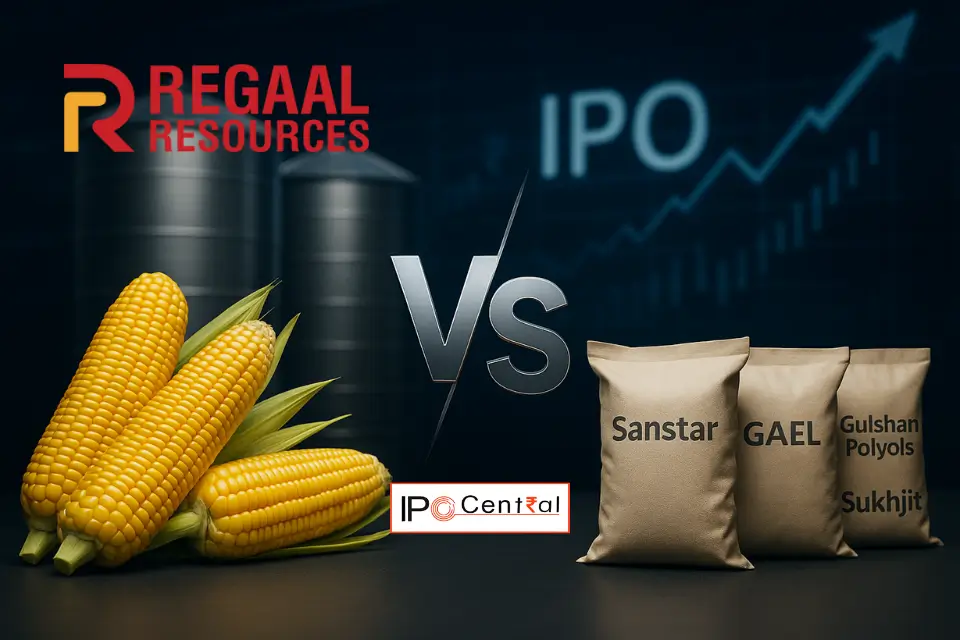
As Regaal Resources readies for its public debut (INR 96–102 per share, 12–14 August), it steps into a competitive league that includes Sanstar, Gujarat Ambuja Exports (GAEL), Gulshan Polyols, and Sukhjit Starch & Chemicals. These players are veterans in maize-based products and speciality starch derivatives, each with its own niche. For investors weighing Regaal Resources vs peers, the question is how the company measures up — and where it might hold an edge.
Industry Backdrop: A Commodity Base with Specialty Ambitions
India’s maize-based processing industry sits at the intersection of agriculture and manufacturing, feeding into food & beverages, pharmaceuticals, paper & packaging, adhesives, textiles, and animal nutrition. While the basic starch segment remains commoditised, the real margin game is in modified starches, derivatives (like maltodextrin, glucose), and value-added food-grade products.
Peer companies differ not just in size but in how far they’ve travelled up the value chain:
- Sanstar – Primarily maize starch and derivatives, strong B2B base, moderate margin profile.
- GAEL – Diversified agro-processor with soya derivatives, feed ingredients, edible oils, and corn starch.
- Gulshan Polyols – Broader chemicals play, spanning ethanol, calcium carbonate, starch derivatives.
- Sukhjit – Established starch manufacturer with long operating history but lower product diversification.
Regaal’s model — a vertically integrated maize processor with ambitions in modified starches, branded ingredients, and white-labelling — positions it in the scalable, margin-accretive zone if execution stays on track.
Regaal Resources Vs Peers: Financial Performance
| Company | FY25 Revenue (INR Cr) | 3-Yr CAGR | EBITDA Margin | PAT Margin |
|---|---|---|---|---|
| Regaal Resources | 915 | 36.9% | 12.32% | 5.19% |
| Sanstar | 953 | 45% | 5.87% | 4.51% |
| GAEL | 4,612 | -3.07% | 8.69% | 5.31% |
| Gulshan | 2,020 | 30.8% | 4.72% | 1.22% |
| Sukhjit | 1,498 | 1.76% | 7.46% | 2.65% |
Observations:
- Regaal’s growth rate outpaces larger incumbents like GAEL and Sukhjit, signalling market share gains and volume ramp-up.
- EBITDA margin is the highest in the group, indicating strong cost control from its Bihar location and near-99.7% capacity utilisation.
- PAT margin, while competitive, has room for improvement if value-added segments scale.
Returns & Leverage: Efficiency vs Expansion
| Company | ROE | ROCE | Debt/Equity |
|---|---|---|---|
| Regaal Resources | 20.25% | 14.17% | 2.08x |
| Sanstar | 7.03% | 9.44% | 0.04x |
| GAEL | 8.30% | 8.58% | 0.07x |
| Gulshan | 4.02% | 5.79% | 0.64x |
| Sukhjit | 7.36% | 9.43% | 0.55x |
Interpretation:
- ROE of 20%+ is exceptional in this sector, signalling strong shareholder returns on current equity.
- High Debt/Equity is a double-edged sword — it amplifies returns in growth phases but raises risk if market conditions soften. IPO proceeds earmarked for debt repayment should lower this ratio and free up capital for expansion.
Regaal Resources Peer Comparison: Valuation Analysis
| Company | P/E | P/B | Price/Sales | Current Ratio |
|---|---|---|---|---|
| Regaal Resources (IPO) | 15.9–16.9 | 3.56 | 1.16 | 1.32 |
| Sanstar | 34.8 | 2.28 | 1.60 | 8.99 |
| GAEL | 20.0 | 1.57 | 0.99 | 2.58 |
| Gulshan | 38.2 | 1.77 | 0.50 | 1.14 |
| Sukhjit | 14.9 | 0.98 | 0.36 | 1.30 |
Takeaways:
- Cheapest on Price/Sales, suggesting headroom for valuation re-rating if margins hold and revenue expands.
- P/E multiple at IPO is below Sanstar and Gulshan, aligning closer to GAEL despite higher margins — a sign of conservative pricing.
- P/B ratio is higher than some peers due to fresh equity infusion, but justified given ROE.
Strategic Levers: Where Regaal Could Pull Ahead
- Geographic Cost Advantage – Proximity to Bihar’s maize belt lowers raw material costs; near-monopoly as the only wet maize processor in the state.
- Infrastructure Readiness – 65,000 MT storage, captive power, Zero Liquid Discharge facility.
- Expansion Plan – Capacity jump from 750 TPD to 1,650 TPD (~120% increase), outpacing peer expansion rates.
- Product Diversification – Moving into modified starches, food-grade branded products, and white-labelling — higher-margin categories.
- Export Gateway – Close to Nepal/Bangladesh borders and ICD Siliguri, facilitating cross-border trade.
Risks to Monitor
- High leverage until post-IPO debt repayment is executed.
- Native starch dependence (59% of revenue) — diversification pace will be key.
- Execution risk in scaling modified starch and branded categories.
- Working capital intensity — current cycle longer than some peers, requiring strong receivables and inventory management.

Investor’s View: Positioned for a Valuation Catch-Up
In the starch and derivatives universe, premium valuations often go to companies with higher-margin portfolios, consistent growth, and low leverage. Regaal Resources vs peers — is already ahead on growth and margins, with valuations at IPO leaving room for upside. Debt reduction post-issue could narrow the gap with Sanstar’s and Gulshan’s multiples, while diversification could protect against commodity swings.
For investors, this IPO is less about immediate listing gains and more about entering at a reasonable valuation before the expansion story unfolds. With a strong base, strategic location, and the right mix of ambition and capacity, Regaal Resources could — if execution stays disciplined — emerge as one of the sector’s more efficient and profitable mid-caps over the next few years.
For more details related to IPO GMP, SEBI IPO Approval, and Live Subscription stay tuned to IPO Central.