




































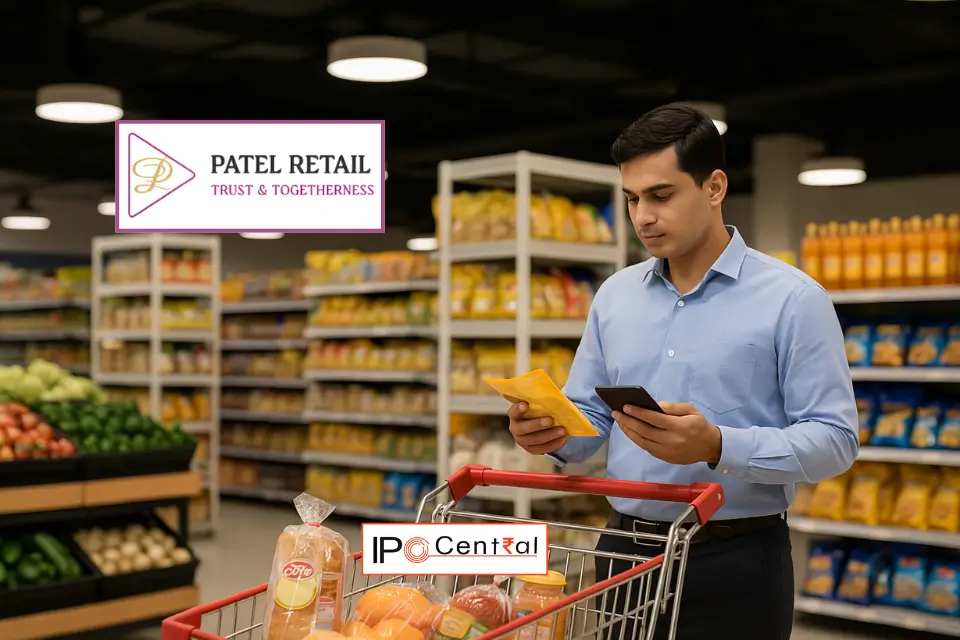
India’s organised retail sector has long been dominated by large-format stores in metros and Tier-I cities, but in the quieter lanes of Tier-III towns and suburban belts, a different kind of retail story has been unfolding. Patel Retail, established in 2008, has positioned itself as a value-focused supermarket chain designed specifically for these underserved markets. From its first store in Ambernath, Maharashtra, the company has expanded to 43 outlets by May 2025, covering nearly 1.79 lakh square feet of retail space and offering more than 10,000 SKUs across 38 product categories.
The company’s upcoming IPO, set for 19–21 August 2025, has brought renewed attention to its business model — a rare hybrid in the Indian supermarket space that blends direct-to-consumer retail, wholesale distribution, integrated manufacturing, exports, and even e-commerce. For investors, understanding how these channels fit together is key to assessing Patel Retail’s growth story.
A Value Proposition Built for Price-Sensitive Markets
Patel Retail’s foundation rests on a simple but powerful idea: bring the range and reliability of an organised supermarket to customers who typically shop in local kiranas and weekly bazaars, without losing the price advantage they expect. Its focus areas — suburban Thane and Raigad districts in Maharashtra — are dense, rapidly urbanising pockets with rising disposable incomes but high price sensitivity.
Every store follows a standardised layout for familiarity, but the product assortment is tailored to local preferences using the company’s in-house IT systems. This allows Patel Retail to adjust SKUs, stock levels, and even pricing at a store level. Seasonal and festival-driven offers, coupled with region-specific promotions, replace heavy national ad campaigns — a marketing choice that helps control costs while keeping brand recall strong within its chosen clusters.
Multi-Channel Revenue Architecture
Unlike most supermarket operators that rely solely on walk-in retail sales, Patel Retail has built a diversified revenue model. Retail stores remain the flagship channel, contributing a significant share of revenue, but the company also sells to a wide network of wholesalers, institutional buyers like hotels and restaurants, and industrial FMCG clients who purchase in bulk.
Beyond domestic markets, Patel Retail exports products to more than 35 countries. These exports take two forms — branded shipments under labels like Indian Chaska and Patel Fresh, and unbranded bulk supplies to foreign distributors, re-packers, and Tier-II supermarket chains. In FY 2025, exports generated INR 273.51 crore, about 33.33% of total revenue, with peanuts, spices, pulses, and wheat flour forming the bulk of shipments.
The company has also made a measured entry into e-tailing through its “Patel’s R Mart” mobile application, launched in 2021, which has over 86,000 downloads. Rather than setting up separate warehouses, it uses its stores as fulfilment centres, ensuring faster deliveries while keeping logistics lean.
Private Labels as a Margin Lever
A key profitability driver for Patel Retail is its growing portfolio of private label brands. These include Patel Fresh for pulses, staples, and wheat flour; Indian Chaska for spices, ghee, and papad; Blue Nation for men’s apparel; and Patel Essentials for home improvement products. By selling under its own labels, the company avoids paying brand premiums to third-party FMCG companies and gains control over sourcing and quality.
Private label penetration has been rising steadily — in FY 2025, private label sales through supermarkets alone brought in INR 62.87 crore, accounting for 17.05% of retail revenue. This not only boosts gross margins but also strengthens customer loyalty, as shoppers start associating quality and value directly with the store brand.
Manufacturing for Control and Efficiency
Patel Retail is not just a retailer — it also operates manufacturing units for spices, wheat flour, peanuts, and fruit pulp. This vertical integration allows direct procurement from farmers and APMC markets during harvest season, locking in supply and stabilising costs for the year.
The company sources strategically from multiple states — chillies from Guntur and Warangal, wheat from Gujarat and Rajasthan, and pulses from Maharashtra and Gujarat — balancing quality and price. Current plant utilisation rates range from about 3% to 69%, leaving significant headroom for scaling up production as demand grows, without heavy new capital investment.
Cluster-Based Expansion Strategy
Store expansion has followed a deliberate cluster model. Rather than scattering outlets across distant markets, Patel Retail adds new stores within a few kilometres of existing ones. This approach maximises supply chain efficiency, enables shared warehousing, and allows marketing campaigns to saturate a local area.
In FY 2025 alone, the company opened nine new stores, bringing its total to 42 by March-end and 43 by May. This concentrated approach has also helped Patel Retail build a deep understanding of its core markets, a critical advantage in Tier-III retail where local tastes can vary sharply even within the same district.
From Trading-Heavy to Brand-Driven
In FY 2023, trading — bulk exports of commodities like sugar, rice, and edible oils, often sourced from third-party brands — contributed a massive 42.34% of total operating revenue. But by FY 2025, that share had shrunk to just 10.13%, with absolute trading revenue falling from INR 431.20 crore to INR 83.17 crore.
On the surface, this looks like a contraction, but strategically, it’s a conscious shift. Trading provided volume, but little brand equity and thinner margins. By reducing reliance on volatile commodity trading, Patel Retail freed up resources to focus on segments where it has greater control over pricing and customer loyalty — namely, branded retail, private labels, and export manufacturing.
Retail Sales: The Core Consumer Engine
Retail operations, particularly through its Patel’s R Mart stores, remain the company’s most visible revenue pillar. Here, private label penetration has steadily increased, helping push EBITDA margins up from 4.25% in FY 2023 to 7.61% in FY 2025.
The cluster-based expansion strategy means each new store doesn’t just add incremental sales — it deepens market saturation, raising same-store sales in surrounding outlets. Retail sales per square foot have remained stable (INR 21,079 in FY 2025 vs INR 21,102 in FY 2024), even as store count and retail floor area have grown. That stability suggests Patel Retail is not sacrificing per-store productivity to chase aggressive expansion.
Wholesale & Institutional Sales: A Capacity Utilisation Play
Beyond its own retail counters, Patel Retail maintains a network of 234 wholesalers (FY 2025), generating INR 145.88 crore in revenue — nearly 17.78% of total operating revenue. This channel serves two purposes:
- It ensures higher capacity utilisation for manufacturing units.
- It gives the company a low-cost way to penetrate regions where setting up its own retail outlets might not yet be viable.
Sales to industrial customers — FMCG manufacturers, biscuit makers, namkeen producers — are particularly strategic. These clients often buy customised product variants in bulk, providing predictable, long-term contracts that can smooth revenue volatility.
Exports: A Global Growth Lever
Patel Retail’s export arm is where the brand’s dual model — branded and unbranded — really shows its flexibility.
- Branded exports (Indian Chaska, Patel Fresh) target organised retail overseas, particularly in spices, wheat flour, and pulses.
- Unbranded exports, often bulk peanuts or spices, go to traders and re-packers who sell under their own labels.
In FY 2025, exports brought in INR 211.13 crore from manufacturing sales alone, plus another INR 62.39 crore from trading exports. This combined export footprint spans over 35 countries, with top markets including Sri Lanka, the UK, and Canada.
While FY 2024’s export share was higher (49.93% of revenue), the FY 2025 dip to 33.33% is again tied to the company’s pivot away from low-margin sugar trading, not a fall in core branded exports. In fact, branded export sales in FY 2025 alone were INR 143.31 crore— solid given the broader commodity pullback.
Margins and Profitability: The Quiet Turnaround
The transformation of Patel Retail’s revenue mix is already visible in its profitability metrics:
- EBITDA rose from INR 43.24 crore in FY 2023 to INR 62.43 crore in FY 2025 — a 20.16% CAGR.
- Net Profit After Tax grew at an even faster 24.23% CAGR, reaching INR 25.28 crore in FY 2025.
- Net margin improved from 1.61% (FY 2023) to 3.08% (FY 2025).
The debt-to-equity ratio has dropped from 2.54 to 1.34 over the same period, which, along with IPO proceeds earmarked for loan repayment, should further strengthen the balance sheet. This deleveraging is crucial in a sector where working capital requirements — especially for stocking inventory across multiple categories — can be intense.
Sustainability of Patel Retail Revenue Streams
What stands out in Patel Retail’s model is that each revenue channel serves a distinct role:
- Retail stores: Build brand loyalty and drive higher-margin private label sales.
- Wholesale/institutional sales: Maximise manufacturing throughput and reduce per-unit costs.
- Exports: Diversify geographically and hedge against domestic demand fluctuations.
- E-tailing: Future-proof the model against digital disruption while leveraging existing stores for fulfilment.
By balancing these channels, Patel Retail has insulated itself from over-reliance on any single revenue source. The sharper focus on branded and value-added products — rather than undifferentiated trading — suggests margins can continue to expand, even without explosive top-line growth.

Final Words
Patel Retail business model is not about chasing scale at any cost. Instead, it’s about building a clustered, multi-channel, vertically integrated ecosystem where manufacturing, branding, and distribution reinforce one another. The transition from trading-heavy revenues to brand-driven, higher-margin streams is already improving profitability, and with IPO funds set to reduce debt and boost working capital, the company is positioning itself for the next leg of growth.
For more details related to IPO GMP, SEBI IPO Approval, and Live Subscription stay tuned to IPO Central.