



































India’s SME IPO market is on fire. Retail investors have been lining up for allocations, often oversubscribing issues by hundreds of times. QIBs and NIIs, too, have been pouring in, chasing the sharp listing gains this segment has delivered.
But amid the frenzy, one category stands out for its conspicuous lack of enthusiasm — the employee quota.
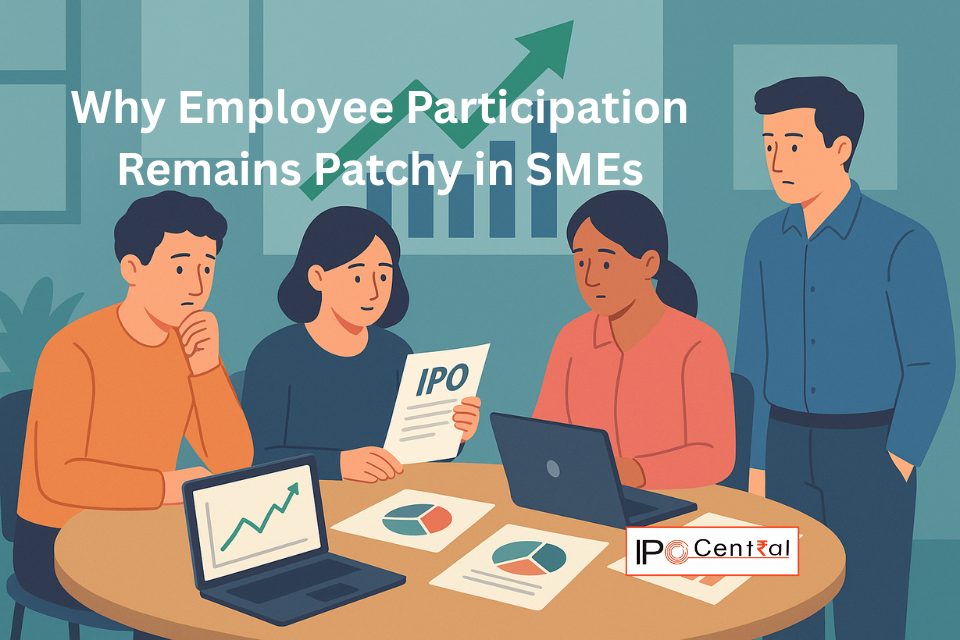
An analysis of the last 10 SME IPOs paints a telling picture: while retail category saw frenzied demand, employee participation was a mixed bag featuring a handful of oversubscriptions and a dominant number of underfilled quotas.
Employee Subscription in SME IPO – The Numbers Behind the Narrative
Our SME IPO database shows that the subscription for the employee category in the past 10 issues stands at:
- Oversubscribed or Fully Subscribed (≥1x): 3 IPOs
- Grand Continent Hotels – 1.00x (exactly filled)
- PS Raj Steels – 1.20x
- BR Goyal Infrastructure – 1.11x
- Undersubscribed (<1x): 7 IPOs, ranging from 0.21x to 0.87x
- Star Imaging & Path Lab – 0.31x
- Parth Electricals & Engineering – 0.87x
- Glen Industries – 0.36x
- Meta Infotech – 0.59x
- Tankup Engineers – 0.36x
- Tejas Cargo – 0.73x
- Chandan Healthcare – 0.21x
The average subscription for the employee category across these IPOs stands at just 0.67x, indicating that most issues failed to see full take-up of the reserved shares.
In other words, 70% of SME IPOs fail to see even full take-up of shares reserved for their own employees.
SME IPO Employee Subscription – Why This Matters?
The employee quota in IPOs isn’t a token allocation — it’s a strategic tool. Among all investing categories in IPOs, employees are the closest to the company and are best placed to benefit from its growth story from the moment it goes public.
A robust employee subscription rate, therefore, signals confidence, loyalty, and alignment between the workforce and the business. Weak participation, on the other hand, raises questions:
- Do employees lack faith in their own company’s prospects?
- Are they financially unable to participate?
- Or is the structure of these quotas failing to engage them?
The Structural Divide: SME vs Mainboard
Comparing this with Mainboard IPOs adds clarity. Mainboard listings, too, don’t always see runaway employee demand; however, their numbers are much better. For reference, the last 10 mainboard IPOs with employee quotas recorded average subscription of 9.46x with just one IPO falling short of the full subscription mark. Larger corporates benefit from:
- Lower ticket size of INR 15,000
- Bigger, more diverse workforces (more white-collar, financially literate employees).
- Well-planned internal roadshows and awareness drives.
- Stronger brand equity, making employees more confident in long-term prospects.
In SMEs, the opposite is often true. The most obvious culprit is the higher ticket size. While SME IPOs were already out of reach of many employees, SEBI recently doubled the application amount to two lots, taking the minimum application size to INR 2,00,000. This has naturally reduced the number of applications. However, there are other factors at play too. Smaller headcounts, limited communication infrastructure, and a workforce skewed towards blue-collar roles are some of the reasons holding back wider participation of employees.
“SME companies are typically smaller, promoter-driven and task-oriented. Many employees are blue-collar workers with smaller disposable incomes and investing for an outsized return isn’t a well-known playbook in their circles”, said Vijay Kuppa, CEO of InCred Money.
This promoter-driven structure also means decisions about IPO communication and employee engagement are often centralised — and, in many cases, de-prioritised. The result? Employees either don’t fully understand the opportunity, or don’t find it worth the risk.
At the same time, speculative activity is high in the SME space, which can further impact employee participation, added Kuppa whose employer offers a platform that facilitates buying and selling of unlisted securities.
Behavioral Economics at Play
Six behavioral factors stand out:
- Risk Aversion in Familiar Territory
Paradoxically, working inside a company can make employees more aware of operational challenges, leading to heightened caution. - Liquidity Constraints
The typical SME IPO requires a minimum application size of INR 2,00,000 in the employee quota. For many employees, that’s a significant portion of monthly or even annual savings. - Perception of the SME IPO Space
- The SME segment is seen as a high-volatility zone — where shares can spike 200% post-listing and crash 50% just as quickly.
- For employees looking for steady returns, this reputation is a deterrent.
- Information Gaps and Overload
- Both too little and too much information can hinder participation:
- Too little: No clear explanation of IPO benefits, discount, or process.
- Too much: Dense RHP documents filled with jargon that first-time investors find intimidating.
- Reverse Herd Behavior
- In retail markets, herd mentality drives demand upwards — investors pile in because others are doing so.
- In SMEs, an internal herd effect can work in reverse: if colleagues aren’t applying, individuals may hesitate, fearing they’re missing some hidden risk.
- Present Bias
- Humans have a tendency to prefer immediate, tangible benefits over larger but uncertain future gains.
- Illiquid equity in an IPO is mentally treated as “locked money,” making it less attractive than keeping funds in accessible savings.
Discounts: A Missed Lever
While some Mainboard IPOs offer employee discounts of ~10%, many SMEs either skip this or keep it at ~5%. But even with these discounts, the steep SME IPO ticket size keeps participation out of reach for most employees. In high-demand retail markets, this differential can be the deciding factor for participation.
What Could Change the Trend
To close the gap, SMEs could consider:
- Boosting Discounts: Meaningful IPO price advantages to its employees, making participation more attractive.
- Linking Quota with ESOPs: Encouraging long-term holding by integrating IPO allocations with stock option plans.
- Awareness Campaigns: Internal sessions to explain not just the IPO mechanics but also the company’s future vision.
- Flexible Funding Options: Tie-ups with financial institutions for IPO financing specifically for employees.
The Bottom Line
SME IPOs are delivering wealth to external investors in spades, but the people working inside these companies are often left on the sidelines. Of the last 10 SME IPOs, seven failed to fully subscribe to their employee quota, a telling statistic in a year when retail investors fought for allocations.
If SMEs want employees to be true stakeholders — and not just staff — they’ll need to rethink how they design, communicate, and incentivise this category. Because in the long run, a committed workforce with skin in the game isn’t just good optics — it’s good business.
For more details related to IPO GMP, SEBI IPO Approval, and Live Subscription stay tuned to IPO Central.