




































LEAP India, the country’s largest on-demand asset-pooling provider by number of pooled assets (per F&S), has filed DRHP with the Securities and Exchange Board of India for an INR 2,400 crore IPO. LEAP India IPO comprises a fresh issue of INR 400 crore and an OFS of INR 2,000 crore. The OFS will be led by Vertical Holdings II and KIA EBT Scheme 3. JM Financial, Avendus Capital, IIFL Capital Services, and UBS Securities India are the lead managers, and MUFG Intime India is the registrar of the issue.
LEAP India IPO: Company Overview
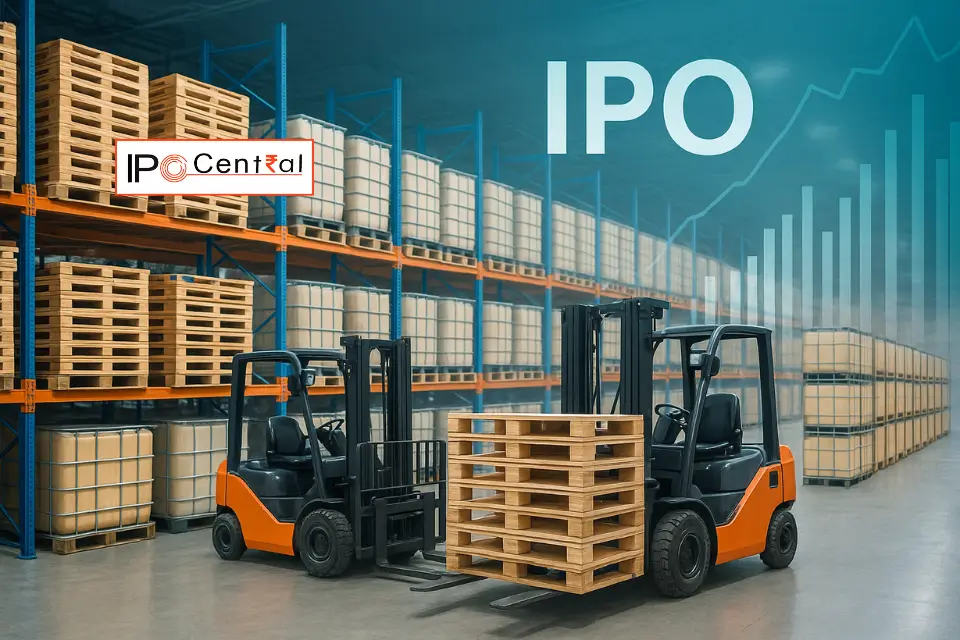
LEAP runs a “share and reuse” pooling model for pallets, containers, and material-handling equipment (MHE). Customers rent assets either as:
- Static Hire: assets remain at a site for a period; billed per day.
- Movement Hire: assets move across locations or legal entities; billed per day plus a movement fee.
Beyond rentals, LEAP earns allotment fees, service charges (including loss recovery) and ancillary revenues (repairs, transport, inventory management).
The model is meaningfully scaled. As of 31 May 2025, LEAP had 1.36 crore by, a network of 7,747 customer touchpoints and 33 fulfilment centres. Customer relationships are sticky: the top-100 churn fell to 0.19% in FY25 (from 0.75% in FY24), with many top accounts on rolls for over five years. The customer base crossed 900 in FY25 (from 500+ in FY23/FY24).
Use of IPO Proceeds
From the INR 400 crore fresh issue, approximately INR 300 crore is earmarked for repayment/prepayment of borrowings, and the rest is for general corporate purposes. As of FY25, Debt/Equity was 0.87.
The CHEP India Pivot
In January 2025, LEAP acquired CHEP India, a leading container and pallet pooling player. Pro forma FY25 numbers (as if CHEP were consolidated from April 1, 2024) show the combined platform with INR 685.89 crore total income, INR 324.80 crore EBITDA (47.35% margin) and INR 48.25 crore net profit, along with higher container utilisation and a broader sector mix. Management is targeting network and procurement synergies, cross-sell across the combined customer set, and tighter reverse-logistics costs.
Financial Picture
- Revenue from operations: INR 253.37 cr (FY23) → INR 364.97 cr (FY24, +44%) → INR 466.47 cr (FY25, +28%).
- Total income (FY25): INR 485.03 cr.
- Asset pooling (ex-MHE): INR 384.22 cr | MHE pooling: INR 88.67 cr | Others: INR 12.14 cr.
- EBITDA: INR 126.29 cr (FY23) → INR 209.92 cr (FY24) → INR 273.80 cr (FY25); margin ~56.45%.
- Net profit: INR 37.56 cr in FY25 (FY24: INR 37.17 cr; FY23: INR 9.01 cr).*
- Cash PAT: INR 191.29 cr (margin 39.44%).
*A later section in the filing references INR 35.76 cr for FY25 PAT; the restated P&L table reports INR 37.56 cr—investors should note this discrepancy when reading the final red herring prospectus.
Concentration is easing: top-10 customers contributed 34.18% of FY25 revenue (vs 39.49% in FY24); on a pro forma basis, the share drops further to 28.72%.
Promoters & Shareholdings
The company is founder-led: Sunu Mathew (Chairman-MD-CEO; 26+ years; ex-CHEP India, L’Oréal) with a senior bench across sales, growth, finance and ops; the corporate promoter is affiliated with KKR. On a fully diluted pre-offer basis, Vertical Holdings II holds 73.94% and Sunu Mathew 21.34%, with other institutional holders in low single digits (aggregate disclosed: 98.91%).
Future Outlook
Management’s strategy revolves around four levers:
- Deeper penetration in existing verticals, with a larger share from movement hire.
- New industries (textiles, paints, solar, pharma, chemicals, heavy engineering).
- Broader value-chain coverage (manufacturer → distributor → retail) and adjacent products (belts, wedges, stillages, racking).
- Inorganic moves and international expansion—GCC entry targeted over 12–18 months; inter-country pallet/container movement already initiated via CHEP.
Risks
- Deleveraging and cash cycle: fresh proceeds target debt; working-capital discipline will matter as the asset base scales.
- Integration execution: realising CHEP synergies without denting utilisation or service levels.
- Capex & depreciation: a high asset base underpins margins but keeps depreciation and finance costs elevated.
- Demand mix: continued broadening beyond F&B and e-commerce into auto/industrials stabilises utilisation.

LEAP is bringing a scaled, tech-enabled, high-utilisation pooling platform to market at a time when palletisation and pooling in India remain under-penetrated. The LEAP India IPO aimed at deleveraging and compounding scale after the CHEP India acquisition. Delivery on integration, working-capital control and contract renewals will shape how this filing translates into a listed-company performance story.
For more details related to IPO GMP, SEBI IPO Approval, and Live Subscription stay tuned to IPO Central.