




































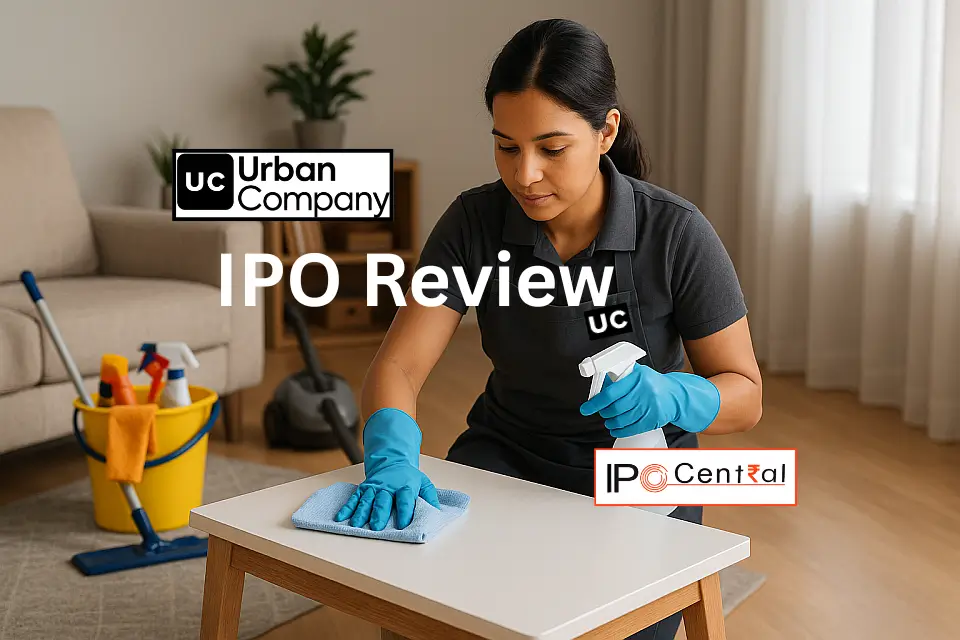
Urban Company operates in the rapidly growing home services sector, organizing and streamlining a highly fragmented market through technology. Urban Company IPO review delves into Urban Company’s remarkable journey from losses to profitability, showcasing its evolution into a tech-driven platform that is redefining the home services sector and setting new standards for consumer-tech unicorns in India.
Company Overview: From Startup to Scaled Platform
Urban Company was founded by Abhiraj Singh Bhal, Varun Khaitan, and Raghav Chandra with the vision to bring structure and reliability to India’s highly fragmented home services market. Over the past decade, the company has transformed from an early-stage startup into one of the most prominent organized players in the home services industry, demonstrating remarkable growth, scalability, and consumer trust.
Today, Urban Company operates across 51 cities worldwide — 47 in India, along with operations in the UAE and Singapore, and service delivery in Saudi Arabia through a joint venture. Since its inception in 2014 until June 2025, the company has successfully fulfilled 97.45 million service orders, showcasing the strength of its business model and operational scalability.
On the supply side, the platform continues to demonstrate strong professional engagement. As of Q1 FY26, Urban Company had 54,347 monthly active service professionals, enabling consistent service delivery across geographies. Customer adoption has grown in parallel — the platform served 65.4 lakh annual transacting consumers in FY25, up significantly from 47.6 lakh in FY23.
A key highlight of this growth has been increasing consumer spending and wallet penetration. The average annual spend per customer rose from INR 3,786 in FY23 to INR 4,079 in FY25, reflecting not just rising user adoption, but also deeper engagement: consumers are booking more services and demonstrating a willingness to pay higher average order values.
Urban Company Business Model: A Two-Sided Ecosystem
Urban Company operates as a technology-driven two-sided marketplace. At its core, it solves pain points for both consumers and service professionals (SPs):
For Consumers
- Convenience: Booking is instant, professionals arrive on time, and many services (like InstaHelp) are available within 15 minutes.
- Transparency: Standardised pricing, upfront rate cards for repairs, and in-app invoicing reduce the risk of “fleecing” — a common issue with local technicians.
- Trust & Safety: Services come with warranties (10–180 days depending on category) and are backed by background checks, SOP adherence, and real-time audits (e.g., bathroom cleaning checklists with photo proof).
- Branded Experience: From beauty kits in disposable sachets to portable massage beds, UC replicates a salon/spa-like experience at home.
For Service Professionals
- UC Partner App: Offers scheduling, SOP workflows, in-app guidance, proof-of-work capture, and digital payments.
- Tools & Inventory: Professionals can buy standardized kits, consumables, and equipment directly via UC. Nearly 65% of active professionals now source through UC’s supply chain.
- Upskilling & Training: Over 1.23 million training hours were conducted in Q1 FY26, including technical, soft skills, and product launch training. Certified professionals earn higher consumer ratings and repeat business.
- Higher Earnings: According to Redseer, UC professionals earn 15–20% more than gig workers in food delivery/quick commerce, while enjoying more predictable schedules.
This dual value proposition creates strong network effects: more consumers attract more professionals, and more professionals ensure better service availability, fueling consumer retention.
Urban Company Revenue Streams: Building Multi-Layered Monetization
One of Urban Company’s biggest shifts since inception is the diversification of revenue streams. It no longer relies solely on commissions from service bookings. Instead, it monetizes across four major verticals:
1. India Consumer Services (Core Business)
This is the backbone — covering cleaning, pest control, appliance servicing, electrical/plumbing/carpentry (EPC), painting, and beauty.
- In FY25, this segment drove the majority of UC’s revenue.
- Consumer engagement is strong: cohorts from 2017 had increased their net transaction value (NTV) 1.8x by 2024, proving retention and upsell potential.
- Seasonal cycles (AC servicing in summer, deep cleaning before Diwali, salon services in the wedding season) provide predictable demand spikes.
2. Products & Tools for Professionals
UC has cleverly built a B2B supply chain inside its marketplace. Professionals buy UC-approved kits, consumables, and tools through the app.
- In Q1 FY26, INR 229 crore worth of products were sold to professionals.
- 46% of this came from UC’s own/exclusive brands (Native, Elysian, Crave).
- Nearly 2/3rd of professionals are now purchasing through UC, ensuring standardization while creating a recurring revenue stream.
This B2B vertical is a hidden moat: it locks professionals into UC’s ecosystem and improves service quality for consumers.
3. Native Brand (Consumer Appliances)
Urban Company is betting big on branded hardware under Native:
- Water Purifiers → Two-year filter life, IoT-enabled integration with the UC app for real-time water quality tracking.
- Electronic Door Locks → Smart locks with cameras and remote unlock, integrated into the UC app.
Both products tie into UC’s existing expertise in servicing appliances. The logic is simple: sell the hardware once, earn recurring revenue via installation, repairs, and consumables. In August 2025, UC’s board approved a dedicated assembly facility for Native products, signaling long-term intent to scale this vertical.
4. International Business
Urban Company operates in the UAE, Singapore, and KSA (via JV with SMASCO).
- Revenue: INR 1,470 crore in FY25 (~10% of total).
- Losses remain high: Adjusted EBITDA of – INR368 crore in FY25, though improving from earlier years.
- A strategic tie-up with Noon (Middle East e-commerce giant) in July 2025 could boost discovery and consumer acquisition in the UAE & KSA.
Urban Company IPO Review: Offer Details and Fund Utilisation
Urban Company’s IPO is designed both as a fresh issue and an offer for sale (OFS).
- IPO Dates: 10 – 12 September 2025
- Price Band: INR 98 – 103 per share
- IPO Size: INR 1,900 crore
- Fresh Issue: INR 472 crore
- Offer for Sale (OFS) – INR 1,428 crore OFS)
- Lot Size: 145 shares (INR 14,935 minimum investment)
- Retail Allocation: 10%
- Listing Date: 17 September 2025
- Listing: NSE & BSE
Use of Proceeds:
The company proposes to utilize the Net Proceeds from the Issue towards the following objects:
- Expenditure for new technology development and cloud infrastructure – INR 190 crore
- Expenditure for lease payments for its offices – INR 75 crore
- Expenditure for marketing activities – INR 90 crore
- General Corporate Purposes
Urban Company IPO Analysis: Financial Performance
Urban Company’s financial trajectory tells the story of a platform that has moved from aggressive investment to profitability. For several years, the company burned cash to expand service categories, build supply chains, and strengthen its brand. That investment began paying off in FY25 when UC reported its first full-year net profit.
The table below highlights the company’s performance:
| (INR in Cr.) | FY 2023 | FY 2024 | FY 2025 | Q1 FY 2026 |
|---|---|---|---|---|
| Revenue | 636.60 | 828.02 | 1,144.47 | 367.27 |
| Expenses | 1,038.68 | 1,020.72 | 1,223.48 | 384.25 |
| Net Income | (312.48) | (92.77) | 239.77 | 6.94 |
| Net Margin (%) | (49.09) | (11.20) | 20.95 | 1.89 |
| EPS | (2.25) | (0.66) | 1.65 (pre-issue) 1.56 (post-issue) | – |
| RONW (%) | (23.33) | (7.18) | 13.35 | – |
| NAV | 9.64 | 9.19 | 12.46 | – |
| EBITDA Margin (%) | (14.33) | (4.64) | 0.37 | – |
The leap from an INR 312 crore loss in FY23 to INR 240 crore profit in FY25 is striking. However, Q1 FY26 results show how thin margins remain — profitability could fluctuate as UC continues investing in InstaHelp, international operations, and new product lines.
Shareholding and Promoter Strength
Urban Company remains a promoter-led business backed by marquee investors.
- Promoters: Abhiraj Singh Bhal, Varun Khaitan, Raghav Chandra – each holding ~6.65% pre-IPO.
- Major investors: Elevation Capital (10.8%), Accel (9.9%), Vy Capital (9.1%), Naspers (7.3%), Bessemer (6.4%).
This mix of seasoned promoters and global VCs gives UC credibility, though the OFS indicates early investors are partially cashing out.
Key Risks and Challenges
Despite a strong brand and market leadership, UC faces significant risks:
- Fragile Profitability: Margins are still slim (but the company turns profitable), it can be affected if expansion costs rise.
- Execution in New Categories: InstaHelp, painting, wall décor, and Native appliances are still untested at scale.
- International Uncertainty: UAE and Singapore are stable, but KSA operations rely on a joint venture, which adds dependency risk.
- Regulatory Hurdles: Classification of service professionals as employees could disrupt the gig model.

Conclusion
Urban Company’s IPO marks a pivotal moment in India’s consumer-tech story. With strong growth, expanding revenue streams, and a shift to profitability, the company is well-positioned to redefine the home services sector. Despite risks, its tech-driven model, trusted brand, and global expansion highlight promising long-term potential for investors seeking exposure to India’s dynamic gig economy.
For more details related to IPO GMP, SEBI IPO Approval, and Live Subscription, stay tuned to IPO Central.