


































Airfloa Rail Technology’s IPO has created a buzz in the market, with the grey market premium (GMP) soaring above 120% and fueling bullish investor sentiment. But every IPO carries not only a growth story—it also comes with hidden challenges that smart investors must weigh carefully. A closer look at the Red Herring Prospectus (RHP) highlights several Airfloa Rail Technology IPO risk factors that raise serious questions about long-term sustainability. From revenue concentration and liquidity pressures to governance lapses and operational fragilities, these risks could significantly impact the company’s performance beyond the short-term listing gains.
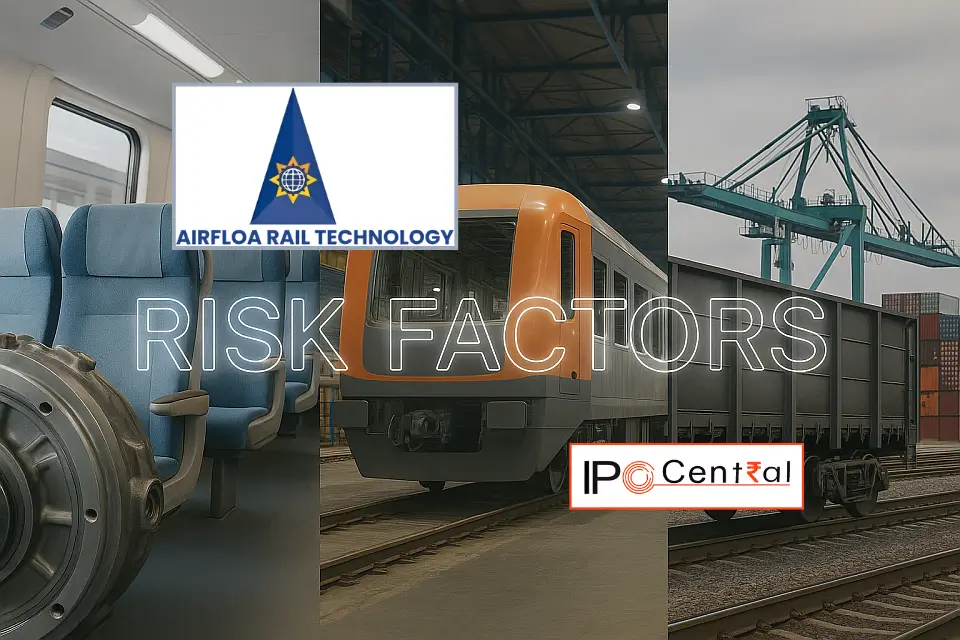
Airfloa Rail Technology IPO Risk Factors
1. Business Dependency Risks
Airfloa Rail Technology derives 55–79% of its revenue from Indian Railways. Any change in railway procurement policy, slower tender allocation, or heightened margin-cutting competition could directly impact revenues and growth. Moreover, over 90% of revenue comes from the top 10 customers. Such concentrated exposure means losing even a single key client could hit both revenue and cash flows significantly.
2. Financial & Working Capital Risks
- Airfloa Rail Technology reported a negative operating cash flow of -INR 4.45 crore in FY25—indicating cash burn despite revenue growth.
- ~INR 119.11 crore is locked in working capital (inventory and receivables), creating constant reliance on bank funding and borrowings.
- Total debt stands at ~INR 59.98 crore. Breaching covenants or a repayment default could give lenders rights over company assets.
- Short-term unsecured borrowings (~INR 2.59–3.29 crore) can be recalled anytime, posing immediate liquidity risks.
Takeaway: Despite strong top-line growth, liquidity pressure and recurring negative cash flows raise serious concerns for sustainability.
3. Operational Risks
Airfloa’s operations are also exposed to several vulnerabilities:
- Raw material volatility: Steel, aluminium, and electrical components sourced from domestic and overseas suppliers are subject to price swings and supply chain disruptions.
- Supplier concentration: 50–65% procurement is from top 10 suppliers—failure of one could disrupt production.
- Capacity utilization: Currently at 77–85%; any dip in demand could lead to underutilization and higher costs.
- Labour challenges: Attrition rates have touched 40–80% in recent years, threatening operational continuity.
- Third-party logistics dependency: Transport disruptions can bring operations to a standstill.
4. Compliance, Legal & Governance Risks
- Instances of non-compliance: delayed AGMs, CSR expenditure defaults, and late auditor appointments have already attracted penalties and show-cause notices from the Registrar of Companies.
- Outstanding tax litigations (INR 1.35 crore) and GST disputes (INR 0.40 crore) could lead to direct cash outflows if judgments go against the company.
- Promoters’ track record: Past association with struck-off companies casts a shadow on governance standards.
- Limited experience with listed company compliance among directors heightens regulatory risk going forward.
5. Promoter & Management Related Risks
- Airfloa Rail Technology is heavily dependent on its promoters for strategic and operational decision-making—making succession or transition a material risk.
- Conflict of interest risk: Subsidiary Sree Dakssnaa Aerospace & Defence operates in a similar space, with no non-compete agreement in place.
- Related party transactions (rents, services, etc.) continue and may persist, raising governance concerns.

Bottom Line: The Shine vs. The Reality
While a high GMP signals strong listing gains in the short term, the real question for investors is long-term sustainability.
Key concerns include:
- High client and sector concentration
- Negative cash flows and heavy debt reliance
- Governance and compliance lapses
- Operational fragility
For serious investors, chasing GMP hype without weighing these risks could prove costly. The IPO may offer glitter on listing day, but only a cautious, risk-adjusted approach will safeguard long-term capital.

Mahesh Yadav is a prolific writer with over a decade of professional experience. A person of wide interests, he found his true calling in the field of investing and specifically the stock market. He has an amazing skill of presenting the most complex financial concepts (and there is no shortage of complexity in investing) in simple language and terms.