



































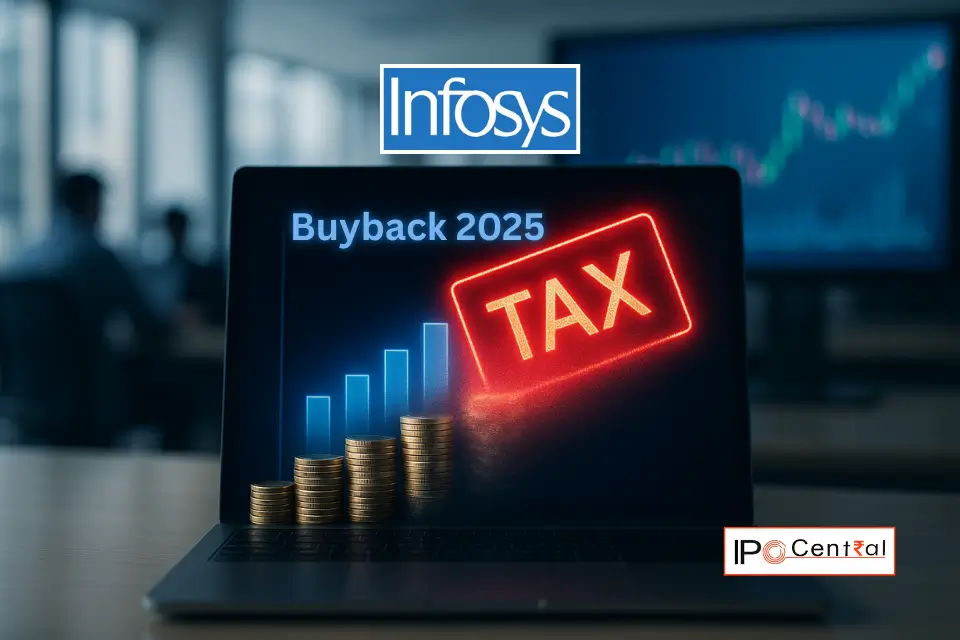
Infosys has once again caught the market’s attention. The IT services giant has announced a INR 18,000 crore buyback, offering to repurchase up to 10 crore shares at a price of INR 1,800 per share. With the stock trading around INR 1,509 on the approval date, that’s a premium of nearly 19% — a tempting proposition for investors. While Infosys Buyback 2025 looks promising, there is more to the story.
Here’s the reality check: before you celebrate the INR 291 “per share profit” on paper, you must understand the tax implications in the gains. Your real gains depend not just on the Infosys buyback price but also on your income tax slab.
Infosys Buyback 2025: Basics
- Buyback size: INR 18,000 crore
- Price: INR 1,800 per share
- Offer type: Tender offer
- Promoter participation: Yes
- Face value: INR 5 per share
- Record date: Yet to be announced
- Acceptance ratio: Estimated at 8.38% for small shareholders
Under SEBI rules, “small shareholders” are those holding shares worth less than INR 2 lakh on the record date.
Infosys Buyback 2025: How the Process Works
Investors holding shares on the record date can tender them through their broker.
- In demat form: You instruct your broker to transfer shares to the clearing corporation’s special account.
- In physical form: You submit share certificates and supporting documents to your broker, who then forwards them to the registrar.
Once the Infosys Buyback 2025 closes, accepted shares are extinguished, and money is credited to your account. Unaccepted shares are returned.
The Tax Twist in Infosys Buyback
Until September 2024, buybacks were tax-efficient. Infosys would have paid a 20% buyback tax, and buyback profits would have been tax-free for shareholders.
From 1 October 2024, the Finance Act changed everything:
- Entire buyback proceeds are now taxed as “dividend income” in the hands of investors.
- Infosys will deduct 10% TDS upfront.
- Your final tax liability depends on your income slab.
Infosys Buyback Profit?: Impact by Income Slab
Here’s what Infosys Buyback profit looks like after tax:
| Taxable Income (FY26, new regime) | Effective Tax on INR 1,800 | Tax-adjusted Buyback Price | Net Profit/Loss (Cost Price: INR 1,509) |
|---|---|---|---|
| Up to 4 lakh | Nil | 1,800 | Profit: 291 |
| 4 – 8 lakh | 5% (90) | 1,710 | Profit: 201 |
| 8 – 12 lakh | 10% (180) | 1,620 | Profit: 111 |
| 12 – 16 lakh | 15% (270) | 1,530 | Profit: 21 |
| 16 – 20 lakh | 20% (360) | 1,440 | Loss: 69 |
| 20 – 24 lakh | 25% (450) | 1,350 | Loss: 159 |
| Above 24 lakh | 30% (540) | 1,260 | Loss: 249 |
Takeaway:
- Low-slab investors may still enjoy a small profit.
- High-slab investors could lose money compared to simply selling in the open market.
Acceptance Ratio and Small Shareholder Angle
IPO Central estimates that small shareholders may have an entitlement ratio of 8.38%. That means:
- If you hold 112 shares (worth ~INR 1.69 lakh), only about 10 shares may be accepted by Infosys in the buyback.
- At INR 1,800 per share, the buyback profit on 10 shares is ~INR 2,905 before tax — translating to just 1.72% return.
- Even if acceptance goes up (say 20–30 shares), the absolute profit remains in the low single digits percentage-wise.
This makes tax efficiency even more critical, because your thin margins can evaporate in higher slabs.
Capital Loss Treatment
Another twist: your cost of acquisition becomes a capital loss, since the buyback proceeds are treated as dividend income.
- Example: If you bought Infosys at INR 1,500 and tendered at INR 1,800, you might think you made a INR 300 gain.
- In reality, INR 1,800 is taxed as dividend, while your INR 1,500 cost becomes a capital loss that you can only set off against capital gains.
- You cannot adjust this loss against the dividend income.
- If no capital gains, you can carry it forward but the responsibility of setting off the losses in future years is completely on taxpayer.
This adds complexity to tax planning for investors with larger portfolios.
Should You Participate?
- If you’re a low-income investor (up to 10% slab): The buyback may still give you a neat premium.
- If you’re in the mid-to-high slabs (20–30%): The tax hit makes the buyback unattractive. Selling in the market may be wiser.
- If you’re a small shareholder: The acceptance ratio limits the number of shares Infosys will buy back. Even if you’re eligible, don’t expect windfall gains.
Bottom Line
Infosys’s buyback sounds like a sweet deal at first glance — INR 1,800 vs INR 1,509 in the market. But don’t let the headline premium fool you. For many investors, especially those in higher tax brackets, the real payout after tax may be lower than the market price.
In short: your tax slab decides your profit. Before tendering shares, do the math carefully.
For more details related to IPO GMP, SEBI IPO Approval, and Live Subscription stay tuned to IPO Central.
Infosys Buyback 2025 FAQs
Q. What is the Infosys buyback 2025 price?
Infosys Buyback price is set at INR 1,800 per share.
Q. What’s the Infosys Buyback 2025 record date?
Infosys Buyback date is not announced yet. You must hold shares in the demat account on that date to participate.
Q. How to apply in Infosys Buyback?
Through your broker, via the tender process. Shares must be transferred to the clearing corporation’s account.
Q. Will I pay tax on Infosys buyback gains?
Yes. The entire INR 1,800 per share is taxed as dividend income. Infosys deducts 10% TDS upfront. Final tax depends on your slab. The cost price is considered capital loss and needs to be set-off against capital gains or carried forward.