



































Ganesh Consumer Products (GCPL) is a leading packaged staples and consumer food company in East India under the brand “Ganesh”. With an 80-year-old brand heritage, GCPL has evolved from a family-run flour mill to a professionally managed FMCG company with a basket of 42 products across 232 SKUs. In FY25, the company had a 12.6% market share in East India’s packaged wheat & gram-based products. Within specific categories, it has leadership positions:
- Largest player in sooji, dalia and maida (31.2% and 16.4% market share).
- Top two in gram based products: 43.4% in sattu and 4.9% in besan.
This background sets the context for the Ganesh Consumer IPO review, as the company looks to strengthen its balance sheet, expand manufacturing capacities, and invest in brand building – positioning itself as an emerging regional FMCG growth story.
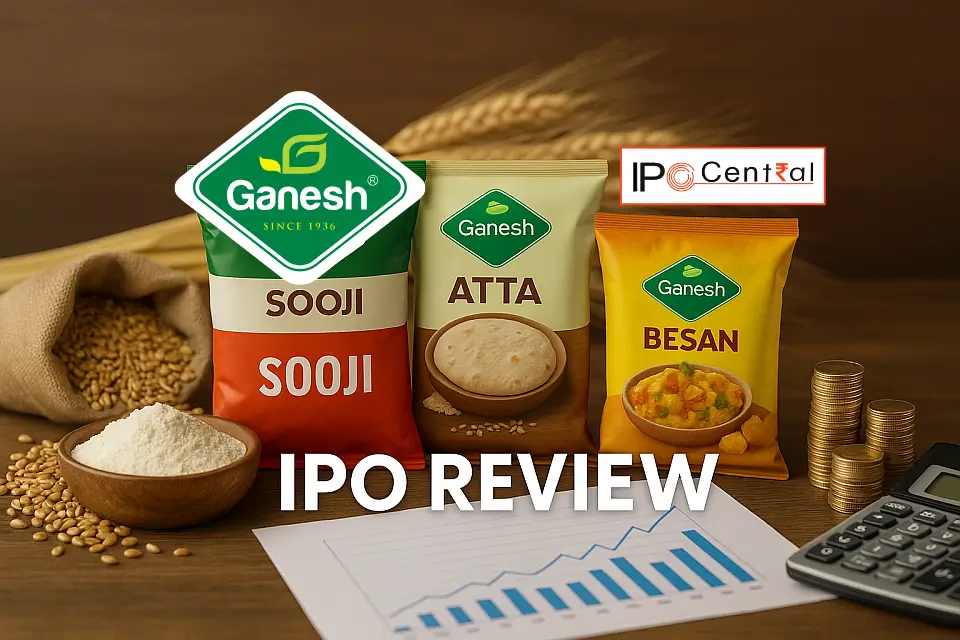
Table of Contents
Ganesh Consumer IPO: Offer Details & Fund Utilization
- IPO Dates: 22 – 24 September 2025
- Price Band: INR 306 – 322 per share (Employee discount – INR 30 per share)
- Issue Size: INR 394.94 – 408.8 crore
- Fresh Issue: INR 130 crore
- Offer For Sale: 86,58,333 shares
- Lot Size: 46 shares (INR 14,812 minimum)
- Listing: NSE & BSE
- Retail Quota: 35%
- Listing date: 29 September 2025
- Promoters: Purushottam Das Mimani, Manish Mimani, Madhu Mimani, Manish Mimani (HUF), and Srivaru Agro Private Limited
- Lead Managers: DAM Capita, IIFL Capital, and Motilal Oswal Investment
- Registrar: MUFG Intime
Fund Utilization
The company proposes to utilize the Net Proceeds from the Fresh Issue towards funding the following objects:
- Prepayment and/or repayment of all or a portion of certain outstanding borrowings availed by the company – INR 60 crore
- Funding capital expenditure for the setting up of a roasted gram flour and gram flour manufacturing unit in Darjeeling, West Bengal – INR 45 crore
- General corporate purposes
Industry Landscape & Market Opportunity
Packaged staples and convenience food market in India is undergoing structural change driven by increasing urbanization, higher disposable income, lifestyle changes and rising consumer awareness about food safety and hygiene.
Packaged Food Growth Outlook
- Total packaged staples market in India is INR 4,06,334 crore in FY25 and expected to grow at 10% CAGR to reach INR 6,53,406 crore by FY30.
- Within this, packaged wheat based products (atta, maida, sooji, dalia) is expected to almost double from INR 35,176 crore in FY25 to INR 73,027 crore in FY30 (CAGR: 15.7%).
- Similarly packaged gram based flour segment (besan, sattu) is expected to grow from INR 8,817 crore (FY25) to INR 18,051 crore (FY30) at 15.4% CAGR.
- Adjacent categories, where Ganesh Consumer has forayed recently, also show robust momentum:
- Packaged Spices: INR 37,760 crore → INR 67,442 crore (12.3% CAGR).
- Packaged Snacks: INR 82,262 crore → INR 1,51,563 crore (13% CAGR).
Regional Focus – East India Advantage
- Eastern India contributes 18.6% of India’s packaged staples market, valued at INR 75,600 crore in FY25.
- It is also the fastest growing regional market at an expected CAGR of 11.1% (FY25–30).
- Within wheat-based packaged products, East India accounted for a 12.6% share, projected to reach INR 9,289 crore by FY30.
This creates a strategic sweet spot for Ganesh Consumer, given its entrenched brand positioning in East India. With rising modern trade, expansion of quick-commerce platforms, and deeper rural penetration, the region offers GCPL a unique opportunity to scale.
Business Model of Ganesh Consumer
Ganesh Consumer’s business model is built on a B2C-first approach complemented by a selective B2B presence. The company has ensured growth through three structural strengths: product diversification, distribution excellence, and operational efficiency.
a) Revenue Mix: B2C-led Growth
Ganesh Consumer derives the majority of its revenues from branded B2C sales, ensuring strong brand visibility and consumer stickiness.
| Segment | FY 2023 | % of Revenue | FY 2024 | % of Revenue | FY 2025 | % of Revenue |
|---|---|---|---|---|---|---|
| B2C – Retail Consumers | 482.78 | 79.1 | 560.32 | 73.8 | 654.70 | 77.0 |
| B2B – Institutional & Bulk | 70.55 | 11.6 | 102.39 | 13.5 | 106.65 | 12.5 |
| Others (trading, job work, services) | 57.42 | 9.4 | 96.36 | 12.7 | 89.11 | 10.5 |
| Total Revenue | 610.75 | 100 | 759.07 | 100 | 850.46 | 100 |
Takeaway:
- B2C remains the backbone, consistently contributing ~75–80% of revenues.
- B2B contribution is stable, largely from atta and flour sold in bulk packs.
- Emerging products (spices, instant mixes, snacks) are steadily scaling from 3% of revenue in FY23 to ~6% in FY25.
b) Distribution Strength – Multichannel Strategy
The company has built a wide-reaching, multi-layered distribution network across Eastern India:
- 28 C&F agents, 9 super stockists, 972 distributors.
- Serves 70,000+ retail outlets in West Bengal, Bihar, Jharkhand, Odisha, and Assam.
- General trade dominates (83%+ of B2C sales in FY25), but modern trade (6.1%) and e-commerce (10.4%) are rising.
Key highlights:
- Over 95% of general trade sales are advance-payment based, showcasing strong channel pull and brand strength.
- Partnerships with modern retailers (204 stores) and presence on leading e-commerce & quick-commerce platforms ensure urban visibility and scalability.
- Technology integration with Botree DMS & SFA, SAP S/4 HANA, and WhatsApp chatbots has optimized distributor management, order tracking, and secondary sales execution.
c) Product Diversification
Ganesh Consumer has consciously expanded from being an “atta-maida” player to a multi-category FMCG brand:
- Core Staples: Atta, maida, sooji, dalia (large volume drivers).
- Gram Products: Sattu & besan – regional dominance and strong consumer loyalty.
- Emerging Foods: Instant mixes (dhokla, kachori), spices (whole & blended), ethnic flours, and ethnic snacks.
- Multiple SKU sizes (100g to 50kg packs) allows GCPL to cater to mass as well as premium consumers.
This diversification has helped to mitigate risk of over dependence on any one category and positioned the company to tap into newer, faster growing FMCG segments.
Manufacturing Infrastructure & Capacity Utilization
Ganesh Consumer operates from seven manufacturing units spread across West Bengal, Uttar Pradesh, and Telangana. These units are strategically located to optimize raw material sourcing, logistics, and market access.
| Location | Units | Key Products | Land Ownership | Installed Capacity (FY25) | Avg. Utilization (FY25) |
|---|---|---|---|---|---|
| Howrah, West Bengal | Jalan Complex I & II, Foodpark, Padmavati | Atta, Maida, Sooji, Dalia, Besan, Sattu, Instant Mixes, Spices | Mix of owned & leased | ~100,000+ TPA (combined) | 50–80% |
| Varanasi, Uttar Pradesh | Varanasi Unit | Atta, Dalia, Maida, Besan, Sattu | Leased (90 yrs) | ~54,000 TPA | 40–120% (some product lines over-utilized) |
| Agra, Uttar Pradesh | Agra Unit | Maida & Sooji | Owned | 47,850 TPA | ~63% |
| Hyderabad, Telangana | Hyderabad Unit | Atta, Maida, Sooji, Dalia | Owned | ~60,000 TPA | ~20% (under-utilized, scope for growth) |
Key Insights:
- Capacity Expansion Mode: Installed capacity grew from ~3,20,000 TPA (FY23) to ~3,73,000 TPA (FY25), clearly indicates the company is ahead of demand.
- Utilization Variability: Core categories like atta, maida and sooji are operating at 60–80% utilization, while newer segments (spices, sattu) are showing variable utilization (40–120%), indicates growth runway.
- Quality Edge: Units are FSSC 22000, ISO 14001 and ISO 45001 accredited. Advanced machinery (grain scanners, Buhler designed mills) enhances yield efficiency – e.g. sooji yield at Padmavati unit: 28–32% vs industry average 6–8%.
Ganesh Consumer IPO Analysis: Financial Performance
Ganesh Consumer has demonstrated consistent revenue growth, stable profitability, and improving return ratios, despite operating in a competitive FMCG segment.
| Particulars | FY23 | FY24 | FY25 | Commentary |
|---|---|---|---|---|
| Revenue from Operations | 610.75 | 759.07 | 850.46 | CAGR of 18% (FY23–25), driven by B2C staples and new product launches. |
| Expenses | 578.38 | 728.85 | 807.24 | |
| EBITDA | 56.14 | 63.35 | 73.24 | Margins stable at 8–9%, reflecting cost efficiency and scale benefits. |
| EBITDA Margin (%) | 9.2 | 8.4 | 8.6 | Slight dip vs FY23, but healthy for a staples-driven business. |
| Profit After Tax (PAT) | 27.10 | 26.99 | 35.43 | Net margins of 3.5–4.5%, aligned with FMCG peers in staples. |
| PAT Margin (%) | 4.4 | 3.6 | 4.2 | Consistent bottom line; FY25 recovery shows improved operating leverage. |
| ROE (%) | 14.2 | 12.7 | 15.8 | Strong capital efficiency, well above industry averages. |
| ROCE (%) | 15.0 | 16.7 | 19.8 | Improving trend—reflects judicious capex and working capital management. |
| Debt/Equity | 0.42 | 0.17 | 0.22 | Healthy leverage; IPO proceeds will further deleverage balance sheet. |
Key Insights:
- Topline Momentum: Revenues rose from INR 610.75 crore (FY23) → INR 850.46 crore (FY25), aided by expansion in product SKUs (150 → 232) and deeper distribution reach (814 → 972 distributors).
- Stable Margins: Despite commodity volatility, Ganesh Consumer maintained 8–9% EBITDA margins. PAT margins at ~4% are on par with larger peers like Adani Wilmar (FY25 PAT margin: 1.8%) and slightly ahead of Patanjali Foods (3.8%).
- Return Ratios: Both ROE and ROCE have improved, indicating strong operating efficiency and capital productivity.
- Balance Sheet Comfort: Net debt is manageable with Debt/Equity of 0.22. IPO fresh issue of INR 130 crore will be partly used to repay debt (~INR 60 crore), which will further enhance financial strength.
Ganesh Consumer IPO Review: Strategic Growth Roadmap
Ganesh Consumer has outlined clear strategies to sustain growth and enhance profitability:
- Geographic Expansion
- Current revenue concentration in West Bengal (92.6% of FY25 sales) is a strength and a risk.
- Strategy: deepen penetration in East India (Jharkhand, Bihar, Odisha, Assam) and selectively expand into new markets like Telangana & UP via the Hyderabad and Varanasi facilities.
- Product Diversification
- Existing portfolio spans 42 products and 232 SKUs across staples, gram-based flours, spices, instant mixes, and ethnic snacks.
- New launches (spices in FY24, snacks in FY25) reflect a move towards higher-margin, faster-growing categories.
- Brand Building
- Heavy investment in television (70% of ad spend on GECs), digital campaigns, cultural event sponsorships, and below-the-line activities like wall wraps and point-of-sale branding.
- Focus on female homemaker segment in urban + rural markets.
- Operational Excellence
- Deployment of SAP S/4 HANA Cloud, Botree DMS & SFA for sales and distribution efficiency.
- Exploring Warehouse Management Systems (WMS) for inventory accuracy and supply chain optimization.
- Automation of packaging and use of biomass briquettes highlight a cost-leadership mindset.
Peer Benchmarking & Industry Positioning
Ganesh Consumer operates in a staples-led FMCG niche where no exact listed peer mirrors its diversified wheat- and gram-based portfolio. However, Patanjali Foods and Adani Wilmar (AWL) serve as broad comparables due to overlaps in packaged foods and edible staples.
Peer Comparison Snapshot (FY25)
| Particulars | Ganesh Consumer | Patanjali Foods | Adani Wilmar |
|---|---|---|---|
| Revenue (INR Cr.) | 850.46 | 34,156.97 | 63,672.24 |
| Revenue Growth (YoY) | 12.0% | 7.7% | 24.2% |
| Gross Margin | 22.2% | 15.6% | 11.8% |
| EBITDA Margin | 8.6% | 5.7% | 3.9% |
| PAT Margin | 4.2% | 3.8% | 1.8% |
| ROE | 15.8% | 12.1% | 13.1% |
| Debt/Equity | 0.22 | 0.07 | 0.18 |
| PE Ratio | 34.89 – 36.72 | 50.15 | 27.15 |
📌 Key Insights:
- Despite being a fraction of peers’ size, Ganesh demonstrates superior operating margins — gross margin (22.2%) and EBITDA margin (8.6%) outpace both Patanjali and AWL.
- ROE at 15.8% is higher than peers, reflecting efficient capital utilization despite smaller scale.
- Balance sheet leverage (D/E 0.22) is manageable and within industry norms.
- At the upper band, Ganesh Consumer is priced at a premium to Adani Wilmar but a discount to Patanjali Foods, justified by its better margins and returns profile despite smaller scale.

Conclusion
Ganesh Consumer is a regional FMCG leader with:
- Strong margins and superior ROE vs peers,
- Dominant market share in core categories,
- Robust distribution network, and
- A clear roadmap for diversification and expansion.
At 34–37x FY25 earnings, valuations are reasonable given the industry potential and Ganesh Consumer’s profitability premium. While geographic concentration remains a key risk, the IPO proceeds directed towards capacity expansion and debt reduction will strengthen the company’s balance sheet and growth trajectory.
For more details related to IPO GMP, SEBI IPO Approval, and Live Subscription, stay tuned to IPO Central.