





































India’s fast-moving consumer goods (FMCG) sector is undergoing a major shift, with consumers increasingly preferring branded staples, packaged foods, and ready-to-cook products. In this evolving market, Ganesh Consumer Products (GCPL) has emerged as a nimble yet promising player with a diverse product basket ranging from wheat-based flours and instant mixes to ethnic snacks and spices under its flagship brand “Ganesh.”
While GCPL’s scale is smaller than industry giants like Patanjali Foods and AWL Agri Business (Adani Wilmar), its profitability, efficiency, and return ratios tell a different story. For investors eyeing the IPO, a peer comparison becomes critical—because this Ganesh Consumer IPO peer comparison analysis will reveal:
- How the company’s margins and returns stack up against Patanjali and Adani Wilmar
- Whether Ganesh Consumer IPO valuations are justified compared to larger peers
- What operational strengths and weaknesses set it apart in the FMCG landscape
- Why Ganesh may be “punching above its weight” despite its smaller size
Ganesh Consumer IPO peer comparison anlaysis doesn’t just highlight numbers—it provides a clearer picture of the company’s true positioning in India’s FMCG growth story.
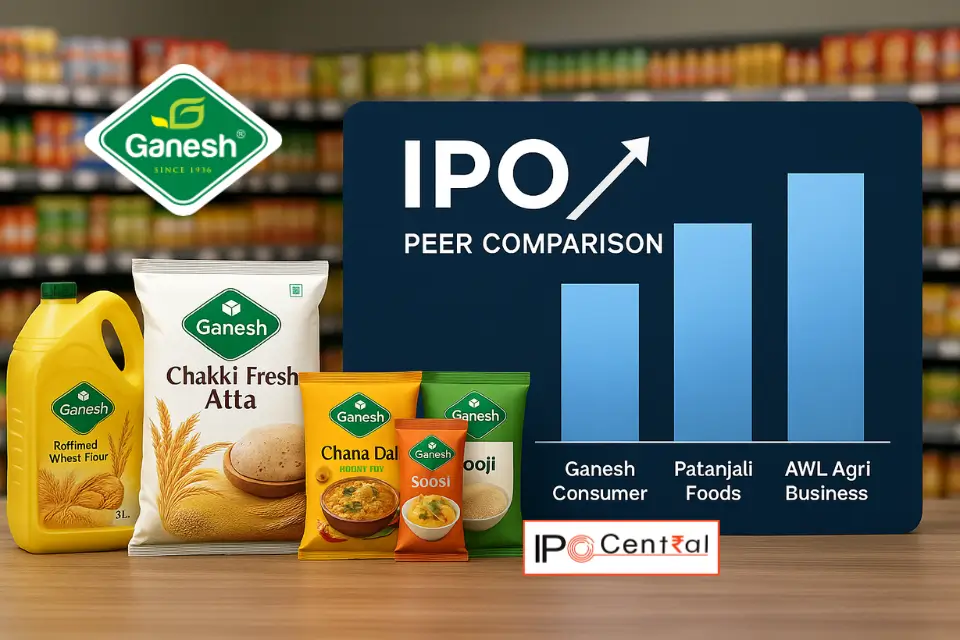
Table of Contents
Ganesh Consumer IPO Snapshot
- IPO Dates: 22 – 24 September 2025
- Price Band: INR 306 – 322 per share
- Employee Discount: INR 30 per share
- Lot Size: 46 shares (INR 14,812 minimum investment)
- Fresh Issue: INR 130 crore
- OFS: 86,58,333 shares (INR 264.94 – 278.8 crore)
- Total Issue Size: INR 394.94 – 408.8 crore
- Lead Manager: DAM Capital, IIFL Capital, Motilal Oswal
- Registrar: MUFG Intime India
- Listing: NSE, BSE
Ganesh Consumer IPO Peer Comparison – Valuation Metrics
| Metric | Ganesh Consumer | Patanjali Foods | AWL Agri Business |
|---|---|---|---|
| P/E Ratio | 36.7 | 54.1 | 29.3 |
| P/B Ratio | 5.23 | 5.79 | 3.58 |
| P/S Ratio | 1.53 | 1.84 | 0.51 |
| Debt/Equity | 0.22 | 0.07 | 0.21 |
| Current Ratio | 1.56 | 2.25 | 1.22 |
- Ganesh Consumer’s P/E of 36.7x is a balanced valuation—cheaper than Patanjali’s 54.1x but priced above AWL, reflecting investor confidence in its growth prospects.
- Its P/B ratio (5.23) is on par with Patanjali, signaling that the market may reward its asset-light and brand-driven model.
- P/S ratio (1.53) sits between Patanjali (1.84) and AWL (0.51), suggesting investors value its revenues more than AWL’s commodity-heavy portfolio.
- While debt is higher (0.22) compared to Patanjali’s very low leverage, it is still within a comfortable range and in line with AWL.
- Liquidity strength (Current Ratio 1.56) surpasses AWL, indicating efficient working capital management, though slightly below Patanjali’s.
Taken together, Ganesh Consumer positions itself in a sweet spot between affordability and growth, providing investors with a more focused FMCG play.
Ganesh Consumer vs Peers: Financial & Operational Performance Analysis
| KPI (FY25) | Ganesh Consumer | Patanjali Foods | AWL Agri Business |
|---|---|---|---|
| Revenue (INR Cr) | 850.46 | 34,156.97 | 63,672.24 |
| Revenue Growth (YoY) % | 12.0% | 7.7% | 24.2% |
| Gross Margin (%) | 22.2% | 15.6% | 11.8% |
| EBITDA Margin (%) | 8.6% | 5.7% | 3.9% |
| PAT Margin (%) | 4.2% | 3.8% | 1.8% |
| ROE (%) | 15.8% | 12.1% | 13.1% |
| ROCE (%) | 19.8% | 14.9% | 20.9% |
| Cash Conversion Cycle (days) | 20.8 | 47.1 | 40.9 |
| SKUs | 232 | NA | NA |
| Manufacturing Facilities | 7 | 26 | 76 |
| Distributors | 972 | ~8,000 | NA |
- Profitability leads the pack: Ganesh’s gross margin (22.2%) and EBITDA margin (8.6%) are well ahead of both Patanjali and AWL, underlining strong cost control and product mix.
- PAT margin (4.2%) outpaces peers, showing resilience even with a smaller scale.
- Return ratios (ROE 15.8%) highlight superior capital efficiency compared to its larger competitors.
- Working capital cycle (20.8 days) is remarkably lean, giving Ganesh a significant operational edge.
- While distribution network is modest versus Patanjali, Ganesh compensates with SKU depth (232 products)—offering a broader variety per consumer segment.
In essence, Ganesh Consumer may not match the scale of its peers, but its efficiency, profitability, and returns suggest it punches above its weight in the FMCG landscape.
Ganesh Consumer IPO Peer Comparison Analysis: Strengths vs. Weaknesses
| Strengths | Weaknesses |
|---|---|
| Superior Profitability: Highest gross margin (22.2%) and EBITDA margin (8.6%) compared to Patanjali and AWL. | Scale Gap: Revenue is smaller vs. Patanjali and Adani Wilmar. |
| Efficient Capital & Operations: ROE (15.8%) and cash conversion cycle (20.8 days) outperform peers. | Higher Leverage: Debt/Equity at 0.22, above Patanjali’s 0.07 (though still comfortable). |
| Diversified SKU Portfolio: 232 SKUs across staples, snacks, spices, and instant foods, unlike peers largely concentrated in oils. | Limited Distribution Network: 972 distributors vs. Patanjali’s ~8,000. |
| Brand Recall in Core Markets: “Ganesh” brand has strong recognition regionally, with potential to scale nationwide. | Manufacturing Footprint: Only 7 plants compared to AWL’s 76 and Patanjali’s 26. |
While Ganesh lags in scale, distribution, and infrastructure, its superior margins, strong returns, and efficient operations provide an edge. Unlike oil-heavy peers, Ganesh is positioning itself as a profitable niche FMCG challenger with a diversified product basket.
Investor Takeaways
For investors assessing Ganesh Consumer IPO, three themes stand out clearly:
- Profitability Over Scale: Despite its smaller topline, Ganesh delivers better profitability metrics than both Patanjali and AWL.
- Valuations Are Justifiable: With a P/E of 36.7x, Ganesh is priced below Patanjali (54.1x) and above AWL (29.3x). Its superior margins make this premium defensible.
- Growth Potential: India’s packaged staples and ethnic foods market remains underpenetrated. Ganesh’s wide SKU portfolio gives it room to expand beyond its regional base.
By contrast:
- Patanjali Foods offers scale and brand power, but its premium valuation (54.1x P/E) already reflects much of its growth.
- AWL Agri Business provides stability in edible oils, but thin margins and volatility remain challenges.
- Ganesh Consumer presents a balanced story—higher profitability, efficient operations, and a scalable niche portfolio.
Conclusion
Ganesh Consumer Products may be smaller than its peers, but the numbers reveal a company that is punching above its weight. Its superior profitability, efficient cash cycle, and higher return ratios set it apart from industry leaders, despite their vast scale and distribution strength.
While scale and reach will take time to build, Ganesh’s diversified FMCG approach—beyond edible oils—positions it for healthier long-term growth. For investors, this IPO offers exposure to a nimble, profitable challenger in India’s evolving FMCG landscape.
In short, Ganesh Consumer is not trying to outmatch giants on size today—it is quietly winning on quality of earnings, efficiency, and focus. And that is often where the most rewarding growth stories begin.
For more details related to IPO GMP, SEBI IPO Approval, and Live Subscription stay tuned to IPO Central.