





































India’s agrochemical industry has long been a crucial pillar supporting the nation’s agricultural backbone. With the government’s continued focus on food security, crop protection, and sustainable farming practices, agrochemical companies have found themselves in the spotlight. Against this backdrop, Advance Agrolife, an established agrochemical manufacturer with more than two decades of experience, is now stepping into the capital markets with its IPO.
The offering has already drawn attention, not just for its valuation but also for the company’s distinct B2B model and strong corporate client base. To truly assess its potential, it becomes important to see how Advance Agrolife fares when benchmarked against its listed peers in the agrochemical space.
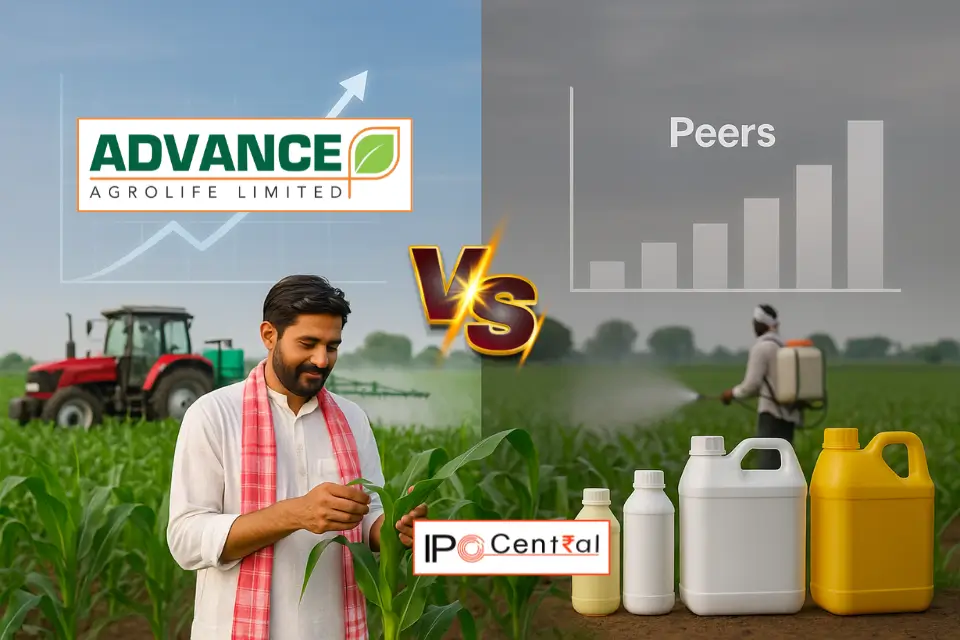
Table of Contents
Advance Agrolife at a Glance
Incorporated in 2002, Advance Agrolife has carved a niche for itself in the agrochemical sector. Unlike retail-facing agrochemical players, the company runs a pure B2B model, supplying technical grade and formulation grade products directly to large corporates. This approach ensures a stable stream of demand without the complexities of farmer-level retail distribution.
Some quick facts that define the company’s profile:
- Promoters: Om Prakash Choudhary, Kedar Choudhary, Geeta Choudhary, and Manisha Choudhary.
- Registrations: 410 approvals, including 380 formulation grade and 30 technical grade products.
- Capacity: Installed manufacturing capacity of 89,900 MTPA spread across three facilities in Jaipur, Rajasthan.
- Production: Manufactured over 44,276 MT of agrochemicals up to Fiscal 2025.
- Clients: Supplies to 849 corporate clients in FY25, of which 94 have been associated for more than three years. Clients include marquee names such as DCM Shriram, IFFCO MC, Indogulf Cropsciences, Mankind Agritech, and HPM Chemicals.
- Shareholding: Pre-IPO, promoters hold a dominant stake (Om Prakash Choudhary – 54.17%; Kedar Choudhary – 36.05%).
This profile underlines Advance Agrolife’s positioning as a backbone supplier to larger agrochemical brands, highlighting both revenue stickiness and scalability.
Advance Agrolife Peer Comparison
When evaluating any IPO, a crucial step is to measure the company against its listed peers. While Advance Agrolife is smaller in scale, its financial efficiency, return ratios, and valuation multiples offer interesting insights.
(a) Financial Performance Snapshot
| Metrics | Advance Agrolife | Dharmaj | Insecticides India | Heranba | PI Industries | Sharda Cropchem |
|---|---|---|---|---|---|---|
| Revenue | 502.2 | 951.0 | 1999.9 | 1,409.7 | 7,977.8 | 4,319.9 |
| EBITDA (%) | 9.61 | 8.09 | 11.41 | 7.48 | 31.63 | 15.17 |
| PAT (%) | 5.10 | 3.66 | 7.10 | 0.16 | 20.81 | 7.05 |
| RoNW (%) | 29.11 | 9.24 | 13.55 | 0.37 | 17.58 | 12.85 |
| RoCE (%) | 27.02 | 11.90 | 17.29 | 4.48 | 22.54 | 15.01 |
| D/E Ratio | 0.80 | 0.29 | 0.10 | 0.41 | 0.02 | 0.00 |
- Advance Agrolife’s RoNW (29%) and RoCE (27%) are the strongest among peers, indicating efficient capital use.
- While margins are lower than PI Industries, they are improving steadily and remain better than Heranba.
- Leverage (0.8x) is higher than most peers, but IPO proceeds should bring relief on this front.
(b) Valuation Metrics
| Metrics | Advance Agrolife | Dharmaj | Insecticides India | Heranba | PI Industries | Sharda |
|---|---|---|---|---|---|---|
| P/E | 25.06 | 30.1 | 14.7 | — | 32.8 | 17.8 |
| P/B | 4.46 | — | 2.04 | 1.42 | 5.21 | 2.98 |
| P/S | 1.28 | 1.10 | 1.09 | 0.76 | 6.78 | 1.65 |
| Current Ratio | 1.16 | — | 1.82 | 1.20 | 3.29 | 1.66 |
- Valuation looks fair at 25x P/E, cheaper than Dharmaj and PI.
- P/S (1.28) is in line with peers, suggesting reasonable pricing.
- Liquidity position (Current Ratio 1.16) is tighter, though expected to improve post-IPO.
(c) Operational & Client Base
| Metrics | Advance Agrolife | Dharmaj Crop Guard | Insecticides India | Heranba Industries | PI Industries | Sharda Cropchem |
|---|---|---|---|---|---|---|
| Business Model | Pure B2B | B2B + B2C | Mix | Mix | Global B2B + Exports | Export-focused |
| Client Base | 849 corporates | 190+ products | 100+ customers, 30+ countries | Pyrethroid-centric | Global MNC contracts | 80+ countries |
| Client Stickiness | 94 clients >3 years | Broad B2C reach | Premium brands | Facing pressure | Long-term contracts | Strong global reach |
| Export Share (%) | ~2% | Growing | 30 countries | Moderate | Large share | Significant |
- Advance Agrolife is differentiated by its pure B2B model, ensuring stability and scalability.
- High client stickiness (94 clients >3 years) reduces revenue volatility despite dependence on top clients.
- Export share is minimal (~2%), but this provides a future growth lever compared to export-heavy peers.
Advance Agrolife’s Business Model
The strength of Advance Agrolife lies in its dual product approach:
- Technical Grade Products: These are raw materials like insecticides, herbicides, and fungicides supplied to other formulation companies.
- Formulation Grade Products: Finished crop-protection products sold by corporate clients under their own brands.
By straddling both sides of the value chain, the company not only captures higher value but also reduces dependency on a single product line.
Diversification Advantage
- The company manufactures across insecticides, fungicides, herbicides, and fertilizers, catering to both Kharif and Rabi seasons. This ensures year-round demand and reduces the risk of seasonality.
- From April 2024, most formulation activities were consolidated at Unit III, improving operational efficiency and freeing Unit I for technical-grade production.
Why the B2B Model Matters
- Revenue Stickiness: Corporate clients prefer stable, compliant suppliers. Long-term contracts reduce volatility.
- Scalability: Advance Agrolife’s growth is aligned with the growth of its clients’ brands, eliminating the need to invest in expensive retail distribution.
- Client Concentration: While the top 10 clients contribute ~70% of revenues, the quality of these clients adds credibility and assurance.

Final Verdict
Advance Agrolife may be modest in size compared to heavyweights like PI Industries or Sharda Cropchem, but its superior return ratios, trusted client relationships, and improving margins give it a distinct edge in its category.
Yes, there are concerns around customer concentration and low export presence, but these are balanced by long-term contracts with marquee Indian corporates and the opportunity to scale exports in the future. With IPO proceeds directed towards working capital, the company is well-placed to strengthen its balance sheet and support growth.
In summary, Advance Agrolife offers investors a niche, high-RoNW B2B agrochemical story at fair valuations, making its IPO a compelling opportunity for those seeking exposure to India’s growing agrochemical sector.
For more details related to IPO GMP, SEBI IPO Approval, and Live Subscription stay tuned to IPO Central.