
















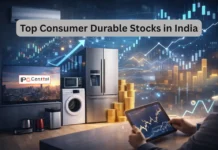


LG Electronics India’s IPO is being billed as the biggest consumer durables event in the Indian market. It’s not just another stock market offering, but an opportunity to gain insight into India’s rapidly growing appliances and electronics sector. In LG India IPO review, we’ll explain how it’s business model is structured, its key revenue streams, and why the company has the potential to outperform its competitors in the coming years.
After reading this review, you’ll not only gain insight into LG India’s financial strengths, but also understand how its operating ecosystem – from manufacturing to distribution and after-sales – makes it a moat-driven market leader.
LG India IPO Review: Offer Details & Shareholding
| IPO Dates | 7 – 9 October 2025 |
| IPO Price | INR 1,080 – 1,140 per share |
| Employee Discount | INR 108 per share |
| Fresh issue | Nil |
| Offer For Sale | 10,18,15,859 shares (INR 10,996.11 – 11,607.01 crore) |
| Total IPO size | 10,18,15,859 shares (INR 10,996.11 – 11,607.01 crore) |
| Minimum bid (lot size) | 13 shares (INR 14,820) |
| Retail Allocation | 35% |
| Listing On | NSE, BSE |
| Lead Manager | Axis Capital, Citigroup Global, Morgan Stanley, J.P. Morgan, and BofA Securities |
| Registrar | KFin Technologies |
| Listing Date | 14 October 2025 |
Shareholding
- Pre-IPO Promoter Holding: 100% (LG Electronics Inc., including 6 nominee shares)
- Shares Offered in IPO: 101,815,859 equity shares
- Weighted Average Cost of Acquisition (WACA): INR 1.66 per share
- Post-IPO Promoter Holding: Will reduce but still remains a strong majority, ensuring promoter’s long-term commitment and control.
LG India IPO Review: Company Overview
LG Electronics India was incorporated in 1997 as a wholly-owned subsidiary of LG Electronics Inc., the global home appliances leader. Its global parentage has been a key advantage—providing not only capital and technology transfer, but also the innovation-first culture that has shaped LG India into a household name. The “LG” brand itself was ranked among Interbrand’s Top 100 Global Brands in 2024, underlining the strength of its global brand equity.
In India, LG has consistently established itself as the No.1 player across multiple categories including refrigerators, washing machines, panel televisions, inverter air conditioners, and microwaves. LG India has held the largest market share (by value) in the offline channel, which still represents around 78% of the consumer electronics market in India. Its ability to anticipate technology shifts has been decisive—LG was the first brand in India to move entirely to inverter air conditioners in 2017, years ahead of competitors. The result: by CY2024 and H1 CY2025, 8 out of 10 ACs sold in India were inverter-based, a transition where LG was a clear pioneer.
On the manufacturing side, LG India has built one of the largest production capacities in the country. Its two advanced facilities at Noida and Pune had a combined installed capacity of 14.51 million units in FY2025, with a healthy utilization rate of nearly 77%. Importantly, these plants manufacture several key components in-house, such as compressors and motors, giving LG stronger control over quality, costs, and supply chain reliability. Looking ahead, the company has committed INR 5,001 crore to build a third plant in Andhra Pradesh, which is expected to be operational by FY2027 and will initially focus on air conditioners and compressors. The company had 3,796 employees as of June 2025.
LG India IPO Analysis: Business Model
LG Electronics India operates on a multi-segment, multi-channel business model that blends product sales, services, and B2B offerings into one integrated ecosystem. Its strategy has been to dominate across all layers of the value chain—manufacturing, distribution, after-sales service, and consumer engagement.
At the core, the company’s revenue is organized into two major divisions:
- Home Appliances & Air Solutions (HA & AS Division) – the largest contributor.
- Home Entertainment (HE Division) – televisions, monitors, and audiovisual products.
In addition, LG generates consistent revenue from installation, repairs, and annual maintenance contracts (AMCs), ensuring a steady stream beyond product sales.
B2C + B2B Ecosystem
- B2C dominance: Over 35,640 touchpoints across India, ensuring reach from metros to rural areas.
- B2B scale: 463 trade partners in June 2025 catering to institutional buyers, builders, and commercial clients.
- Services revenue adds a recurring layer: FY2025 service income + installation commissioning reached INR 665.9 crore, up from INR 484.6 crore in FY2023—a CAGR of ~17%.
Operating Strategy: From Manufacturing to Service
LG’s in-house manufacturing is a competitive advantage. By producing key components (compressors, motors), LG reduces supply chain risks, ensures product reliability, and optimizes costs. Its capacity utilization at ~77% in FY2025 suggests both efficiency and room for expansion. The new Andhra Pradesh plant will further add scale, cementing LG’s “local for local” strategy.
The after-sales network—1,006 service centers and over 13,368 engineers—creates a service moat, making customer stickiness far stronger than most competitors. In consumer durables, this is a crucial driver of repeat sales and long-term brand loyalty.
LG Electronics India IPO Review: Financial Performance
Key Financials
| Metric / Period | FY2023 | FY2024 | FY2025 | Q1 FY2026 |
|---|---|---|---|---|
| Revenue | 19,868.24 | 21,352.00 | 24,366.64 | 6,262.94 |
| EBITDA | 1,895.12 | 2,224.87 | 3,110.12 | 716.27 |
| EBITDA Margin (%) | 9.54 | 10.42 | 12.76 | 11.44 |
| Net Profit (PAT) | 1,344.93 | 1,511.07 | 2,203.35 | 513.26 |
| PAT Margin (%) | 6.69 | 7.01 | 8.95 | 8.10% |
| ROCE (%) | 34.38 | 45.31 | 42.91 | 9.10* |
| RONW (%) | 31.13 | 40.45 | 37.13 | 7.96* |
| Debt/Equity | 0.00 | 0.00 | 0.00 | 0.00 |
*Quarterly ratios are indicative and not annualized; annual ROCE/RONW are more meaningful.
🔎 Key Takeaway:
LG India has demonstrated consistency in topline growth, clocking a 12% CAGR over FY2023–25. The small Q1 FY2026 dip is actually a reflection of seasonal shifts in consumer durables demand, and such fluctuations often provide headroom for stronger H2 growth (festive-driven).
Profitability metrics are particularly impressive—EBITDA margin improved steadily from 9.5% in FY2023 to 12.8% in FY2025, while PAT margins climbed from 6.7% to 8.9%. This signals a business that is scaling profitably, unlike many peers that trade off growth for margins.
The hallmark of strength is capital efficiency: ROCE above 40% and RONW above 35% show that LG India is extracting maximum productivity from its capital base, while maintaining a debt-free balance sheet—a rare feat in a capex-heavy sector.
Segmental Revenue Mix
| Segment / Product | FY2023 | FY2024 | FY2025 | % of FY2025 Revenue |
|---|---|---|---|---|
| Home Appliances & Air Solutions | 15,030.68 | 15,679.75 | 18,267.86 | 74.97% |
| – Refrigerators | 5,805.57 | 5,784.49 | 6,696.45 | 27.5% |
| – Washing Machines | 4,220.84 | 4,491.94 | 5,041.70 | 20.7% |
| – Air Conditioners | 3,990.61 | 4,290.16 | 5,270.83 | 21.6% |
| – Others (Purifiers, etc.) | 1,013.67 | 1,113.16 | 1,258.88 | 5.2% |
| Home Entertainment | 4,833.92 | 5,672.25 | 6,098.78 | 25.0% |
| – Televisions | 3,932.03 | 4,558.33 | 4,924.82 | 20.2% |
| – Other AV/IT Products | 901.89 | 1,113.92 | 1,173.97 | 4.8% |
| Total | 19,864.59 | 21,352.00 | 24,366.64 | 100% |
🔎 Key Takeaway:
The business mix is a well-balanced portfolio. The Home Appliances & Air Solutions division contributes ~75%, led by refrigerators, washing machines, and ACs (each ~20–27%). This indicates a stronghold in “essential” categories with year-round demand.
The Home Entertainment division contributes ~25%, largely from TVs (~20%). This acts as a complementary revenue driver during festive cycles and ensures LG maintains relevance in both necessity-driven and aspirational consumer spending.
Service Revenue (Recurring Income)
| Period | Service Revenue (INR Cr.) | Growth % |
|---|---|---|
| FY2023 | 484.63 | – |
| FY2024 | 576.91 | +19% |
| FY2025 | 665.90 | +15% |
🔎 Key Takeaway:
A standout feature of LG India’s business is its recurring services income, which has grown at ~17% CAGR in the last two years. Unlike peers who depend entirely on one-time product sales, LG generates steady inflows from installation, AMCs, and maintenance.
This not only smoothens cash flows but also creates a customer stickiness loop: every AMC contract or installation touchpoint brings the consumer back into LG’s ecosystem, driving repeat purchases and strengthening brand loyalty. It transforms LG from being a “product-selling company” into a lifetime service partner for households.
Key Risks & Strategic Considerations
- Seasonality & Demand Cycles: Consumer durable sales in India—especially air conditioners and refrigerators—are often seasonal, peaking in summer. While this could lead to revenue fluctuations, LG’s diverse portfolio across categories (from TVs to washing machines to microwaves) ensures balanced cash flows year-round. In fact, in FY2025, while ACs contributed 21.6% of revenues, refrigerators (27.5%) and washing machines (20.7%) provided a steady base.
- Raw Material & Supply Chain Dependence: Global price volatility of key inputs (steel, copper, semiconductors) can affect margins. Yet LG has steadily localized procurement, with 54% of raw materials sourced domestically in Q1 FY2026—up from ~49% in FY2024. This “Make in India” push not only reduces import risk but also strengthens cost competitiveness.
- Competitive Intensity: The Indian appliances market is highly competitive, with players like Havells, Voltas, Whirlpool, and Samsung. However, LG’s scale (INR 24,366 crore revenue FY2025), brand trust (Interbrand Top 100), and unmatched service network form a moat that competitors struggle to replicate.
- Execution of New Plant (Andhra Pradesh): The INR 5,001 crore investment in the new manufacturing facility is a major step. Execution risks exist, but given LG’s two-decade successful track record of running large-scale plants at Noida and Pune, the expansion is expected to further cement its leadership in capacity and cost efficiency.
Conclusion
LG Electronics India is more than just an IPO—it’s an entry into India’s most trusted consumer durable brand with a global parent’s backing, strong fundamentals, and unmatched distribution power. While some may point to the “Offer for Sale” structure as a limitation, the reality is quite the opposite—LG India is cash-rich, debt-free, and self-sufficient, needing no external funds. The IPO, therefore, is about providing investors a chance to participate in a market leader’s growth journey, rather than filling funding gaps.

📌 Verdict:
For investors seeking long-term wealth creation in India’s consumption-driven growth story, LG Electronics India IPO offers a rare combination of scale, profitability, efficiency, and brand power. It stands as one of the most compelling IPOs of 2025 in the consumer space.
For more details related to IPO GMP, SEBI IPO Approval, and Live Subscription stay tuned to IPO Central.