





























Every WhatsApp message, stock trade, OTT stream, and AI query that flashes across India’s screens runs through a humming grid of servers and cooling towers — housed in massive, power-hungry fortresses called data centers. In the quiet corridors of Chennai, Mumbai, Noida, and Hyderabad, these steel-and-silicon powerhouses are becoming the core infrastructure of India’s digital economy, much like highways and ports were for the industrial era.
With India’s data center capacity set to quadruple by 2030, this is not just a technology story — it’s a USD 6.8 trillion economic transformation being built, megawatt by megawatt.
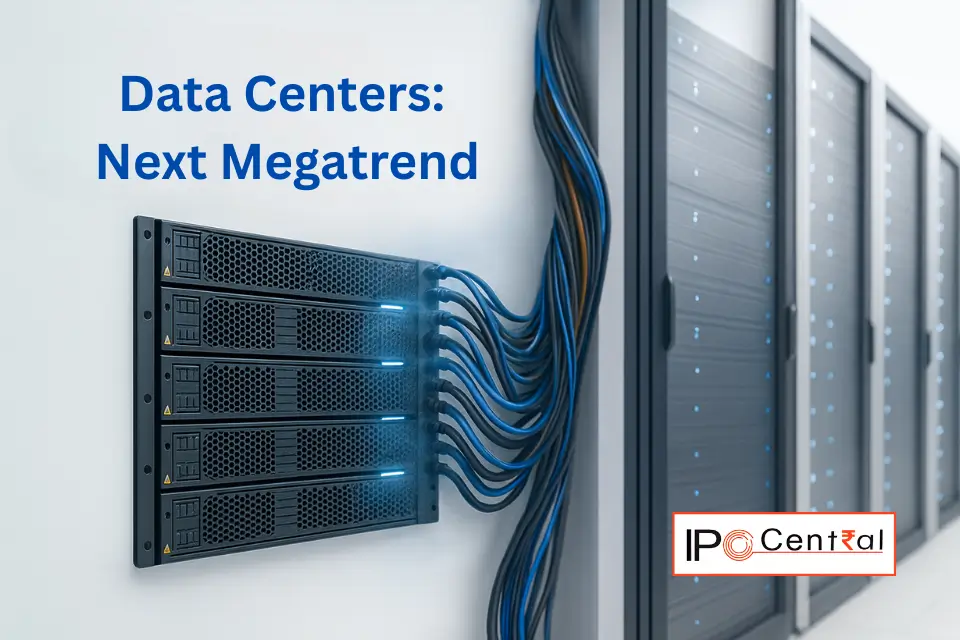
What Exactly Is a Data Center?
At its simplest, a data center is a facility that stores, processes, and distributes digital data. But beneath that simplicity lies a labyrinth of systems — high-density servers, backup generators, chillers, fiber networks, and 24×7 monitoring. Modern data centers are built to sustain near-zero downtime (typically 99.99% uptime), with specialized architecture ensuring uninterrupted power and cooling.
💡 Did You Know? A large 20 MW data center can consume as much electricity as a small township of 20,000 homes.
India’s Data Center Boom: The New Infrastructure Story
India’s data center industry has moved from being a niche IT segment to a core pillar of national infrastructure.
Fueled by AI adoption, 5G rollout, OTT consumption, and data localization laws, the market is projected to grow from 1.3 GW (FY25) to 5.7 GW by FY30. Data Center Stocks in India can clock a 30–35% CAGR — one of the fastest in the world.
The key hubs — Mumbai, Chennai, Delhi-NCR, Hyderabad, Bengaluru, and Pune — now host nearly all major operators: Sify Infinit Spaces, Nxtra by Airtel, CtrlS Datacenters, ST Telemedia, NTT, Equinix, Digital Realty, and Iron Mountain — all racing to expand capacity.
Revenue Engine: How Data Center Stocks Make Money
Data centers primarily earn from colocation, where enterprises and cloud players lease racks, cages, or dedicated halls for their servers.
They also charge for:
- Interconnection services (cloud connects, cross-connects)
- Build-to-suit facilities for hyperscalers like AWS or Azure
- Managed and value-added services (security, monitoring, backup)
- AI compute infrastructure, now emerging as a major new revenue stream
The business is capital-intensive upfront, but stable and annuity-like later. Once operational, long-term leases (5–10 years) ensure steady cash flow, making it the “real estate of the digital age.”
💡 Did You Know? Even a 0.1 improvement in Power Usage Effectiveness (PUE) can save up to INR 10 crore annually for a 20 MW facility.
Unit Economics: The Numbers That Matter
To understand the data center business, five metrics dominate boardroom dashboards:
| Metric | Meaning | Typical Range (India) |
|---|---|---|
| PUE (Power Usage Effectiveness) | Efficiency ratio (Total Power ÷ IT Load Power) | 1.4–1.6 |
| Occupancy / Utilization | % of built capacity leased | 60–80% |
| EBITDA Margin | Operating profitability | 35–45% |
| CapEx per MW | Cost to build 1 MW of capacity | INR 60–90 crore |
| ROCE | Return on Capital Employed | 7–10% |
Margins improve as centers mature — early years are burdened by depreciation and interest costs, but once utilization stabilizes, cash flow predictability rivals that of telecom towers or toll roads.
The Cost Story: Power, Cooling, and Real Estate
The biggest cost head in a data center’s P&L? Power — often 40–60% of total operating expenses.
Every kilowatt of IT load demands roughly 1.5 kilowatts of total power, factoring in cooling and losses.
- Power cost: INR 6–8 per kWh on average
- Cooling systems: advanced chillers, liquid immersion, rear-door exchangers
- Land and construction: major CapEx driver (INR 10–20 crore/MW)
- Maintenance & networking: smaller recurring costs
❄️ Did You Know? Liquid immersion cooling can reduce energy use by up to 40% compared to traditional air cooling — and is now being deployed in Sify’s AI-ready campuses.
Competitive Landscape: Scale Meets Specialization
Data Center stocks in India’s ecosystem is bifurcating — between hyperscale operators (serving AWS, Google, Meta, etc.) and enterprise colocation providers (serving BFSI, healthcare, and public sector).
Sify Infinit Spaces, the homegrown pioneer, operates 14 facilities (188 MW) and remains India’s third-largest player — behind Nxtra (Airtel) and NTT. Sify’s edge lies in its converged ICT model — combining network, cloud, and colocation — and its early bet on AI-ready infrastructure.
Growth Drivers: Why the Future Is Supercharged
- AI and Machine Learning: GPU-intensive AI workloads are redefining cooling and density requirements.
- Data Localization: India’s Digital Personal Data Protection Act, 2023 mandates domestic data storage — boosting domestic capacity.
- 5G & Edge Computing: Low-latency applications like gaming and IoT demand distributed mini data centers.
- Cloud Migration: Enterprises shifting from on-prem to hybrid or multi-cloud models.
- BFSI & Government Digitization: Compliance-heavy sectors fueling secure colocation demand.
- Renewable Integration: Operators like Sify sourcing >60% of Mumbai power from renewables.
Challenges: High CapEx and Tight Margins
Despite the optimism, the business is capital heavy and margin sensitive.
Depreciation (≈10%) and high interest costs suppress near-term profitability.
Land acquisition delays, multi-layered state approvals (30–40 clearances), and fluctuating energy tariffs add friction.
Moreover, PE-backed entrants and global giants have intensified price competition, compressing yields.
⚠️ Did You Know? The approval process for a single hyperscale data center in India can require up to 18 months of multi-agency clearances.
Technology Frontiers: The AI-Ready Shift
Next-generation data centers are high-density, high-efficiency, and AI-certified.
Sify’s DGX-Ready campuses in Chennai, Noida, and Navi Mumbai are capable of hosting racks with up to 130 kW power load — critical for GPU clusters.
Liquid immersion and direct-to-chip cooling systems are now standard for AI compute zones, while AI-driven automation manages power, cooling, and predictive maintenance.
🤖 Did You Know? One rack of NVIDIA H100 GPUs can consume 25–30x more power than a standard enterprise rack.
Data Center in India vs the World: A Strategic Advantage
India’s CapEx per MW (~INR 70 crore) is among the lowest globally — nearly half of Singapore or Japan — while land and labor remain cost-effective.
Add to that:
- Favorable government policies (infrastructure status, power subsidies)
- Expanding undersea cable connectivity
- Young digital-first population
The result: India is now one of the top three global destinations for data center investments, alongside the U.S. and Singapore.
Outlook: The Next Trillion-Dollar Infrastructure Bet
Between FY25 and FY30, AI-related workloads will surge from <1% to 20% of total data center demand, reshaping infrastructure design.
Edge facilities will mushroom across Tier-2 and Tier-3 cities.
And as renewable integration deepens, India’s data centers will evolve into smart, green, and globally competitive infrastructure.
Sify Infinit Spaces, with its first-mover advantage, AI focus, and sustainability edge, stands poised to lead this new era — where digital growth meets industrial scale.
Conclusion: The Power Plants of the Digital Century
If 20th-century wealth was built on oil refineries and steel mills, the 21st century’s fortunes are being forged inside air-conditioned, humming rooms of data centers.
They are the power plants of the digital economy — silent, steady, indispensable.
Data Centers in India isn’t just about servers and racks; it’s about digital sovereignty, AI ambition, and energy innovation. And as India marches toward a USD 6.8 trillion economy, these invisible fortresses will form the backbone of its digital empire.
📘 Glossary: Key Terms
| Term | Meaning |
|---|---|
| PUE (Power Usage Effectiveness) | Ratio of total facility energy to IT load energy; measures energy efficiency. |
| WUE (Water Usage Effectiveness) | Water consumption per unit of IT energy used. |
| DGX-Ready | NVIDIA certification for data centers capable of hosting high-density AI GPU workloads. |
| CapEx per MW | Capital cost to build one megawatt of IT capacity. |
| Hyperscaler | Large cloud provider (AWS, Google, Azure) leasing multi-megawatt space. |
| Colocation | Leasing shared space, power, and cooling to enterprises in a data center. |
| Edge Data Center | Smaller facility near end users to reduce latency. |
| Liquid Immersion Cooling | Servers immersed in non-conductive fluid for energy-efficient cooling. |
For more details related to IPO GMP, SEBI IPO Approval, and Live Subscription stay tuned to IPO Central.