



































Shreeji Global FMCG IPO marks one of the most interesting listings in India’s SME segment this year — not because of its size, but because of its story. Shreeji Global FMCG IPO review is designed for investors and analysts who wish to understand how a traditional agro-based enterprise evolves into a process-driven FMCG business, and how this evolution reflects in its revenue architecture, scalability, and operational efficiency. Let’s explore the Shreeji Global FMCG IPO analysis in detail:
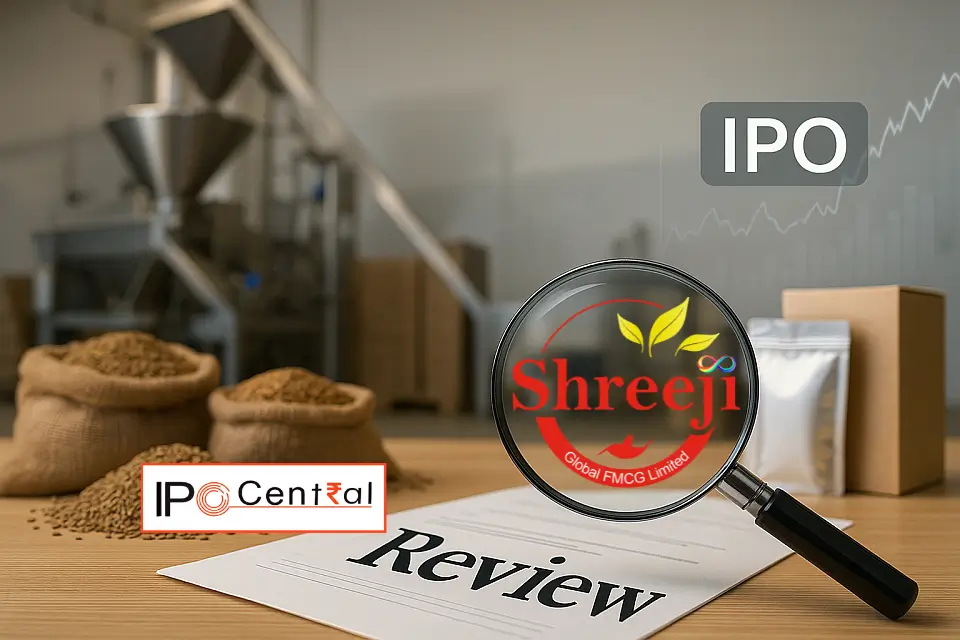
Shreeji Global FMCG IPO Review: Company Overview
Incorporated in 2018, Shreeji Global FMCG has swiftly grown into a leading player in the agro-processing and FMCG sector. The company, originally engaged in trading and processing agricultural commodities, has successfully transitioned into an integrated manufacturing model. Its product basket includes spices (whole and ground), oilseeds, pulses, grains, and multigrain flours, marketed under its flagship brand “SHETHJI.”
Shreeji Global FMCG IPO Analysis: Business Model
At its core, Shreeji Global FMCG operates on a fully integrated B2B model, with 100% of its sales currently coming from institutional and wholesale buyers. This model provides volume stability and predictable cash flows while keeping marketing and distribution costs efficient.
Key Business Pillars
- Backward Integration – Sourcing directly from farmers and APMCs, minimizing dependency on intermediaries.
- Processing Infrastructure – Advanced cleaning, sorting, grinding, and packaging facilities ensure consistency and scalability.
- Product Diversification – Presence across multiple agro and FMCG categories — spices, pulses, grains, flours, and oilseeds — reduces concentration risk and allows cross-segment synergies.
- Operational Efficiency – The company leverages technology-driven processes, in-house quality control, and automated machinery for higher throughput.
Role of Logistics & Group Synergy
Transportation efficiency is central to Shreeji’s operations. The company uses a hybrid logistics model — combining third-party transporters with in-house support from Shethji Warehousing and Logistics (a group entity).
This synergy ensures:
- Faster dispatch and reduced downtime,
- Lower logistics cost per ton, and
- Better coordination between procurement and outbound supply chains.
In FY2025, nearly 49% of total logistics operations were handled through Shethji Logistics — a move that helped control costs even as shipment volumes grew.
Shreeji Global FMCG IPO Review: Revenue Streams
Shreeji Global FMCG business model is backed by a diversified and expanding revenue base. While the company remains rooted in agro-processing, its strategic transition toward FMCG-style operations has begun to reshape both the structure and quality of its revenues.
1️⃣ Product-Wise Contribution
The company’s revenue continues to be dominated by its core spice segment, which accounts for an estimated 85–90% of topline performance. Within this, whole seeds and ground spices remain the largest categories, benefiting from consistent domestic and export demand. In FY2024–25, the company commenced operations in flour and multigrain atta, contributing to early-stage diversification.
| Product Category | FY2025 Capacity (MT) | FY2025 Utilization | Key Drivers |
| Whole Seeds | 91,200 | 67% | Core agri products like cumin, coriander, and sesame |
| Ground Spices | 4,000 | 81% | Red chilli, turmeric, cumin powder, blends |
| Flours (Atta) | 3,750 | 84% | Multigrain, millet, and health-based variants |
The addition of new product lines, particularly blended spices and multigrain flours, positions Shreeji to move up the value chain — capturing higher margins from processed and branded categories.
2️⃣ Geographic Mix: Domestic Dominance with Rising Exports
While the domestic market remains Shreeji’s mainstay, contributing over 91% of revenue in FY25, export growth has shown a sharp upward curve — rising from 0.6% in FY23 to 8.9% in FY25.
| FY2023 | FY2024 | FY2025 | 5M FY2026 | |
| Domestic Sales | 464.50 | 566.71 | 591.27 | 223.13 |
| % of Total | 99.4 | 96.3 | 91.1 | 89.1 |
| Export Sales | 2.79 | 21.51 | 57.65 | 27.26 |
| % of Total | 0.6 | 3.7 | 8.9 | 10.9 |
Exports span 25 countries, with the UAE, Malaysia, and Saudi Arabia leading the demand. Notably, Shreeji Global FMCG has entered newer regions such as Oman, the UK, and Azerbaijan, highlighting the expanding global footprint of Indian-origin spices under the Shethji brand.
3️⃣ Customer and Channel Mix
Shreeji Global FMCG serves a diversified clientele of 520 buyers, including:
- 45 Authorized Distributors across India,
- 44 Corporate & Modern Trade Clients,
- 378 Bulk Buyers, and
- 53 Overseas Importers.
Its flexible packaging range — from 20-gram retail packs to 30-kilogram bulk units — allows the company to cater to both household and industrial segments. The management’s upcoming focus on Direct-to-Consumer (D2C) channels and e-commerce presence aims to further strengthen the brand-to-customer connect, improving margin profiles over time.
Shreeji Global FMCG IPO Analysis: Financial Performance
The company’s financial trajectory underscores a steady, structural improvement in profitability, efficiency, and balance sheet strength.
| Particulars | FY2023 | FY2024 | FY2025 | 5M FY2026 |
| Revenue from Operations | 467.29 | 588.23 | 648.92 | 250.39 |
| EBITDA | 4.01 | 10.92 | 20.37 | 13.83 |
| EBITDA Margin (%) | 0.85 | 1.85 | 3.13 | 5.51 |
| PAT | 2.05 | 5.47 | 12.15 | 9.20 |
| PAT Margin (%) | 0.44 | 0.93 | 1.87 | 3.67 |
| Debt-Equity Ratio | 2.13 | 1.47 | 1.03 | 0.76 |
| ROCE (%) | 11.93 | 23.82 | 32.07 | 19.59 |
| ROE (%) | 28.66 | 41.54 | 51.74 | 26.92 |
Key Takeaways:
- Revenue CAGR (FY23–FY25): 17.5%
- EBITDA Growth: 5× in two years, reflecting improved process efficiency and automation.
- PAT Growth: Nearly 6× increase, from INR 2.05 crore in FY23 to INR 12.15 crore in FY25.
- Balance Sheet Strengthening: The Debt-Equity ratio improved from 2.13x to 1.03x, indicating prudent financial management.
IPO Structure & Utilization of Proceeds
Shreeji Global FMCG’s public issue reflects a growth-focused capital strategy, aimed at scaling infrastructure and strengthening working capital rather than providing promoter exits.
| IPO Dates | 4 – 7 November 2025 |
| IPO Price | INR 120 – 125 per share |
| IPO Type | Fresh Issue (No Offer for Sale) |
| Total IPO Size | 68,00,000 shares (INR 81.60 – 85.00 crore) |
| Minimum Bid | 2,000 shares (INR 2,50,000) |
| Lot Size | 1,000 shares (INR 1,25,000) |
| Individual Allocation | 35% |
| Listing On | NSE SME |
| Listing Date | 12 November 2025 |
| Promoters | Jitendra Kakkad, Vivek Kakkad, Tulshidas Kakkad & Dhruti Kakkad |
| Lead Manager | Interactive Financial Services |
| Registrar | MUFG Intime India |
Shreeji Global FMCG IPO Objectives
The company proposes to utilize the Net Proceeds from the Fresh Issue towards funding the following objects:
- Capital Expenditure for Factory Premises – INR 5.67 crore
- Capital Expenditure for Plant and Machinery & Cold Storage – INR 29.01 crore
- Capital Expenditure for Solar Power for internal consumption – INR 4.25 crore
- Working Capital – INR 33.54 crore
- General corporate purposes
Peer Benchmarking & Valuation Summary
When compared to listed peers Sheetal Universal and Madhusudan Masala, Shreeji Global FMCG clearly distinguishes itself through scale, return ratios, and growth consistency — despite being in a transitional phase from bulk agro-processing to branded FMCG.
| Company | EPS | P/E | RONW (%) | Revenue (INR Cr) | ROCE (%) | D/E Ratio |
| Shreeji Global FMCG | 7.61 | 16.43 | 41.11 | 648.9 | 32.07 | 1.03 |
| Sheetal Universal | 8.14 | 17.75 | 21.26 | 105.7 | 0.33 | 1.32 |
| Madhusudan Masala | 8.49 | 17.31 | 12.83 | 216.5 | 28.33 | 0.71 |
Key Takeaways:
- Scale Advantage: Shreeji Global FMCG’s revenue base (~INR 649 crore) is nearly 3× larger than the combined topline of its peers, showing strong sourcing and operational reach.
- Returns & Leverage: With ROCE at 32% and ROE above 40%, the company efficiently converts capital into earnings while maintaining a healthy debt-equity ratio (1.03x).
- Valuation Comfort: At an issue P/E of ~16x, valuations appear moderate compared to peers trading around 17–18x, leaving room for re-rating as FMCG operations scale up.
- Margin Outlook: Though current EBITDA margin (3.13%) trails retail-heavy peers, Shreeji’s ongoing expansion into blended spices, millet-based flours, and D2C sales offers a clear runway for margin improvement.
Growth Drivers and Scalability Outlook
1️⃣ Capacity-Led Expansion
The upcoming expansion includes:
- Blended Spice Facility: 22,500 MT annual capacity
- Multigrain & Millet Flour Plant: 37,500 MT
- Cold Storage: 5,000 MT
- Solar Power Plant: 1,000 KW for captive use
These upgrades will significantly lower energy costs, improve raw material preservation, and enable product consistency year-round — strengthening both operating margins and brand reliability.
2️⃣ Product Diversification
Beyond core spices, Shreeji’s new “Shethji” blended spices (Garam Masala, Chhole Masala, Sambhar Masala, etc.) and millet-based flours align perfectly with evolving consumer trends toward convenience and health-oriented foods. This portfolio diversification supports better gross margins and helps transition the business from commodity-oriented to consumer-facing FMCG.
3️⃣ Digital & D2C Strategy
The company plans a multi-channel digital expansion, listing on leading e-commerce platforms and launching its own D2C website. This shift will not only improve visibility but also help build direct consumer feedback loops — essential for brand equity and future premium pricing.
Shreeji Global FMCG IPO Review: Risk Perspective
Every expanding business faces execution challenges — but in Shreeji’s case, risks are actively mitigated by strategic choices.
- Commodity Price Volatility: Raw materials like cumin and coriander are cyclical in nature, exposing the business to input cost fluctuations. However, Shreeji mitigates this risk through direct sourcing via APMCs at Gondal and Rajkot, which provides better cost control and seasonal procurement advantages.
- B2B Concentration: With 100% of current sales coming from the B2B segment, the company faces customer concentration risk. However, it plans to expand into D2C and export markets to diversify its customer base and enhance margin flexibility.
- New Capacity Execution: Rapid capacity expansion can lead to ramp-up and execution challenges. However, Shreeji has a proven record of scaling operations, having successfully executed 91,200 MT of capacity upgrades between FY22 and FY24.
- Competitive Market Environment: The spice industry is highly price-sensitive, leading to intense competition. However, Shreeji focuses on consistent product quality, strong supplier relationships, and gradual brand-led expansion to strengthen its market position.

Final Words
Shreeji Global FMCG stands out as a well-managed transition story from agro-processing to a scalable FMCG enterprise. Revenue has grown steadily from INR 467 crore in FY23 to INR 649 crore in FY25, with profit rising sixfold and margins improving to 3.13%. The company’s return ratios — ROCE at 32% and ROE at 41% — reflect strong capital efficiency, while the debt-equity ratio of 1.03x indicates financial discipline.
The upcoming expansion in blended spices, millet flours, and cold storage, along with the solar power initiative, positions Shreeji for cost optimization and higher value addition. Its move toward D2C and e-commerce channels under the “Shethji” brand strengthens its path toward brand-led FMCG growth.
In short, Shreeji Global FMCG combines scale, efficiency, and a forward-focused strategy, making it a structurally sound and sustainable growth story in India’s expanding food and agri-FMCG space.
For more details related to IPO GMP, SEBI IPO Approval, and Live Subscription, stay tuned to IPO Central.