





























India’s bars and beer aisles felt strangely empty.
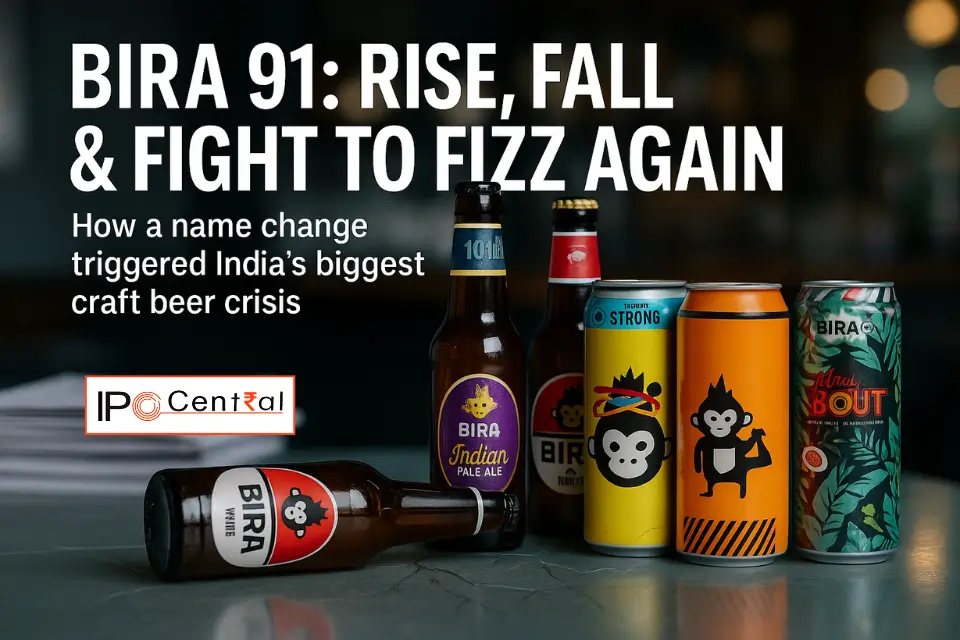
The bright yellow-and-black monkey logo that once dominated every pub, music festival, and airport lounge had suddenly disappeared. For months, consumers kept asking the same question:
“Bro, why isn’t the Bira 91 stock coming?”
Retailers shrugged. Distributors complained of “no supply for months.” Employees whispered about delayed salaries. Investors held tense emergency calls. A brand that once symbolised India’s modern, youthful drinking culture had gone silent.
Within a year, Bira 91’s unlisted share price — once trading at INR 950–1000 (Dec 2021) — crashed to INR 201.
Production halted. Salaries stopped. And a billion-rupee empire built over a decade began cracking — all because of a bureaucratic nightmare triggered by one word.
This is not just a story of mismanagement.
It’s a story of how India’s coolest beer brand evaporated almost overnight.
Bira 91 Story: The Meteoric Rise (2015–2023)
In 2015, a Delhi-born entrepreneur named Ankur Jain returned from the US with a dream to brew India’s own craft beer story. That dream took shape as Bira 91, a quirky brand with a grinning monkey on its label and a promise to make beer fun, fresh, and Indian.
What began as an experiment brewing in Belgium quickly turned into a phenomenon at home. Within a few years, Bira 91 became India’s fastest-growing beer brand, selling over 9 million cases across 550 towns and 18 countries. Its bright bottles and flavors like White, Blonde and Boom made beer a youthful, Instagram-ready symbol of urban cool.
Big money followed the froth. Investors from across the world lined up — Kirin Holdings of Japan, Sequoia India (now Peak XV), Tiger Pacific, Sixth Sense, and others bet on India’s craft beer revolution. By FY 2023, the company clocked INR 824 crore in revenue and was valued at nearly INR 4,400 crore in the unlisted market. Unlisted shares traded at INR 950 – 1000 each — the sign of a brand on the brink of an IPO.
Bira was everywhere — from cricket stadiums to music festivals to airport lounges. It sponsored the ICC T20 World Cup and five IPL teams. It was India’s own hipster beer, and for a moment, it felt unstoppable.
The Ruin: A Word That Broke the Bottle
Then, in late 2023, as Bira prepared for a 2026 IPO, it made a decision that would unravel everything. The company dropped a single word — “Private” — from its name, becoming B9 Beverages Limited instead of B9 Beverages Private Limited. It was a routine corporate step, meant to signal maturity before listing.
But in India’s highly regulated alcohol industry, that tiny legal change had massive consequences. Because alcohol is a state subject, each state’s excise department treats a “new legal name” as a new company — which meant that Bira had to re-apply for every licence and label approval from scratch in every state.
No grace period. No shortcut. No exceptions.
Within weeks, the entire distribution network froze. Delhi and Andhra Pradesh — which accounted for over one-third of sales — went offline. Warehouses piled up with unsellable beer worth INR 80 crore, and retailers moved to competitors like Simba and BeeYoung.
For four to six months, Bira could not legally sell a single can.
Internally, founder Ankur Jain called it a “catastrophic administrative oversight.” But the damage was done. What was supposed to be a step toward the Bira 91 IPO turned into a regulatory quicksand that swallowed the company’s momentum, cash flow, and credibility.
By mid-2024, revenue had fallen 22% to INR 638 crore, losses ballooned to INR 748 crore, and production came to a standstill. For employees and investors alike, it was the moment the bubbles burst.
“Due to the name change, there was a 4–6 month cycle where we had to re-register labels and re-apply across states which resulted in literally no sales for several months despite demand,” — Ankur Jain
The Crash: Numbers Don’t Lie
By mid-2024, the numbers at B9 Beverages looked like the balance sheet of a company in free fall.
The six-month sales blackout caused by the name change wiped out INR 80 crore in inventory, as beer already brewed under the “old” name could no longer be sold legally. Warehouses across Delhi, Andhra Pradesh, and Maharashtra were filled with stale stock that had to be written off completely.
When production resumed partially, distributors had moved on, retailers had delisted the brand, and consumers — once loyal to the funky monkey — had forgotten its taste.
The results were devastating:
- Sales dropped 22%, from INR 824 crore in FY23 to INR 638 crore in FY24.
- Losses spiked 68%, touching INR 748 crore, surpassing even total revenue.
- Cash flow turned negative by INR 84 crore, with liabilities exceeding assets by INR 619 crore.
- Volume crashed from 9 million cases to just 6–7 million.
Even investors who once toasted to Bira’s success began to sober up. BlackRock, which had been in talks to infuse INR 500 crore, pulled out. And though a small INR 100 crore rights issue provided temporary relief, it came at a 55% discount, signalling deep distress.
At the same time, Bira’s unlisted share price, once touching INR 1000 in 2021, fell to INR 201 by late 2025 — an 80% erosion in value.
For India’s most celebrated craft beer startup, this was more than a financial collapse — it was a credibility crisis.
Supply Chain Meltdown
When Bira’s legal name changed, its supply chain disintegrated overnight.
Every state excise department demanded fresh label registrations, new product codes, and reissued distribution licenses. There was no centralised process — each market had its own rules, paperwork, and waiting period.
“With a name change, every permit, licence, and label must be redone from scratch. This process generally takes at least six months,” said Bishan Kumar, Editor-in-Chief of Spiritz Magazine.
The result was a logistical nightmare:
- Production halted in July 2024.
- Warehouses overflowed with expired beer.
- Retailers in NCR and Mumbai ran dry, some reporting zero Bira stock for six months.
- Distributors refused new orders, fearing regulatory penalties.
Employees called it “an invisible lockdown.” Despite strong consumer demand, the company simply could not sell.
“Once the permit loop began in multiple states, Bira’s supply chain broke, and working capital dried up,” said another alcobev industry insider.
Competitors — Simba, BeeYoung, White Owl, and Kingfisher Ultra — quickly grabbed shelf space, cementing their hold while Bira remained trapped in paperwork.
Internal Unrest: The Human Cost of Mismanagement
As the financial strain deepened, tensions inside Bira 91 exploded.
By October 2025, over 250 current and former employees formally petitioned B9’s board and major investors — including Kirin Holdings and Peak XV Partners — demanding the removal of founder Ankur Jain.
Their allegations were serious:
- Salaries are delayed 4–6 months
- Provident Fund (PF) contributions are unpaid for over a year
- Tax deductions and reimbursements are pending
- Vendors are unpaid for months
- No transparency from leadership
For many, Bira’s “cool startup” culture had curdled into disillusionment. Former employees accused management of running the company like a family proprietorship, with all power concentrated among Ankur Jain, his mother, and his wife — the three promoter directors.
An insider report told:
“Bira came in strong, but there was never a clear sense of direction. One hasty move after another — from snapping up The Beer Café to burning cash on IPL sponsorships. This isn’t how you run an INR 4,000-crore company.”
Even as news of employee unrest spread, Jain maintained that no formal petition had been received and called the media reports “inaccurate and cynical.” Yet, the damage was visible in morale, trust, and reputation.
Corporate Governance Under Fire
The chaos exposed deeper structural flaws:
- Absence of regulatory foresight before the name change
- Lack of expert advisors during the transition
- Over-dependence on short-term loans
- Aggressive expansion without internal controls
For many industry observers, Bira 91’s downfall became a case study in how startup culture — obsessed with growth and brand coolness — can implode when basic governance is ignored.
Bira 91 Story: Brewing Battle and the Fight to Fizz Again
As Bira 91’s finances soured, its investors began tightening their grip.
In a dramatic turn of events, Kirin Holdings (Japan) and Anicut Capital — the company’s largest shareholder and key lender — invoked the shares pledged by B9 Beverages and took control of The Beer Café, one of Bira’s few profitable subsidiaries.
The Beer Café takeover shocked the startup ecosystem.
Through its subsidiary BTB Marketing (Better Than Before), Bira91 owned 42 Beer Café outlets and other hospitality ventures. With the pledge invoked, ownership passed to Kirin and Anicut, effectively stripping Bira 91 of one of its crown jewels.
Founder Ankur Jain hit back, filing a legal petition in the Delhi High Court.
He alleged that the lenders’ actions were “in contravention of contracts and illegal.”
On 17 October 2025, the Delhi HC issued an interim order restraining Anicut from selling or creating third-party rights over BTB’s shares — a temporary lifeline for Jain.
But the battle lines were drawn.
Industry insiders said the move was not just about collateral — it was about control.
Major shareholders, including Peak XV, Sofina, Sixth Sense Ventures, and Kirin, had reportedly discussed removing Jain during a September investor call. They were willing to infuse fresh funds only if he stepped down.
Jain, however, denied any such ultimatum, asserting that the board remained supportive.
Still, the optics were clear — Bira’s leadership was fractured, and its investors were no longer willing to “drink to that.”
Bira 91 Asset Sale: A Desperate Lifeline
By late 2025, the financial haemorrhage had reached critical levels. Production had been suspended since July. Over 250 employees hadn’t been paid for six months, and provident fund contributions were overdue for more than a year.
In an internal letter to staff, Ankur Jain acknowledged the crisis and announced a plan to sell one of the company’s assets to generate immediate cash. The goal:
- Clear pending salaries and PF dues
- Pay off tax deductions and vendor arrears
- Restart operations in key markets like Delhi and UP
Jain said that a buyer had been identified, and the proposal had been sent to Kirin Holdings, Anicut Capital, and Peak XV Partners for approval. The deal, he promised, would allow the company to “stabilise business and bring relief to employees.”
But skepticism loomed large. Some investors questioned whether a genuine offer or term sheet even existed. To them, the asset sale looked more like a fire sale, a temporary fix for a deeper structural problem — poor governance, rising debt, and a broken distribution chain.
Even so, insiders said the proposed sale reflected one thing clearly: Bira was running out of options.
The Attempted Comeback: A Fragile Reboot
Despite everything, the brand refused to go flat.
By mid-2025, Bira 91 had begun clawing its way back:
- Delhi and Uttar Pradesh markets came back online after securing new excise licences.
- New manufacturing partnerships revived limited production.
- A new CFO and senior leadership team were brought in to professionalise operations.
- The company raised INR 85 crore through a rights issue at INR 325 per share, trimming costs and shifting focus to profitable metros.
Q4 FY25 even showed early signs of recovery — a 40% growth over the previous quarter.
Meanwhile, Bira 91 unlisted share price stabilised around INR 200–₹210, still far from its 2021 peak of INR 1000, but an indication that the bleeding had slowed.
The company also entered talks with Global Emerging Markets (GEM) for a USD 132 million fundraising, which, if successful, could give it enough fizz to stay alive.
The Lessons in the Foam
For a brand that once symbolized India’s startup swagger, Bira 91 story is a sobering reminder that success can evaporate faster than beer bubbles.
A simple name change — meant to pave the road to Bira 91 IPO — instead revealed the cracks beneath: regulatory unawareness, hasty decision-making, weak governance, and overdependence on brand hype.
Yet, there’s still hope. The brand is back in bars, its taprooms are reopening, and its loyal fans are rediscovering that familiar monkey logo. But the question that now hangs over India’s once-coolest beer brand is not whether it will survive —
It’s whether it will ever truly regain its fizz.
