


































When most e-commerce companies thrive on charging sellers hefty commissions, Meesho did the unthinkable — it decided to charge none. No commission, no listing fee, and yet, the company grew into India’s largest e-commerce platform by orders and users in FY2025.
That paradox — “how Meesho makes money without charging anyone to sell?” — is exactly what makes its business model one of the most interesting experiments in Indian tech. Let’s decode the engine that runs behind the scenes of this zero-commission powerhouse.
1. The Core Idea: Growth Through Affordability and Volume
At its heart, Meesho isn’t trying to mimic Amazon or Flipkart. It’s building an India-first commerce ecosystem designed for price-sensitive consumers and small, regional sellers.
By removing commissions and middlemen, the company enabled lakhs of small businesses to come online. The result?
- Products available at Everyday Low Prices,
- Sellers with higher margins, and
- A massive surge in transaction volume.
This “low-margin, high-volume” flywheel is the foundation of how Meesho earns — not from taking a slice of every sale, but by monetizing everything that surrounds it.
2. Fulfillment Services: Turning Logistics Into a Profit Center
While sellers don’t pay commissions, they do pay for order fulfilment — packaging, pick-up, and delivery. The company manages this through its logistics arm, Valmo, which powers millions of shipments each month. Because of its massive scale, Meesho’s delivery costs are 35–60% lower than industry averages.
That efficiency allows the company to:
- Charge sellers a nominal logistics fee,
- Still keep consumer prices low, and
- Earn consistent revenue per order shipped.
It’s the same logic that built Amazon’s empire — but inverted for the Indian market: instead of premium customers, Meesho scales through mass affordability.
3. Advertising: The Real Money Maker
If fulfilment is Meesho’s steady engine, advertising is its turbocharger. Sellers pay Meesho to boost their product visibility within the app through sponsored listings and performance ads. These ads work on a CPC (Cost Per Click) model and are powered by Meesho’s AI-driven recommendation engine, which ensures better targeting and higher conversion rates.
- Sellers get smart ad suggestions based on sales trends.
- The company gets high-margin ad revenue, which grows as the seller base scales.
Think of it like this: Meesho removed commissions to attract sellers — and then created an entirely new market for in-platform advertising, which now forms a key pillar of its monetization.
4. Data Insights: Selling Intelligence, Not Just Access
Every click, view, and transaction on Meesho’s app generates valuable behavioral data. The company packages this into analytics dashboards and insight tools for sellers — helping them understand product performance, regional demand, and pricing trends.
While small sellers use basic analytics for free, larger brands and regional manufacturers often pay for premium insights and performance reports. In other words, Meesho monetizes its data layer without compromising user affordability.
5. “New Initiatives”: Planting Future Revenue Streams
Meesho is now expanding into adjacent services that can multiply its revenue base beyond e-commerce:
- Local Logistics Network – Delivering daily essentials via a low-cost, hyperlocal supply chain.
- Financial Services Platform – Partnering with regulated institutions to offer loans, credit, and insurance to sellers and delivery agents.
Each of these verticals can generate service fees or revenue-sharing income, diversifying Meesho’s monetization far beyond product sales.
6. The Indirect Advantage: The Flywheel Effect
Meesho’s zero-commission model works because it creates a self-reinforcing ecosystem:
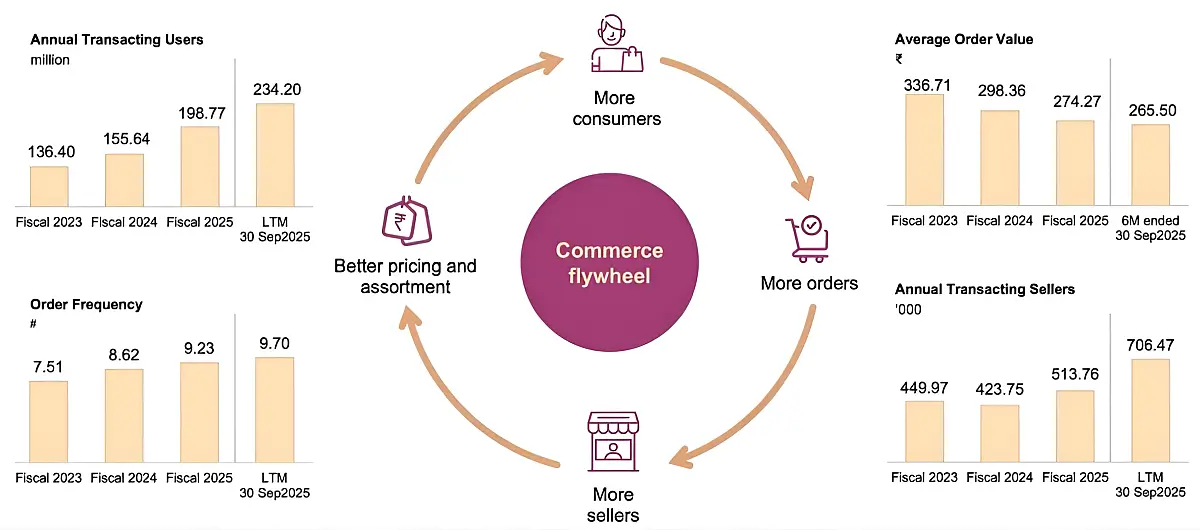
More sellers → Lower prices → More buyers → More orders → More logistics + ad revenue → More sellers join.
Unlike traditional players chasing margin per order, Meesho thrives on scale.
Its ability to handle over 180 crore orders in FY2025, despite falling average order value (INR 274 vs INR 336 in FY2023), shows how powerful this volume-based model is.
Even thin margins become meaningful when multiplied across millions of daily transactions.
7. Why It Works in India
India’s e-commerce growth story is no longer just about metros. Nearly 88% of Meesho’s users come from outside the top 8 cities, and over half are women — a segment traditionally underserved online.
These consumers demand affordability, trust, and vernacular accessibility — all of which Meesho’s model delivers:
- AI/ML-powered personalised discovery feed (73% of orders come via recommendations).
- Simple interface that works on low-end smartphones.
- Vernacular search in 11 languages powered by generative AI.
This hyper-local, inclusive strategy makes the company’s growth deeply embedded in India’s digital middle class.
8. Is This Model Future-Proof?
That’s the big question — and it’s exactly where Meesho’s real challenge lies.
Zero-commission e-commerce sounds noble, but it demands constant efficiency and massive scale to stay profitable.
The company’s future success will depend on three levers:
- Automation and AI – Further reducing per-order costs through logistics optimization.
- Ad Revenue Expansion – Increasing monetization per active seller as competition intensifies.
- Ecosystem Services – Scaling financial products and local commerce to diversify earnings.
If Meesho executes on these, it could become India’s first truly mass-market, tech-enabled retail ecosystem — not just an e-commerce app. But if logistics costs rise or ad monetization plateaus, the same zero-commission promise could turn into pressure on margins.
For now, however, the bet seems to be working — Meesho’s volume-led, affordability-driven flywheel is redefining how India shops, sells, and scales online.
“The real test for Meesho’s business model isn’t how fast it grows — it’s how long it can keep growing without breaking the very rule that made it famous: zero commission.”
For more details related to IPO GMP, SEBI IPO Approval, and Live Subscription stay tuned to IPO Central.

Mahesh Yadav is a prolific writer with over a decade of professional experience. A person of wide interests, he found his true calling in the field of investing and specifically the stock market. He has an amazing skill of presenting the most complex financial concepts (and there is no shortage of complexity in investing) in simple language and terms.