



























India’s railway electrification and manufacturing ecosystem just gained a new headline maker. MV Electrosystems, a homegrown power-electronics company with deep roots in railway propulsion technology, has filed DRHP with the Securities and Exchange Board of India (SEBI), seeking to raise INR 290 crore through a fresh issue.
The filing comes at a time when India’s railway modernization drive is accelerating and government policy is squarely focused on localising high-value electrical systems under Make in India and Atmanirbhar Bharat.
MV Electrosystems IPO: Company Overview
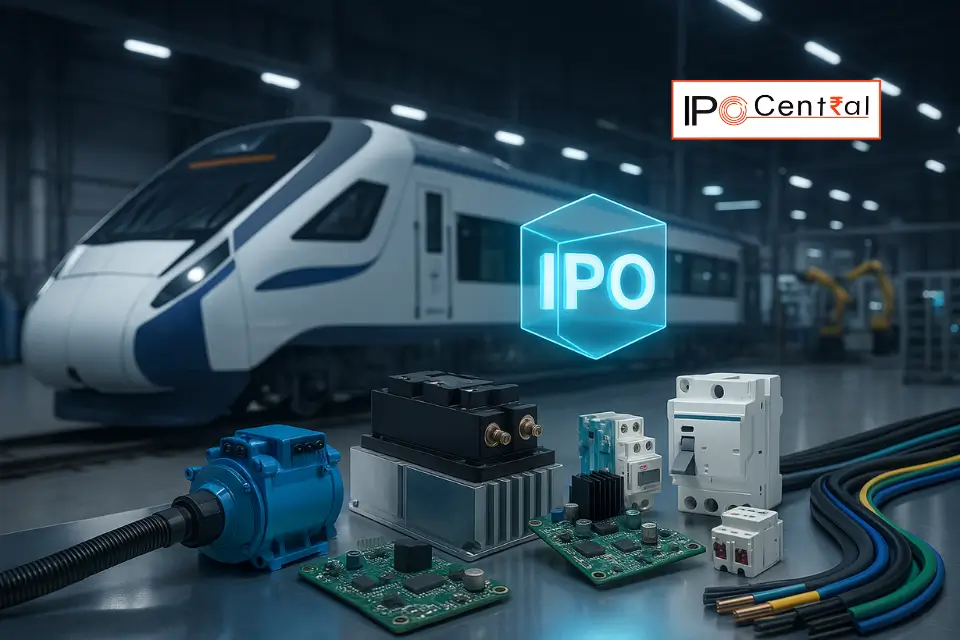
MV Electrosystems is a technology-driven power-electronics and electrical systems manufacturer, focused on railway rolling stock. Its core offerings include: IGBT-based 3-Phase Drive Propulsion Equipment for electric locomotives; switchgear and control panels for coaches / EMUs; and cable protection and wiring harnesses.
The company emphasises indigenous design and manufacturing under India’s “Make in India” and “Atmanirbhar Bharat” policy thrust — positioning itself as a supplier that can reduce import dependence while meeting stringent rail-industry standards.
With its indigenously developed IGBT-based 3-phase propulsion system recently approved by Chittaranjan Locomotive Works (CLW), MV Electrosystems is positioning itself as one of the few domestic firms capable of supplying critical propulsion technology to Indian Railways—an area historically dominated by multinational players.
Business, Infrastructure & Manufacturing Capabilities
- MVEL operates an assembly-cum-manufacturing facility (Unit 1) in Baghola, Palwal (Haryana), already certified for production of propulsion systems. The facility supports manufacturing of high-value items like propulsion equipment, as well as panels, cable conduits, and other rail electrical infrastructure.
- The company is establishing a second facility (Unit 2, Nangla Bhiku, Palwal) to scale up capacity, reflecting their expectation of increased demand after prototype clearance.
- Its R&D centre in Faridabad is equipped for full lifecycle design: from concept and 3D modeling to prototyping, testing (electrical, thermal, mechanical), and validation. Simulation tools include MATLAB, SolidWorks, Cadence (ORCAD), and ANSYS.
- Vertical integration is being strengthened — including installation of an SMT line for PCB assembly and dedicated test-setups to ensure final product compliance with railway standards before dispatch.
In sum, MVEL appears to have built a self-sufficient ecosystem from engineering to manufacturing — a notable advantage in a domain requiring high reliability and certification (e.g. from regulators like RDSO, CLW).
Order Book & Market Opportunity
MVEL has secured purchase orders from multiple locomotive works of Indian Railways — over the years since 2020 — for 123 propulsion equipment sets, with aggregate order value (excluding GST) of roughly INR 196.5 crore. Some orders include a three-year Annual Maintenance Contract (AMC) after the fifth year post-supply.
As of the DRHP, 122 of those sets remain to be executed, giving a firm order book of significant value. The company has also received new developmental orders — including for a composite converter propulsion system for WAP-7 locos and hotel load converters for 3-phase electric locomotives.
With India pushing aggressively toward 100% broad-gauge electrification, high-speed trains, and modern rolling stock (EMU / MEMU / metro), demand for domestically manufactured propulsion and electrical systems could grow substantially. MVEL aims to leverage this structural opportunity.
Furthermore, recent directives from Indian Railways toward procurement of integrated propulsion kits (instead of piecemeal subsystems) may favour companies like MVEL that are equipped for system-level supply — not just components.
MV Electrosystems IPO: Financial Snapshot
MVEL’s restated financials reflect a business in transition:
- Revenue from operations has fluctuated: INR 68.07 crore in FY2023 → dropped to INR 49.96 crore in FY2024 → rose to INR 62.64 crore in FY2025.
- EBITDA margins improved to ~14% in FY2025, reflecting higher-value engineering content.
- However, profitability remains modest: PAT in FY25 was ~INR 1.4crore (PAT margin ~2.2%).
- In the first four months of FY26 (Apr–Jul 2025), the company reported a loss — largely reflecting ramp-up costs and deferred tax.
Key financial ratios: Debt-to-Equity remains elevated (~1.5–1.7x in recent years), Return on Equity under pressure in early FY26, whilst capacity utilization shows the company is still effectively zeroing in on propulsion output (as production only begins post-prototype approval).
On the positive side, switchboard, conduit and cable-management manufacturing lines are operating near capacity — indicating an established recurring business outside propulsion systems.
But significant execution risk remains: scaling from prototype to serial production of high-power propulsion equipment is complex, capital-intensive, and highly regulated. There is a long lead time between supply orders, production, testing, and revenue realisation.
Additionally, customer concentration is high: the majority of sales are to Indian Railways (directly or via OEMs), which exposes the firm to policy, payment cycle and procurement-timing risks.
MV Electrosystems IPO: Use of IPO Proceeds
The IPO proposes to raise up to INR 290 crore via fresh issue. Planned utilisation:
- INR 180 crore — long-term working capital
- INR 210 crore — R&D for new power-electronics products
- Balance for general corporate purposes (e.g., scaling manufacturing capacity, completing test setups, vertical integration)
This capital injection — if deployed judiciously — could enable MVEL to ramp up propulsion manufacturing (via Unit 2), build out testing infrastructure, expand product range (hotel-load converters, EMU/MEMU propulsion systems, rail-infrastructure systems), and possibly explore export markets or non-rail power-electronics applications (renewables, power conversion, EV charging, etc.).
What Makes MVEL Stand Out — and What Warrants Caution
Strengths:
- Proprietary, indigenously developed technology for rail propulsion — significant differentiation in a segment historically dominated by foreign or foreign-collaborated suppliers.
- Integrated in-house capabilities: design → simulation → manufacture → testing → supply. This reduces dependency on third-party design houses or foreign licensors — a clear advantage under India’s “Make in India / Atmanirbhar Bharat” policy push.
- Growing order book and repeat business from Indian Railways locomotive works, along with developmental orders.
- Opportunity to expand into system-level supply (integrated propulsion kits), potentially increasing ticket size and margin profile.
- Diversified product base beyond propulsion: switchgear/panels, cable management, which can provide steady revenue while the propulsion side scales up.
Risks:
- Execution risk in scaling from prototype to serial production of high-power traction systems. Any delay or failure in quality control/testing could jeopardise orders and reputation.
- High customer concentration; dependence on government orders and budget cycles.
- Working capital intensity and elevated leverage, especially in initial phases of scaling.
- Competition from established domestic and international manufacturers (though few have fully indigenous propulsion designs).
- Long gestation period before meaningful cash flows from propulsion business commensurate with capacity; until then, company financials may remain volatile.
Conclusion
MV Electrosystems IPO DRHP filing signals that it is ready to step into the public markets — offering investors a stake in a potentially transformative journey: from a niche rail-components manufacturer to a full-fledged propulsion and rail-electronics solutions provider.
For long-term investors bullish on India’s railway modernisation, green mobility, and domestic manufacturing push, MVEL represents a “play” on structural trends: electrification of rail, shift to indigenisation, and localisation of high-value systems.
However, the journey is far from risk-free. The company’s success will hinge on execution — delivering quality, maintaining timelines, scaling production, and converting orders into revenues.
For more details related to IPO GMP, SEBI IPO Approval, and Live Subscription stay tuned to IPO Central.

Rajat Bhati has a strong technical background and 5 years of experience in the stock market. He focuses on equity research, technical analysis, IPO valuations, and risk management, helping investors make clearer, data-backed decisions. Today, he works full-time to educate people about the opportunities in IPO market.