






























The US decision to enforce a sweeping 25% tariff—plus potential penalties—on nearly all Indian exports, beginning 1 August 2025, has sent tremors across Dalal Street and beyond. This isn’t just about geopolitics or yet another tweet storm. For Indian markets and investors, especially those eyeing the IPO pipeline, the ripples will be deep, complex, and persistent.
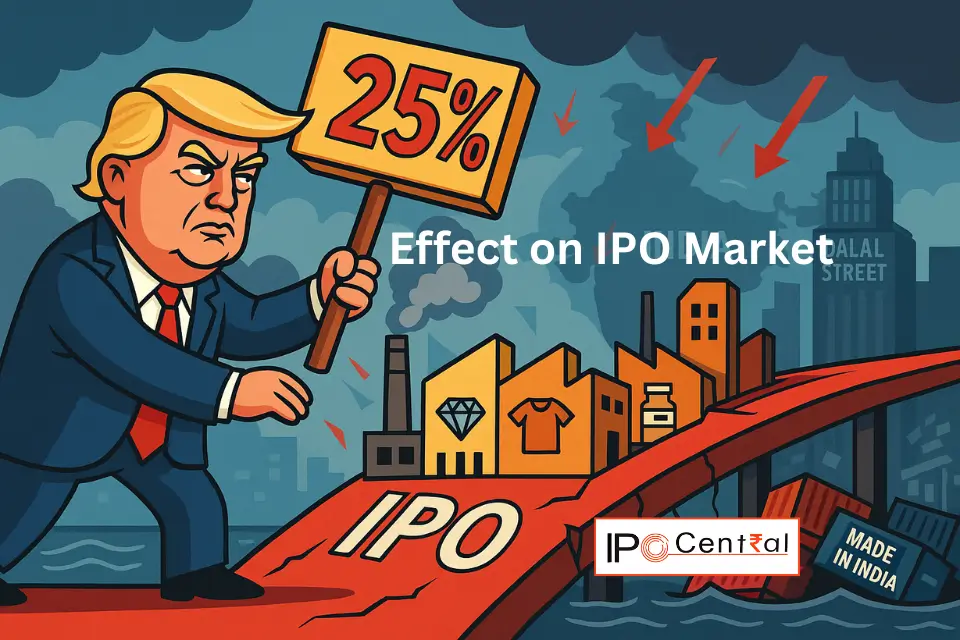
US Tariff Effects on IPO Market: Sectoral Freeze or Another Covid-style Drydown!
Indian equity markets have already felt the heat. The initial tariff headlines have wiped nearly USD 248 billion off market value between January and July 2025. SENSEX tumbled over 800 points on the announcement, while the MSCI India Index is staring at its weakest month, a stark contrast to MSCI Asia Pacific’s 14% and Korea’s 36% YTD gains.
The most immediate collateral damage from the 25% US Tariff on India? India’s IPO market, which had been on a revival spree post-pandemic, may see a pronounced downturn.
- Delay or Shelving of Sectoral IPOs: Sectors with heavy export exposure—especially electronics, textiles, chemicals, gems & jewellery—face valuation pressure, increased uncertainty, and may rush to defer their public listings.
- Historical Parallels: During Covid-19 in 2020, only 14 IPOs materialised through the year (raising INR 26,312 crore, with modest average returns but 4 out of 14 debuting with negative returns)—the lowest in eight years. A recurrence is on the cards for highly export-dependent names, as global trade headwinds and listing performance anxieties build.
- Valuation and Liquidity Crunch: Persistent tariff fears erode pricing power for IPO-bound companies; risk-averse investors may demand hefty discounts or stay away altogether.
Sectoral Effects of US Tariffs: Which Sectors Will Bear the Brunt?
A sectoral scan, anchored by export dependency and the new tariff regime, offers a data-driven view of who’s worst positioned:
| Sector | FY25 US Export Exposure (USD B) | Share of India’s US Exports | Comments/Sensitivity |
|---|---|---|---|
| Electronics/Electricals | 12.3 | 15% | Smartphones/iPhones at risk; Apple’s US plan jeopardized; India overtaking China in iPhone US supply was a key win, now at risk. |
| Gem & Jewellery | 9.1 | 12% | US is top buyer; blanket tariffs, double-digit cost increase could trigger order cancellation, supplier switching. |
| Pharmaceuticals | 8.7–9.8 | 40% of pharma exports | Mixed views—immediate tariffs unlikely, but Section 232 review and future 12–18 month tariff threat looms; 25% cost pass-through unlikely. |
| Textiles & Apparel | 2.9–10.8 | 28% (apparel) | US buyers may shift to Vietnam/Bangladesh; heavy pressure on cotton/garments, job losses. |
| Auto Components | 2.2 | 29% of auto part exports | Supply chain hit, cost spike for US assemblers; finished vehicle exports are marginal. |
| Steel & Aluminium | India’s solar story may slow, with the US as primary buyer. | ~8% | Already subject to Section 232 tariffs, but new measures may further dent competitiveness. |
| Solar Equipment | ~1.0 | 97–99% of PV exports | US is India’s biggest shrimp buyer, and price competitiveness at risk. |
| Marine (Shrimp, Seafood) | 2.4 | One-third of marine exports | US is India’s biggest shrimp buyer, and price competitiveness is at risk. |
| Machinery, Boilers, Nuke | 6.5 | ~8% | High-value capital goods face margin compression. |
- Stock Market Impact: With every 5% hike in tariffs, MSCI India’s EPS shrinks by roughly 0.8%. Thus, a 25% tariff could sap 2% off the Index’s earnings per share, driving further volatility and capital erosion.
- GDP & Export Volume: Estimates suggest GDP growth may fall by 0.2–0.7% in FY26, translating to an $18–30 billion hit to economic output, as up to 10% of Indian goods risk being priced out of the US market if tariffs are sustained.
COVID-19 Era Parallels: Is This Another “IPO Winter”?
2020’s Covid-triggered IPO slump is fresh in investor memory—minimal listings, high uncertainty, and selective enthusiasm for resilient sectors. History rarely repeats verbatim, but it often rhymes:
- IPO Count Down: Sectors feeling the heat from US tariffs could see a freeze akin to 2020, with IPOs either postponed indefinitely, launched at deep discounts, or simply failing to attract anchor investors.
- Export-dependence is a Red Flag: Textile, gems, electronics IPO hopefuls are most at risk, mirroring early pandemic “wait-and-watch” stances from both companies and retail investors.
25% US Tariff on India: Commentary from Industry Leaders
Policy unpredictability from the US was already on the radar, but most market participants were hoping for a tariff deal rather than a unilateral imposition.
FICCI President Harsha Vardhan Agarwal called the move “unfortunate” but expressed hope for a “short-term phenomenon” and a “permanent trade deal soon.”
FIEO’s Dr. Ajay Sahai struck a pragmatic note, expecting “negotiations between buyers and sellers” to determine how much cost can be absorbed.
The broader market has reacted nervously. Nilesh Shah, MD of Kotak Mahindra AMC, warned of “negative market reaction” but also urged for policy acceleration in India to boost competitiveness.
What Could India, Exporters, and Investors Do?
For Policymakers:
- Don’t Panic—Negotiate: The government could double down on high-level US talks already slated for August. Many analysts, like Rajiv Kumar, view these tariffs as a high-pressure bargaining tactic, not a permanent paradigm shift.
- Retaliation vs. Rebalancing: While counter-tariffs (on American agri, chemicals, packaged foods) are on the table, focus should remain on equitable deals, leveraging India’s vast market and critical US supply-chain roles.
- Export Diversification: Fast-track FTAs and preferential trade with the EU, Japan, ASEAN, Middle East, and others to reduce US dependency. Support exporters in market adaptation.
For Exporters:
- Recalibrate Supply Chains: Seek revenue opportunities in alternative markets. Use government-backed schemes and incentives to defray near-term pain.
- Product Portfolio Review: Consider shifting production footprints partially closer to end markets (e.g., in the US) for high-tariff items; reassess pricing, value-add, and pass-through economics.
For IPO-bound Companies & Investors:
- Patience and Flexibility Essential: Export-driven IPO stories will need to bake in uncertainty and perhaps delay launches, just as was prudent in 2020.
- Domestic-Focus Advantage: Investors should favour IPOs from companies with strong India-centric demand, minimal export dependency, and robust sectoral tailwinds (e.g., domestic pharma, infra, digital, consumption).
- Sector Selection: Assess each listing’s tariff exposure, global supply-chain links, and ability to pass on costs. Deep-dive prospectuses for US revenue concentration and margin sensitivity.

Bottom Line
While the 25% US tariff on India is more than a shot across the bow, it is on expected lines as both countries work together to forge a trade deal. Nevertheless, it’s a stern reminder that global trade can be as much about politics as economics. For India’s IPO hopefuls and market participants, the next few quarters will require adaptability, shrewd reading of policy signals, and a disciplined focus on fundamentals more than ever before. The IPO market may not freeze as in the Covid year, but expect a sectoral winter and much sharper scrutiny of cross-border growth stories. With diplomacy and diversification, India’s market ambitions can weather even this storm—though perhaps with a few casualties and a lot more caution on the road ahead.
For more details related to IPO GMP, SEBI IPO Approval, and Live Subscription stay tuned to IPO Central.