




































In a significant move toward market expansion and capital optimisation, Amir Chand Jagdish Kumar Exports (“ACJK Exports”), a storied name in the Indian basmati rice export industry, has filed its DRHP with SEBI. The IPO, comprising a Fresh Issue of Equity Shares aggregating up to INR 550 crore, marks the company’s maiden step into the public markets.
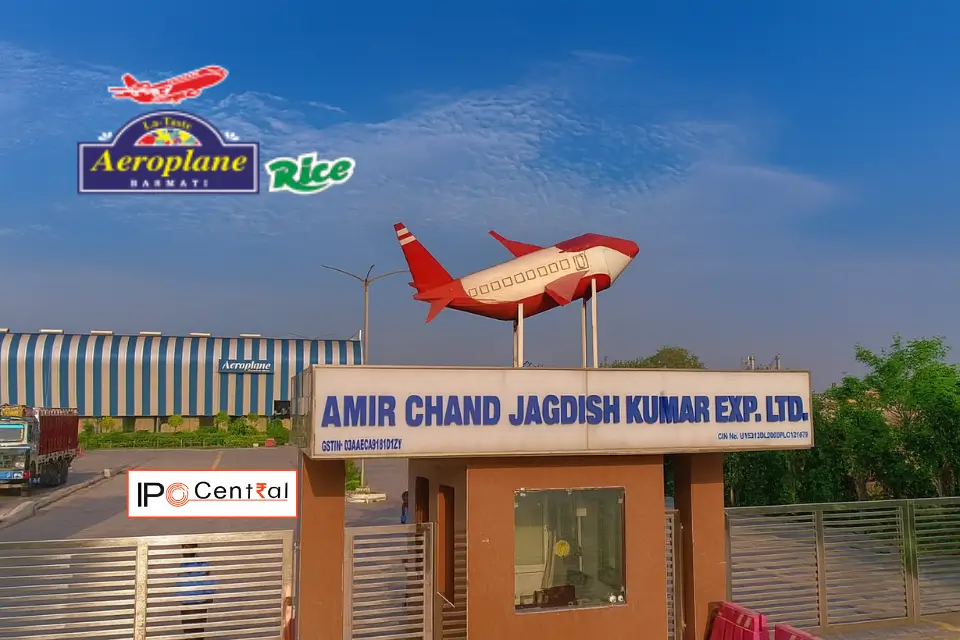
An Agrarian Empire in the Making
Founded in 2003 but with roots that stretch back over four decades, ACJK Exports has grown from a family-run sole proprietorship into a vertically integrated rice processing and FMCG enterprise. Under the stewardship of Jagdish Kumar Suri, Rahul Suri, and Ramnika Suri, the company has built a formidable presence across both domestic and global rice markets.
With its flagship “Aeroplane” brand and over 40 sub-brands like Ali Baba, World Cup, and Jet, the company is among the top 3 branded basmati rice exporters in India by revenue (CARE Report). Its premium rice is sold in more than 37 countries, with a commanding share in Middle Eastern markets, which alone contributed 44.71% of revenue in FY24.
Financial Performance: A Grain-by-Grain Growth Story
| Metric | FY22 | FY23 | FY24 |
|---|---|---|---|
| Revenue from Operations | 1,220.37 | 1,315.85 | 1,549.52 |
| EBITDA | 68.06 | 79.69 | 109.66 |
| EBITDA Margin | 5.58% | 6.06% | 7.08% |
| PAT | 17.16 | 17.50 | 30.41 |
| PAT Margin | 1.41% | 1.33% | 1.96% |
| ROE | 6.62% | 6.43% | 10.27% |
| Debt-to-Equity (X) | 2.75 | 2.38 | 2.50 |
Aeroplane Basmati IPO financial trajectory has been commendable, underscoring prudent capital deployment and expanding operational efficiencies.
Despite high working capital requirements typical of the rice industry, the company has kept leverage at manageable levels while improving margins.
Amir Chand Jagdish Kumar Exports IPO Proceeds
Of the INR 550 crore gross proceeds from the IPO, INR 500 crore is earmarked for working capital, crucial for managing the procurement-heavy nature of the rice business. The rest will be used for general corporate purposes. The company is also open to a pre-IPO placement of up to INR 50 crore, which, if executed, will reduce the size of the public issue accordingly.
Aeroplane Basmati: Business Model
ACJK Exports’ integrated model spans the entire basmati rice value chain—from procurement and ageing of paddy to packaging and distribution. With over 325 registered procurement agents, the company procures directly from northern India’s mandi system, often at peak season (Sep–Jan), when pricing and quality are most favourable.
The company operates three facilities in Amritsar, Safidon (Haryana), and Delhi, with a combined annual production capacity of 5,50,800 MT and 1,20,000 MT of rice storage. Utilisation, currently around 35-37%, offers ample headroom for scaling operations without immediate capex.
FMCG Diversification: More Than Just Ric
While 99% of revenues still come from rice, ACJK has begun building a footprint in branded FMCG staples such as atta, maida, sooji, besan, sugar, and salt. Although this vertical contributed just 0.23% to revenues in 9M FY25, the company is betting on rising urbanisation and food safety consciousness to grow its FMCG portfolio. The strategy includes venturing into value-added products like pasta, noodles, and honey, with a stated ambition to boost non-rice revenues.
Marketing on a Budget, But with Impact
Interestingly, Aeroplane Basmati has achieved its scale with minimal marketing spend, investing less than 0.5% of total expenses over the past three fiscal years on branding. That’s about to change. The company now plans to engage Bollywood or Tollywood celebrities to strengthen consumer brand recall and fuel its direct-to-consumer (D2C) ambitions via e-commerce platforms.
A Distribution Network That Delivers
The domestic distribution network has grown to 425 Indian distributors as of May 2025, while the international front is managed through 50 overseas distributors. ACJK has ambitions to scale this to 700+ domestic distributors by FY28, targeting deeper penetration in Tier 3 and Tier 4 cities—a clear play on India’s growing rural and semi-urban demand for branded staples.
Risks and Considerations
Investors should weigh the following risk factors:
- Heavy reliance on top procurement agents (top 10 account for 55.76% of raw material purchases).
- Export concentration: The Middle East makes up over 44% of revenue.
- Working capital intensity: High inventory and receivables cycle.
- Limited FMCG traction so far: Less than 1% of revenue despite branding ambitions.
Nonetheless, its strong promoter pedigree, integrated operations, growing domestic share, and capacity underutilization suggest ample upside potential if execution remains disciplined.

The Bottom Line
ACJK Exports IPO filing isn’t just another announcement—it’s a coming-of-age story for a homegrown rice powerhouse that has weathered commodity cycles, price controls, export policy swings, and global competition. As India continues to brand and export its agri-produce more aggressively, players like ACJK are well-positioned to capitalise on the shift.
For investors seeking a bet on India’s agribusiness export story with a consumer brand twist, Amir Chand Jagdish Kumar (Exports) may offer a compelling grain of opportunity in the upcoming IPO season.
For more details related to IPO GMP, SEBI IPO Approval, and Live Subscription stay tuned to IPO Central.