


































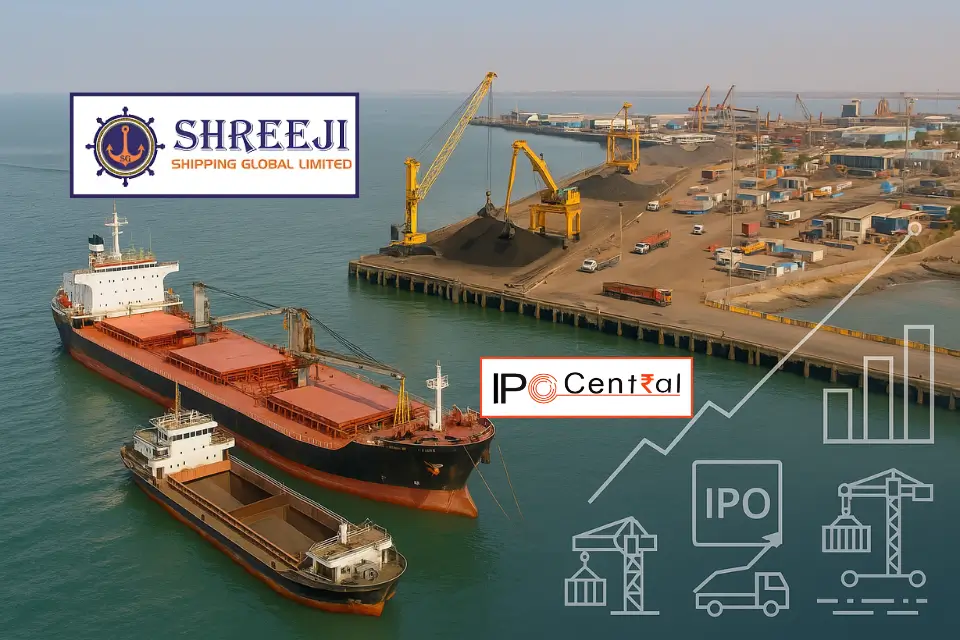
In a sector where minutes lost can translate into lakhs in added costs, Shreeji Shipping Global has built its business around precision, speed, and control. With its IPO slated for August 2025, the company is stepping into the public markets at a moment when India’s coastal shipping and bulk logistics industry is under transformation.
The company isn’t a traditional deep-sea shipping line; rather, it operates in the more specialised and often overlooked space of shallow-draft and non-major port cargo handling. Shreeji Shipping’s edge lies in providing end-to-end dry bulk logistics solutions — from transferring cargo offshore to delivering it inland — in locations where infrastructure constraints often deter larger competitors.
This is not just about owning vessels; it’s about owning the process. And that process is where the business model comes to life.
1. Position in the Maritime Value Chain
Shreeji occupies a critical mid-link between ocean freight and inland distribution. Large vessels, or “mother ships,” often cannot dock at shallow Indian ports due to draft limitations, narrow entrances, or tidal variations. This is where Shreeji steps in — conducting Ship-to-Ship (STS) lighterage to transfer cargo to smaller vessels (“daughter ships”), which then carry goods to shore.
From there, Shreeji Shipping’s services extend to stevedoring (loading/unloading), storage, high heaping, railway rake handling, and finally inland transportation. This integrated approach ensures clients — ranging from cement majors to steel producers — deal with one operator from sea to stockyard.
2. Value Proposition – Speed, Reach, and Control
In maritime logistics, reducing port time is money saved. Shreeji Shipping’s value proposition revolves around:
- End-to-End Integration – Covering offshore lighterage, onshore stevedoring, port services, and transportation in one contract.
- Asset Control – An owned fleet of 83 vessels and 376 units of earthmoving equipment allows tight control over availability and performance.
- Port Specialisation – Operating in smaller ports like Navlakhi, Magdalla, Bhavnagar, Bedi, and Dharmatar, where major players are less entrenched.
For customers, this means reduced demurrage, minimal idle time, and a single point of accountability for the entire cargo journey.
3. Customer Segments and Relationships
Shreeji Shipping’s customers represent a diverse cross-section of India’s industrial economy:
- Energy & Infrastructure – Adani Enterprises, Torrent Power.
- Cement – UltraTech, Ambuja, ACC.
- Metals – ArcelorMittal Nippon Steel.
- Coal Traders – Agarwal Coal, Mohit Minerals.
- Government Shipping – Ceylon Shipping Corporation (Sri Lanka).
Contracts are customised — pricing depends on cargo type, fleet deployment, delivery timelines, environmental conditions, and port infrastructure. The largest customer accounted for 20.86% of FY25 revenue, with the top 10 customers contributing 64.12%.
4. Operational Blueprint – How the Model Works
Shreeji Shipping’s operations can be visualised as a multi-stage pipeline:
- STS Lighterage – Mother vessels are anchored offshore; daughter vessels ferry cargo to port.
- Stevedoring – Cargo is unloaded at berth or onboard at anchorage.
- Port Services – Storage yards, high heaping, dust suppression via water sprinkling, and liaison with customs.
- Transportation – Port-to-premise delivery using owned and rented fleets.
- Fleet Chartering & Equipment Rental – Monetising surplus vessel and equipment capacity.
Every step is optimised for turnaround time, because in shipping, efficiency is not just operational — it’s financial.
5. Key Resources – The Muscle Behind the Model
- Fleet – 63 self-propelled barges, 5 mini bulk carriers, 8 tugboats, 7 floating cranes.
- Earthmoving Equipment – Excavators, loaders, tippers, tankers, and other specialised vehicles.
- Human Capital – 1,173 permanent employees plus seasonal contract labour.
- Infrastructure – Facilities like the Morbi storage yard for interim cargo handling.
6. Partnerships and Vendor Ecosystem
While asset-heavy, Shreeji Shipping supplements capacity through spot arrangements with third-party vessel and equipment providers to handle peak demand. Strong working relationships with port authorities, customs officials, and regulators ensure operational compliance and speed.
7. Geographic Footprint
While 92.84% of FY25 revenue came from India, Shreeji operates internationally at Puttalam Port (Sri Lanka) and has served clients in Guinea, West Africa — indicating potential to replicate its model overseas.
8. How the Model Translates into Money
Shreeji Shipping business model is integrated with multiple revenue lines:
- Cargo Handling (Lighterage & Stevedoring) – The backbone of revenue, tied to total cargo handled (15.71 MMT in FY25).
- Transportation – INR 71.59 crore in FY25, or 11.78% of revenue, moving 2.49 MMT inland.
- Fleet Chartering & Equipment Rental – INR 47.39 crore in FY25, 7.8% of revenue, down from prior years as more capacity was absorbed in-house.
- Other Port Services – Storage, high heaping, rake handling, dust suppression — typically bundled within contracts, adding incremental margins.
9. Financial Performance Snapshot
| Metric | FY23 | FY24 | FY25 |
|---|---|---|---|
| Revenue | 827.00 | 731.00 | 607.61 |
| Net Income | 118.89 | 124.51 | 141.24 |
| Margin (%) | 14.38 | 17.03 | 23.25 |
| EBITDA (%) | 22.82 | 27.07 | 33.03 |
While topline has moderated due to lower chartering activity, profit margins have expanded sharply, driven by higher in-house asset utilisation and operational efficiency.
10. IPO Objectives – Strategic Expansion
The IPO aims to raise INR 391–411 crore, primarily for:
- Acquisition of Supramax Bulk Carriers – INR 251.18 crore to tap deeper-water cargo opportunities.
- Debt Repayment – INR 23 crore to strengthen the balance sheet.
- General Corporate Purposes – Funding working capital and operational scaling.
The Supramax acquisition marks a strategic shift, potentially allowing Shreeji to capture higher-value international and major-port business while retaining its shallow-port dominance.
12. Shreeji Shipping IPO: Strengths & Watchpoints
Strengths:
- Vertically integrated, asset-heavy model with control over execution.
- Deep relationships with industrial customers.
- Strong operational moat in smaller ports.
- Improving margins and profitability.
Watchpoints:
- High customer concentration.
- Attrition management in a skilled labour-intensive model.
- Exposure to fuel cost swings and operational disruptions.
If executed well, the Supramax expansion could diversify revenue streams and open new geographies, but it will also test Shreeji’s ability to manage larger-scale, more complex shipping operations.

Final Take
Shreeji Shipping business model is a study in control and specialisation. By owning both the assets and the process in a niche, infrastructure-constrained segment, it has built resilience and pricing power. For investors, the IPO offers exposure to a player with strong operational fundamentals, clear growth levers, and a proven ability to turn operational efficiency into expanding margins — but one that must balance expansion with the discipline that built its moat in the first place.
For more details related to IPO GMP, SEBI IPO Approval, and Live Subscription stay tuned to IPO Central.
