































India’s renewable energy journey is at an inflection point, with the government targeting 750 GW of renewable capacity by 2030. Riding this strong policy and demand wave, Saatvik Green Energy has rapidly emerged as one of the fastest-growing solar PV module manufacturers in the country. The company is now opening its doors to public investors with a INR 900 crore IPO, scheduled between 19 – 23 September 2025, and listing on 26 September 2025 at the NSE and BSE.
However, before committing capital, every prudent investor must understand not just the company’s growth story but also its strengths, weaknesses, opportunities, and threats. A structured Saatvik Green IPO SWOT analysis helps bring clarity to these factors, enabling investors to make an informed decision.
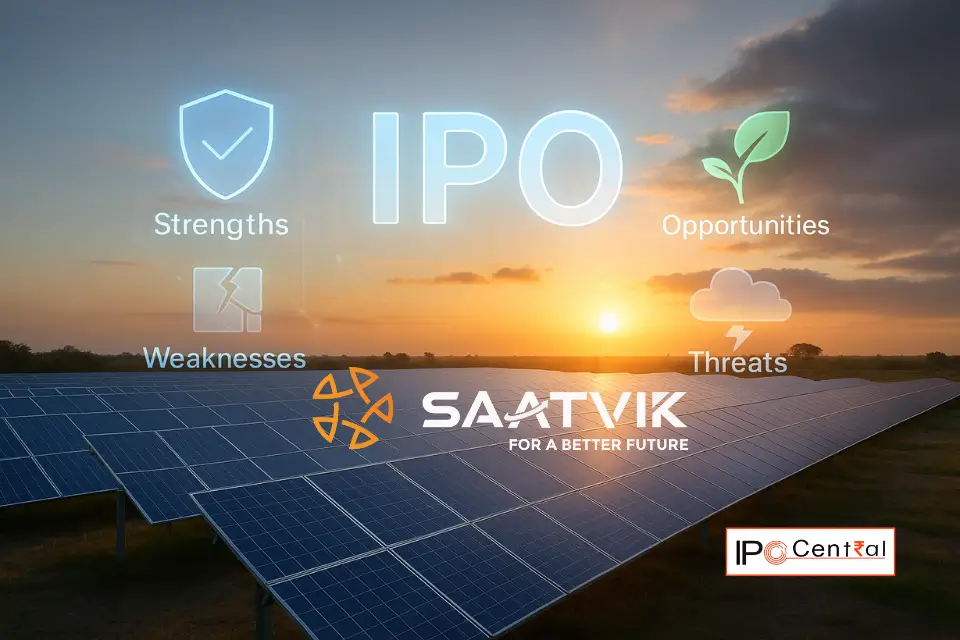
Table of Contents
Company Overview
Founded in 2016, Saatvik Green Energy has rapidly established itself as a leading solar PV module manufacturer, with a strong focus on innovation, efficiency, and scalability.
- Manufacturing Base: Operates three advanced facilities in Ambala, Haryana with 3.80 GW installed module capacity as of March 2025, achieving a healthy 83.70% utilization in FY25.
- Expansion: Plans are underway to add another 1 GW in Ambala by FY26 Q2, and a large-scale facility in Odisha with 4 GW module + 4.8 GW cell capacity by FY27. With these additions, total module capacity will reach 8.80 GW, positioning Saatvik among the top domestic players.
- Products: Offers advanced Mono PERC, N-TopCon, and bifacial modules, achieving efficiencies of 21–26% and peak outputs up to 720 watts.
- Clientele: Delivered projects for NTPC (61.42 MW floating solar in Telangana), Jindal Steel (12 MW rooftop), and Dalmia Bharat, among others. In FY25, it bagged a significant 661 MW order for the Khavda Solar Park in Gujarat, one of India’s largest renewable hubs.
- Order Book: As of March 2025, the company held a INR 5,076.8 crore order book (~4.05 GW), providing strong revenue visibility.
Saatvik’s business is diversified across module manufacturing, EPC services, O&M contracts, solar pumps under PM-KUSUM scheme, and a growing retail/distribution network.
Saatvik Green IPO Snapshot
- IPO Size: INR 900 crore
- Fresh Issue: INR 700 crore
- Offer for Sale (OFS): INR 200 crore
- Price Band: INR 442 – 465 per share
- Lot Size: 32 shares (INR 14,880 minimum investment)
- Employee Discount: INR 44 per share
- Listing: NSE & BSE
- Promoters: Neelesh Garg, Manik Garg, Manavika Garg, and SPG Trust
- Lead Manager: DAM Capital Advisors (with Ambit & Motilal Oswal as co-managers in certain tranches)
- Registrar: KFin Technologies
Saatvik Green IPO SWOT Analysis
The IPO journey of the company is best understood through a Saatvik Green SWOT analysis—bringing to light its strengths, identifying weaknesses, and evaluating both emerging opportunities and potential risks.
Saatvik Green Energy SWOT: Strengths
- Strong Manufacturing Base with High Utilization
- Saatvik operates 3.80 GW installed module capacity at Ambala as of FY25, with 83.7% utilization, among the highest in the Indian solar industry.
- Capacity will expand to 8.80 GW modules + 4.80 GW cells by FY27, making Saatvik a top-3 domestic manufacturer.
- Diverse Product Portfolio with Advanced Technology
- Offers Mono PERC (efficiency up to 21.2%), N-TopCon (efficiency up to 22.84%), and Bifacial modules (efficiency up to 26.27%, peak 679 Wp output).
- Early mover in TOPCon technology, with future roadmap into tandem and perovskite cells, aligning with global trends.
- Robust Order Book Ensuring Revenue Visibility
- Domestic order book stood at INR 5,076.8 crore (~4.05 GW) as of March 2025.
- Major projects include 661 MW Khavda Solar Park order (Gujarat), NTPC floating solar (61.42 MW), and Jindal Steel rooftop (12 MW).
- Integrated EPC + O&M Services
- EPC portfolio: 69.12 MW installed capacity by FY25, including marquee clients like NTPC, Jindal Steel, and Dalmia Bharat.
- O&M services add long-term revenue stickiness and deepen client relationships.
- Strong Financial Track Record
- Revenue tripled in 2 years: INR 608.6 Cr (FY23) → INR 2,158.4 Cr (FY25).
- PAT surged ~4,400%, with margins stabilizing at ~10%.
- ROE at 63.4% and ROCE at 60.5% in FY25, far ahead of most peers.
- Government Tailwinds & Policy Support
- Beneficiary of PLI schemes, ALMM mandates, and PM-KUSUM solar pump scheme.
- Policy-driven demand visibility ensures long-term growth runway.
- Distribution Network & Retail Push
- Nationwide network of 53 partners (resellers, distributors, channel partners).
- Warehouses in Rajasthan, Maharashtra, Kerala, and Madhya Pradesh for last-mile access.
- Expanding into retail rooftop panels & solar pumps, backed by financing tie-ups.
Saatvik Green Energy SWOT: Weaknesses
- High Dependence on Imported Raw Materials
- In FY25, 42.2% of raw material (notably cells & aluminum frames) was sourced from China. While this indicates exposure to global supply chains, Saatvik is actively backward integrating by setting up 4.8 GW cell and wafer lines in Odisha, which will reduce reliance on imports and improve margins.
- Low Export Contribution: Exports were just 1.39% of FY25 revenue (~INR 29.9 crore), compared to peers like Waaree (>50%). However, Saatvik has already established a U.S. subsidiary (Texas), positioning itself to capture IRA-driven demand in the U.S. — meaning exports are a future growth lever, not a weakness.
- Cyclical EPC Revenues: EPC revenue contribution dropped from INR 160 Cr in FY24 → ₹74 Cr in FY25, highlighting cyclicality. But management’s strategy is clear: EPC is used as a strategic enabler to showcase module quality and capabilities, while core focus remains scalable manufacturing.
- Execution Risk in Large Expansion Plans: Odisha and MP expansions involve significant capex (~INR 477 Cr from IPO proceeds). Large projects always carry execution timelines and cost risks. That said, Saatvik’s track record of scaling Ambala from 550 MW (FY23) → 3.74 GW (FY25) at high utilization demonstrates its ability to deliver on ambitious targets.
- Leverage Still Higher than Peers?: Debt-to-equity stood at 1.36x in FY25, compared to Waaree (0.1x). Yet, the IPO fresh issue will materially reduce debt and strengthen the balance sheet, making this a short-term challenge turning into a long-term positive.
Saatvik Green Energy SWOT: Opportunities
- Massive Renewable Energy Push in India: India has set a target of 750 GW renewable capacity by 2030, of which solar will contribute a major share (~280–300 GW). Saatvil may capitalize on this green energy push.
- Rooftop Solar Boom: Government schemes such as PM Surya Ghar Muft Bijli Yojana and PM-KUSUM are accelerating rooftop and solar pump adoption. Saatvik has already entered this segment, and with planned financing tie-ups (solar loans, EMI options), affordability will drive further demand.
- International Expansion Potential: Saatvik has set up a U.S. subsidiary in Texas and is targeting GCC, Sri Lanka, and Canada markets. With the U.S. Inflation Reduction Act (IRA) pushing unprecedented solar adoption, Saatvik has a strategic entry point into one of the fastest-growing global markets.
- Backward Integration into Cells & Wafers: New facilities in Odisha and Madhya Pradesh will transform Saatvik from a module assembler into an integrated solar manufacturer. This will further expand EBITDA margins (already improved from 3.9% in FY23 → 16.4% in FY25) and reduce dependency on imports.
- Strong Distribution & Retail Play: Saatvik already has a network of 53 partners and warehouses in 4 states ensuring deep penetration in Tier-II/III cities and rural markets. Expansion into retail solar branding and financing partnerships will position the company as a hybrid B2B + B2C solar player.
- Technology Leadership: Beyond Mono PERC, Saatvik is deploying N-TopCon (22.84% efficiency), bifacial modules (up to 26.27% efficiency, 679 Wp output), and working on tandem/perovskite technologies.
- This ensures alignment with next-gen global solar adoption trends.
Saatvik Green Energy SWOT: Threats
- Intense Competition: Domestic peers such as Adani Solar, Waaree (13.3 GW), and Premier Energies (5.1 GW) are larger in scale. However, Saatvik’s rapid ramp-up (550 MW in FY23 → 3.7 GW in FY25) and Odisha expansion will place it firmly among the top-3 domestic players by FY27.
- Policy & Regulatory Risks: Import duties (BCD), ALMM mandates, and subsidy changes can create volatility. Saatvik’s strategy of domestic backward integration ensures resilience, allowing it to convert policy shifts into competitive advantages.
- Dependence on Global Raw Material Supply: Around 42% of raw materials (notably cells and aluminum frames) were sourced from China in FY25. This risk will reduce significantly once the Odisha and MP facilities are operational, ensuring better supply security and higher margins.
- Rapid Technological Shifts: The solar sector evolves quickly (PERC → TOPCon → perovskite). Saatvik is proactively adopting TOPCon at scale and has already outlined a tandem/perovskite roadmap, ensuring it remains at the forefront of technology adoption.

Final Word
At a P/E of ~27x, Saatvik Green Energy IPO offers investors a well-priced, high-growth renewable energy story with sector-leading returns on equity. Supported by government policies, rising solar adoption, and its aggressive capacity expansion, Saatvik Green Energy is poised to shine brighter in India’s renewable energy revolution.
Investors with a long term lense may consider the IPO as a wealth creator in India’s growing green energy landscape.