
















Raipur-headquartered Jinkushal Industries (JKIPL), engaged in trading, refurbishment, and branded sales of construction machinery, is set to launch its IPO comprising a fresh issue of ~INR 104.9 Cr and an OFS of ~INR 11.61 Cr.
For investors evaluating opportunities in the construction equipment and export-driven manufacturing space, Jinkushal Industries IPO review provides a fact-driven analysis of JKIPL’s business model, financial performance, strengths, risks, and valuation outlook. At its core, the company is positioning itself as an asset-light, globally focused player with integrated operations across new machine trading, in-house refurbishment, and its proprietary HexL brand of construction machines.
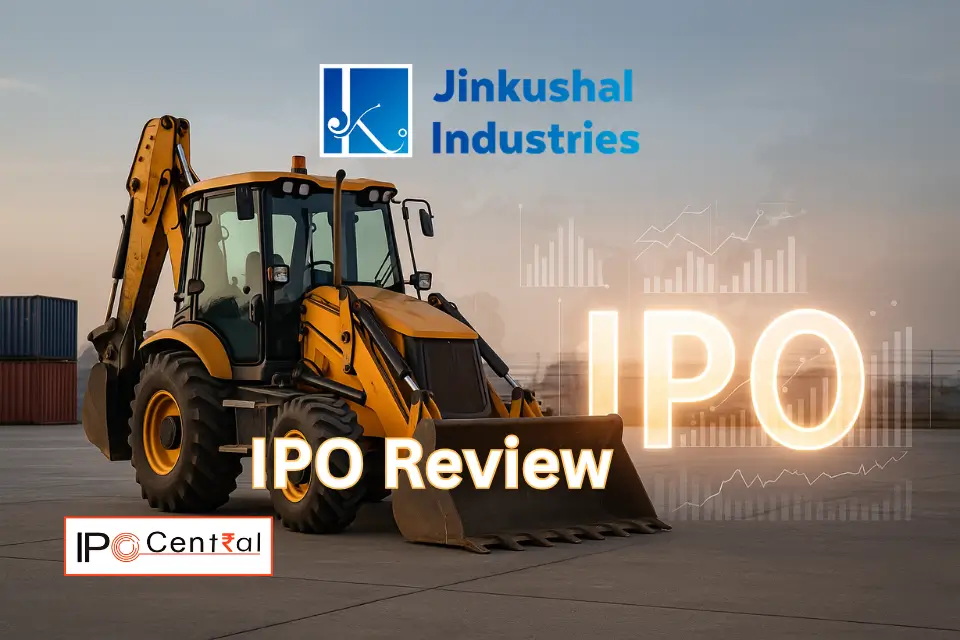
Table of Contents
Company Overview
Promoted by the Jain family, Jinkushal has transitioned from being a trading-centric business to a diversified player with multiple revenue streams.
- Trading: The company procures construction equipment from third-party suppliers, adds value through customization, and exports to global buyers.
- Refurbishment: Through its 30,000 sq. ft. Raipur facility, staffed by 42 skilled technicians and equipped with cranes, cutting machines, welding systems, and sandblasting units, JKIPL restores used machines to near-original condition.
- HexL Brand: Its proprietary brand, currently focused on backhoe loaders manufactured through contract partners, is being scaled with an eye on future electric machines, aligning with global sustainability trends.
JKIPL has also strengthened its international presence via subsidiaries in JAFZA (UAE) and Florida (USA). These subsidiaries act as sales and servicing hubs, improving client proximity across Middle East, Africa, Latin America, and North America.
As of 31 March 31, 2025, the company had 90 permanent employees and 21 interns, with mechanical operations forming the largest chunk. Attrition (~31%) is elevated, particularly in skilled roles such as technical repairs and procurement, reflecting industry-wide churn pressures.
Jinkushal Industries IPO Review: Business & Operations
A. Business Model & Verticals
Jinkushal Industries business model follows an asset-light model, where manufacturing is outsourced but quality, design, and distribution remain under its control. This minimizes capex exposure while allowing scalability. The company’s operations span three distinct verticals:
- Trading of New Customized Machines
- The process begins with capturing specific customer requirements — technical specs, operational needs, and tender timelines.
- JKIPL sources machines from multiple suppliers, ensuring availability within required lead times. If direct matches aren’t available, made-to-order machines are procured.
- Customization is a key value driver: specialized attachments, performance upgrades, or accessorization often fetch additional margins.
- Revenue stream: primarily trading margins + customization charges.
- Refurbishment of Used Machines
- This vertical differentiates JKIPL from many peers. Its Raipur facility executes a full refurbishment cycle: gate-in inspection → mechanical & structural evaluation → disassembly → cleaning & surface treatment → reconditioning (engine, hydraulics, transmission, electricals) → reassembly → quality testing (load, fuel efficiency, safety) → export dispatch.
- The refurbished machines are sold internationally at competitive prices, making them attractive to contractors and rental companies with budget constraints.
- Beyond cost-effectiveness, this also provides a sustainability edge by extending machine lifespans and reducing industrial waste.
- Revenue stream: refurb cost recovery + resale margin, with repeat demand due to affordability.
- HexL Brand (Contract Manufacturing)
- JKIPL’s proprietary HexL brand is manufactured by third-party facilities but under its design, technical specifications, and inspection protocols.
- The brand currently covers backhoe loaders but has ambitions to enter the electric construction machinery space, which could prove a long-term growth driver amid tightening environmental regulations.
- Strategic impact: HexL allows JKIPL to capture higher margins vs trading and build brand equity, a key differentiator in an otherwise commoditized export market.
B. Global Operations & Subsidiary Role
JKIPL’s overseas subsidiaries are critical enablers of the sales cycle:
- UAE Subsidiary: Manages Middle East, Africa, and parts of Latin America, with dedicated sales managers, lead generators, and administrators. Their dual role includes:
- Pull-based engagement: tracking tenders, customer budgets, and machine requirements.
- Push-based promotion: weekly sales calls, WhatsApp updates, email marketing, and inventory promotion.
- US Subsidiary (Florida): Focuses on North America, providing local engagement, after-sales coordination, and faster negotiation cycles.
These hubs also assist in payment follow-ups, collections, and customer relationship management, reducing turnaround times and building buyer trust in markets where physical presence is critical for used equipment sales.
C. Distribution & Sales Channels
JKIPL employs a multi-channel sales strategy:
- Direct Global B2B Distribution: Sales to contractors, rental firms, and infrastructure developers. Direct exports cut out intermediaries, enabling better pricing and stronger relationships.
- Dealer/Distributor Partnerships: Key for regional penetration, particularly in emerging markets. Dealers provide local support and aggregate demand.
- Digital & Auction-Based Platforms: JKIPL leverages global online auctions, enabling remote bidding, transparent price discovery, and access to a wider buyer base. This channel is a growth lever, especially post-COVID as digital adoption accelerated.
D. Operational Strengths & Risks
Strengths
- Diversified revenue model across trading, refurbishment, and own brand.
- Asset-light strategy ensures scalability with limited capex.
- Subsidiaries provide localized presence, enhancing market penetration.
- Refurbishment vertical offers a cost-efficient, sustainable solution, appealing to budget-sensitive buyers.
- HexL brand provides a path toward margin expansion and brand equity creation.
Risks
- Supplier concentration: Top 5 suppliers accounted for nearly 50% of purchases in FY25, a potential risk to bargaining power.
- Competitive intensity: Global OEMs like Caterpillar, JCB, and Komatsu dominate with stronger service ecosystems and financing options.
- Attrition challenges: 31% turnover in FY25, especially in technical and procurement roles.
Industry Landscape
The global construction equipment sector is dominated by large OEMs such as Caterpillar, Komatsu, JCB, and Volvo, which hold advantages in scale, brand equity, and financing options. Independent exporters like JKIPL face challenges due to:
- Price competition from China, benefitting from lower costs and better infrastructure.
- After-sales service disadvantage compared to OEMs.
- Capital-intensive working capital cycles due to long inventory holding and customer credit.
Despite these challenges, growth opportunities exist:
- Expanding infrastructure projects across Asia, Africa, and Latin America.
- Rising demand for refurbished equipment as cost-effective alternatives.
- Growing industry shift towards electric machinery — aligning with JKIPL’s plan to launch HexL electric models.
Jinkushal Industries IPO Review: Financial Performance
| Particulars | FY23 | FY24 | FY25 |
|---|---|---|---|
| Revenue from Operations | 233.45 | 238.59 | 380.56 |
| Total Expenses | 220.53 | 218.07 | 361.87 |
| Profit After Tax (PAT) | 10.12 | 18.65 | 19.14 |
| EPS (INR) | 3.40 | 6.27 | 6.15 |
Key Highlights
- Revenue Growth: FY25 revenue jumped ~60% YoY, driven by higher trading and refurbishment volumes.
- Profitability: PAT nearly doubled in 3 years (INR 10.11 crore in FY23 → INR 19.14 crore in FY25).
- Expense Pressure: Other expenses rose sharply in FY25, suggesting marketing and global expansion costs.
- EPS Stability: Despite profit growth, EPS remained flat in FY24–FY25, indicating dilution impact.
Shareholding & Promoter Details
| Shareholder | Equity Shares Held | % Holding |
|---|---|---|
| Anil Kumar Jain | 1,66,57,760 | 56% |
| Abhinav Jain | 53,54,066 | 18% |
| Sandhya Jain | 29,74,600 | 10% |
| Tithi Jain | 29,74,600 | 10% |
| Yashasvi Jain | 14,87,300 | 5% |
| Kamla Bai Jain | 2,97,460 | 1% |
| Total | 2,97,45,786 | 100% |
Offer for Sale (OFS)
| Promoter | Shares Offered |
|---|---|
| Anil Kumar Jain | 6,20,570 |
| Abhinav Jain | 2,17,850 |
| Sandhya Jain | 1,21,128 |
Utilization of Proceeds
- INR 72.67 crore from the proceeds will primarily fund long-term working capital requirements and the balance with be used for general corporate purposes.
Jinkushal Industries IPO Analysis: Strengths vs. Risks
| Strengths | Risks/Challenges |
|---|---|
| Diversified Business Model – Mix of new/customized trading, refurbishment, and own-brand HexL (with electric models in pipeline). | Execution Complexity – Managing multiple verticals increases operational risks; electric machinery launch may need higher R&D and compliance. |
| In-House Refurbishment Facility – 30,000 sq. ft. Raipur centre with 42 skilled staff, enabling full-cycle refurbishment. | Single Location Dependence – Any disruption at Raipur facility (labour/regulatory/logistics) could hit output significantly. |
| Global Subsidiary Network – UAE & US hubs enhance client engagement, logistics, and market penetration. | Cost Burden – Subsidiaries add fixed costs; limited early-stage scale may affect profitability. |
| Strong Supplier Relationships – Top 5 suppliers contribute ~50% of purchases, ensuring sourcing stability. | Supplier Concentration Risk – Heavy reliance on a few vendors may hurt margins and supply security if relations or market conditions change. |
| Balanced Sales Strategy – Push (dealer incentives, bulk orders) + Pull (digital marketing, auctions, brand awareness). | Intense Competition – OEMs (Caterpillar, Komatsu, JCB) and Chinese exporters dominate with stronger brand equity and cost advantage. |
| Consistent Profitability – PAT doubled in 3 years (INR 10.12 Cr in FY23 → INR 1,914 Cr in FY25); EPS stable at >INR 6. | Working Capital Pressure – Cycle stretched to 109 days in FY25; finance costs rose from INR 68 lakh (FY23) to INR 3.81 Cr (FY25). |

Final Verdict
Jinkushal Industries IPO Review highlights a company with diversified revenue streams, strong refurbishment capability, and global reach. While growth prospects look promising, challenges around working capital, supplier dependence, and intense competition remain. For investors, this IPO offers potential upside, but cautious evaluation of valuation and execution risks is essential.
For more details related to IPO GMP, SEBI IPO Approval, and Live Subscription stay tuned to IPO Central.

Rajat Bhati has a strong technical background and 5 years of experience in the stock market. He focuses on equity research, technical analysis, IPO valuations, and risk management, helping investors make clearer, data-backed decisions. Today, he works full-time to educate people about the opportunities in IPO market.