























Hospital IPOs are easy to misread because the headline metrics—number of hospitals, beds, expansion plans—don’t automatically translate into shareholder returns. In healthcare delivery, the return profile is built (or broken) by a few operational truths: how much of revenue comes from IPD vs OPD, whether bed utilisation stays healthy, whether the company can earn more per occupied bed-day (ARPOB), and how the payer mix affects pricing and collections.
Gujarat Kidney and Super Speciality IPO review focuses on exactly that: business model mechanics and revenue streams. Let’s dig deeper into the IPO:
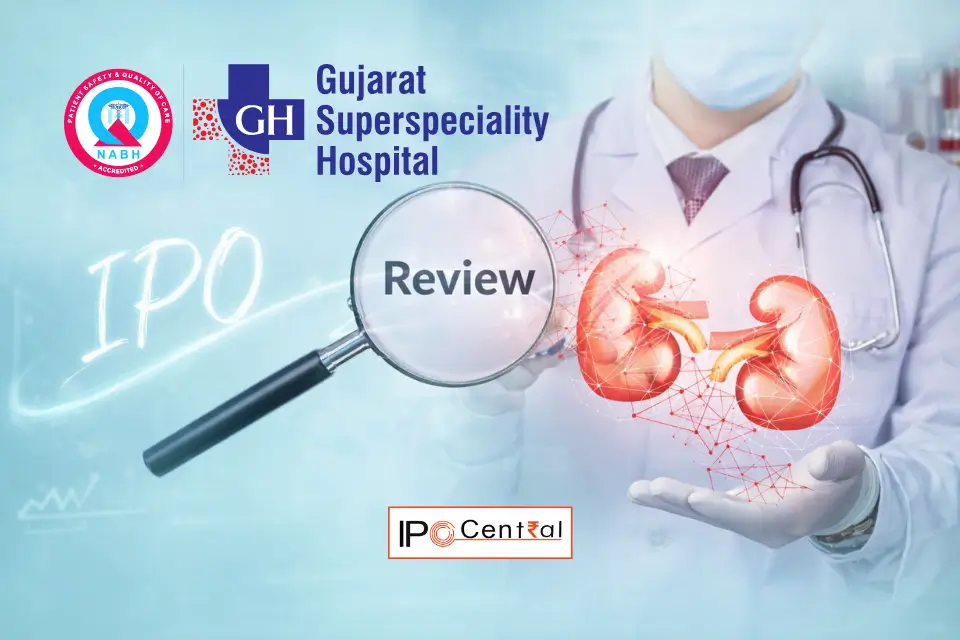
Table of Contents
Gujarat Kidney and Super Speciality IPO Snapshot
Gujarat Kidney & Super Speciality is coming with a fresh issue only. The stated issue terms are:
| Item | Details |
|---|---|
| IPO dates | 22 – 24 December 2025 |
| Price band | INR 108 – 114 per share |
| Issue size | 2,20,00,000 shares (INR 237.6–250.8 crore) |
| Offer for sale | Nil |
| Lot Size | 128 shares (INR 14,592) |
| Face value | INR 2 |
| Promoters | Dr. Pragnesh Yashwantsingh Bharpoda; Dr. Bhartiben Pragnesh Bharpoda; Dr. Yashwantsingh Motisinh Bharpoda; Anitaben Yashwantsinh Bharpoda |
The proposed objects of issue are meaningful because they map directly to the two levers that drive hospital economics—capacity and case-mix:
- Proposed acquisition of Parekhs Hospital, Ahmedabad: INR 77.00 crore
- Part-payment for already acquired Ashwini Medical Centre: INR 12.40 crore
- Additional shareholding in Harmony Medicare (Bharuch): INR 10.78 crore
- Capex for new hospital in Vadodara: INR 30.10 crore
- Robotics equipment for Vadodara: INR 6.83 crore
- Repayment/prepayment of certain secured borrowings: INR 1.20 crore
- Inorganic growth and general corporate purposes
Gujarat Kidney and Super Speciality IPO Review: The Business
At its core, this is a Gujarat-focused, multi-hospital healthcare delivery platform positioned across secondary (surgical) and tertiary (super-speciality surgical) services. The company operates multiple multispeciality hospitals in cities such as Vadodara, Godhra, Bharuch, Borsad, and Anand, backed by in-house diagnostics and pharmacies inside hospitals.
Network Scale: Capacity and Utilisation Are Story Starters
The proforma operating KPI table shows the following capacity stack:
| KPI (Proforma) | FY2023 | FY2024 | FY2025 | 3M FY2026 |
|---|---|---|---|---|
| Total bed capacity | 439 | 539 | 539 | 539 |
| Approved beds | 369 | 494 | 494 | 494 |
| Operational beds | 339 | 389 | 389 | 389 |
| ICU beds | 70 | 80 | 80 | 80 |
| Average occupancy (%) | 54.49 | 53.81 | 56.12 | 54.77 |
| ALOS (days) | 6 | 6 | 6 | 6 |
Two takeaways already stand out:
- Occupancy is stable in the mid-50% range, not sharply rising. So the next leg of profit improvement cannot rely only on “more filled beds.”
- With ALOS steady at 6 days, the model isn’t extracting efficiency by shortening stays. That points attention to the most important unit-economics variable: ARPOB.
Revenue Streams: IPD is Engine, OPD is Funnel, “Other” is Silent Contributor
Hospitals do not earn like consumer businesses. In most chains, IPD (in-patient) drives the bulk of revenue and margin because surgeries, critical care, implants/consumables, and higher complexity treatments sit there. OPD, while important for patient acquisition, typically monetises at a lower ticket size. Gujarat Kidney and Super Speciality’s proforma numbers reflect this classic structure.
IPD vs OPD: What Revenue Mix Looks Like
Using the proforma revenue and volume table:
| Metrics | FY2023 | FY2024 | FY2025 | Q1 FY2026 |
|---|---|---|---|---|
| IPD revenue | 62.74 | 71.94 | 81,72 | 21.86 |
| OPD revenue | 10.40 | 13.60 | 16.22 | 3.99 |
| Revenue from operations (total) | 85.79 | 103.44 | 119.98 | 31.09 |
From FY2025 alone, IPD contributes ~68% of revenue from operations and OPD ~13.5%. The remaining ~18% falls into “other operating revenue,” which—without a separate split—can reasonably include diagnostics/pharmacy/consumables/other hospital services booked outside the IPD/OPD lines.
This “other” bucket is not a footnote. If it grows sustainably, it can support margins because ancillaries are often higher-frequency, higher-capture streams in a hospital ecosystem.
Unit realisation: How Much the Company Earns Per Patient Interaction
When you translate the proforma numbers into per-patient economics, the direction is notable.
IPD realization (approx.)
- FY2023: ~INR 55.8k per IPD patient
- FY2024: ~INR 56.5k
- FY2025: ~INR 61.5k
- Q1 FY2026: ~INR 67.5k
OPD realization (approx.)
- FY2023: ~INR 1.35k per visit
- FY2024: ~INR 1.49k
- FY2025: ~INR 1.69k
- Q1 FY2026: ~INR 1.91k
In hospital economics, rising realization can come from case-mix improvement (more complex, higher-value procedures), better capture of diagnostics/consumables, or pricing changes. Because occupancy is broadly stable, the story logically tilts toward earning more per unit of care delivered, not merely increasing bed-fill.
The KPI that Bridges “Clinical” and “Commercial”: ARPOB
The proforma KPIs show ARPOB trending upward:
| ARPOB (INR) | FY2023 | FY2024 | FY2025 | Q1 FY2026 |
|---|---|---|---|---|
| Average revenue per occupied bed | 9,304.77 | 9,416.71 | 10,255.39 | 11,243.06 |
That is a clear signal: the company is extracting more revenue per occupied bed-day, which is one of the most credible ways a hospital chain improves profitability when occupancy is not surging.
Gujarat Kidney and Super Speciality IPO Analysis: Why Renal Sciences Positioned As “Case-Mix Upgrader”
Gujarat Kidney and Super Speciality’s place strong emphasis on renal sciences/urology and tertiary capabilities. This isn’t just branding; it can materially affect ARPOB and margins. The company shared procedure volumes across urology sub-specialties (consolidated basis), including endourology, urologic oncology, pediatric urology, reconstructive urology, renal transplant, and laparoscopic urology. FY2025 volumes show meaningful throughput (for example, endourology at 850 procedures in FY2025), and the platform also highlights interventional cardiology presence in key locations.
For investors, the commercial point is simple: tertiary/super-speciality depth is how you earn more per occupied bed-day without needing an aggressive occupancy jump, provided the clinician ecosystem and infrastructure remain strong.
Payer mix: what it suggests about pricing and collection dynamics
Your payer mix indicates a blend across self-pay, insurers/TPA, and government schemes. For FY2025 in that table:
- Self-payers and others: 68.82%
- Insurers through TPAs: 21.00%
- Government schemes: 9.72%
The direction is clear: the business is not heavily reliant on government schemes, and self-pay remains substantial—often a positive for pricing flexibility, though more sensitive to local competition and demand.
Gujarat Kidney and Super Speciality IPO Analysis: Financials
Proforma consolidated financials
| Metrics | FY23 | FY24 | FY25 | Q1 FY26 |
|---|---|---|---|---|
| Revenue from operations | 85.79 | 103.44 | 119.98 | 31.09 |
| EBITDA | 17.62 | 20.85 | 28.91 | 13.60 |
| EBITDA margin (%) | 20.53 | 20.16 | 24.09 | 43.76 |
| PAT | 6.36 | 9.97 | 15.13 | 8.36 |
| PAT margin (%) | 7.41 | 9.64 | 12.61 | 26.87 |
| EPS (INR) | 1.90 | 2.77 | 2.89 | 1.37 |
| Debt/Equity (x) | 0.73 | 0.54 | 0.22 | 0.15 |
| ROCE (%) | 25.49 | 29.37 | 35.88 | 17.26 |
- Revenue scales materially from FY2023 to FY2025.
- PAT margin improves from 7.41% to 12.61%, which is consistent with operating leverage and/or richer mix.
- Leverage improves sharply: Debt/Equity moves from 0.73 to 0.22, and borrowings reduce versus FY2023 levels.
Gujarat Kidney and Super Speciality IPO Review: Future Outlook
The company positions itself as a regional player with specialty strength (renal sciences/urology) and tertiary offerings, with some hospitals holding NABH accreditation. That positioning can support referral pull and unit economics.
The risk set, however, should be viewed through a revenue lens:
- With occupancy broadly stable, growth has to keep coming from ARPOB, case-mix, and successful ramp-up of new capacity/acquisitions. If ramp-up lags, returns can dilute.
- A multi-location acquisition strategy increases exposure to integration risk—standardizing procurement, clinical protocols, billing systems, and staffing models.
- An asset-light/lease-heavy posture can improve returns, but introduces lease renewal/escalation dependency.
- Payer mix can shift over time; a higher insurer/government share can boost volumes but may pressure pricing, while high self-pay is more demand-sensitive.

Bottom Line
Gujarat Kidney & Super Speciality is an IPD-led hospital platform where profitability is being driven less by occupancy expansion and more by earning more per occupied bed-day—a credible pathway in healthcare if specialty depth and execution hold.
The investment debate therefore is not “how many hospitals do they have,” but rather:
- Can the company sustain ARPOB improvement as it expands?
- Can it integrate acquisitions (Ashwini, Harmony and proposed Parekhs) without disrupting doctor availability, patient experience, or billing discipline?
- Can new capital deployed into capacity and technology translate into durable case-mix uplift, not just short-term revenue?
For more details related to IPO GMP, SEBI IPO Approval, and Live Subscription stay tuned to IPO Central.