

















Last Updated on January 5, 2026 by Rajat Bhati
“In a country where mobility drives livelihoods…” Victory Electric Vehicles opens its messaging with a simple idea: last-mile mobility is not just transport—it is income. From there, the company’s story is best understood not as a pitch deck, but as a shop-floor narrative: raw material becomes a frame, the frame gets protected through paint discipline, systems get assembled with care, and vehicles are tested before dispatch.
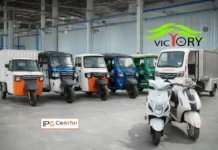
Victory Electric Vehicles International (Victory) manufactures electric three-wheelers across L3 (e-rickshaws/e-carts) and L5 (electric autos for passenger and goods transport), along with electric scooters and customized electric three-wheelers designed for specific commercial applications. Incorporated in 2018, the company operates from Bahadurgarh, Haryana, and is scheduled to list on NSE Emerge via an IPO in 7–9 January 2026.
In a conversation with IPO Central, Victory’s Promoter and Managing Director Mr. Sanjay Kumar Popli repeatedly emphasized one operating truth: the segment rewards those who change ahead of the curve and execute consistently.
Mr. Sanjay Kumar Popli: “We knew we had to evolve with the market—so we started working on the L5 category early.”
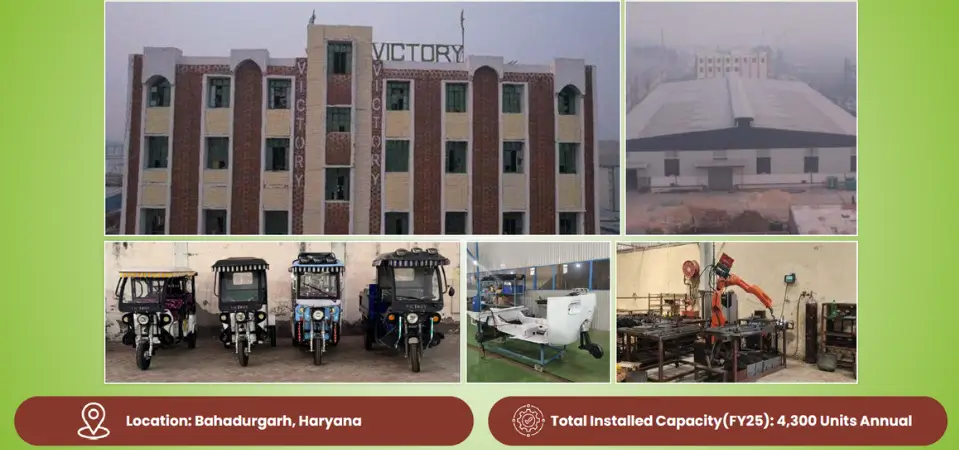
“No Shortcuts”: The Manufacturing Story Starts with the Frame
Victory Electric’s manufacturing narrative begins at the most basic level—material and structure. The company highlights MS sheets and pipes being cut, bent, welded, and finished to form the vehicle’s body structure. The subtext is deliberate: in a price-sensitive category, cost pressure can tempt shortcuts; Victory Electric wants to be viewed as a manufacturer that resists that trade-off.
This positioning is reinforced by its process flow: pipe cutting and sheet bending → welding → grinding/finishing → cleaning → paint pre-treatment/base/top coating → assembly → finished goods. For last-mile buyers and dealers, this kind of standardized sequence is often the first marker of reliability.
The “Often Ignored” Stage: Cleaning & Paint as Corrosion Insurance
One of the more meaningful operational points Victory Electric Vehicles calls out is paint discipline. It describes an eight-step cleaning and paint process, framing it as critical—and frequently neglected in low-cost manufacturing.
The practical logic is easy to follow: proper cleaning removes residue and contaminants so paint bonds correctly; better bonding improves corrosion resistance and preserves finish under daily wear. This is not a glamorous selling point, but it is the kind of detail that can separate an assembly mindset from a manufacturing mindset.
Assembly, Testing, & Dispatch: Reliability As a System
From structure and surface protection, the build moves into systems integration: motors, controllers, wiring, batteries, suspension, and braking systems are installed step-by-step. Victory Electric frames the next step as equally important—testing and quality checks focused on electrical safety, performance, and road readiness—followed by dispatch approval only after standards are met.
The company links this approach to dealer-friendly outcomes: fewer breakdowns, higher uptime, and stronger long-term channel confidence. In last-mile economics, that logic is direct: uptime is income.
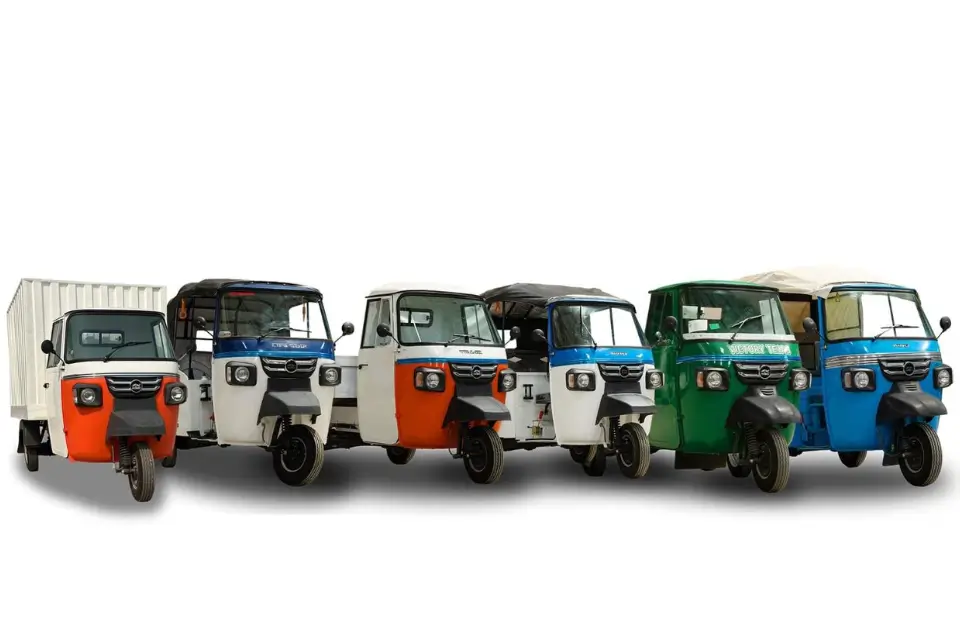
Product Ladder: L3 As the Base, L5 As the Higher-Productivity Rung
Victory Electric positions its range around use cases and route economics.
L3 (E-rickshaws / E-carts)
- Max speed: up to 25 kmph
- Motor power: ≤ 1,200W
- Goods payload (variant): up to 310 kg
L5 (Passenger & Goods Autos)
- Max speed: up to 55 kmph
- Motor power: up to 3,000W
- GVW: up to 1,500 kg (excluding traction battery)
In the interview, Mr. Popli explained why the L5 rung matters strategically—particularly as some markets become crowded and certain pockets see operational restrictions for lower-speed categories.
Mr. Sanjay Kumar Popli: “We anticipated saturation in parts of the market, so we moved early to build capabilities in the L5 segment.”
The Pivot Shows Up in FY25 Numbers
Victory’s FY25 mix suggests L5 is not a distant initiative—it is already material.
FY25 revenue mix by vertical (INR Cr)
| Vertical | FY25 Revenue (INR Cr) | Mix |
|---|---|---|
| L3 E-Rickshaw | 27.65 | 54.36% |
| L5 E-Rickshaw | 18.86 | 37.09% |
| E-Scooty | 0.81 | 1.60% |
| Spare Parts | 3.54 | 6.95% |
| Total | 50.86 | 100% |
For an SME manufacturer, ~37% revenue contribution from L5 in FY25 is a strong signal that the product ladder has traction and that dealers are finding demand for the higher category.
Victory Electric Vehicles: Capacity And Utilization
FY 2024-25 was the pivotal year for the company in its move towards L5 E-Rickshaws and it repurposed the existing L3 E-Rickshaw production line towards this goal. Consequently, its annual manufacturing capacity which stood at 5,220 units of L3 vehicles in FY 2023-24, got translated to a capacity of 2,670 L3 vehicles and 850 L5 vehicles as the latter category takes thrice the time to make as compared to its lighter counterpart. Capacity utilization in the latest year stood at 80.56% for L3 vehicles and 64.71% for L5 vehicles.
Capacity (Units) & Utilisation (%)
| Particulars | FY23 | FY23 Util. | FY24 | FY24 Util. | FY25 | FY25 Util. | H1 FY26 | H1 FY26 Util. |
|---|---|---|---|---|---|---|---|---|
| L3 E-Rickshaw | 4,500 | 70.96% | 5,220 | 73.66% | 2,670 | 80.56% | 1,335 | 68.91% |
| L5 E-Rickshaw | NA | NA | NA | NA | 850 | 64.71% | 425 | 29.41% |
| Two-Wheeler | 780 | 16.15% | 780 | 70.51% | 780 | 16.03% | 390 | 57.69% |
| Total | 5,280 | 62.86% | 6,000 | 73.25% | 4,300 | 65.72% | 2,150 | 59.07% |
Key Takeaways
- L3 utilization remains high in FY25, indicating steady base demand.
- L5 utilization is meaningful for a newer vertical with longer cycle time.
- Two-wheelers appear underutilized in FY25, implying selective focus or a different ramp cadence.
Differentiation: Customization, Technical Depth, & Uptime Economics
Victory emphasizes customized three-wheelers—vehicles tailored to specific applications such as food delivery formats. In fragmented markets, customization often helps reduce direct price comparisons and can strengthen dealer pull within micro-markets.
Mr. Popli described differentiation in practical user-economics terms, focusing on uptime and redundancy. One example was a dual-battery approach positioned as a way to reduce interruptions and extend working hours.
Mr. Sanjay Kumar Popli: “We introduced a double-battery solution to improve uptime for users.”
He also stated that the company imports lithium cells and assembles battery packs in-house, framing it as a controllability and service advantage.
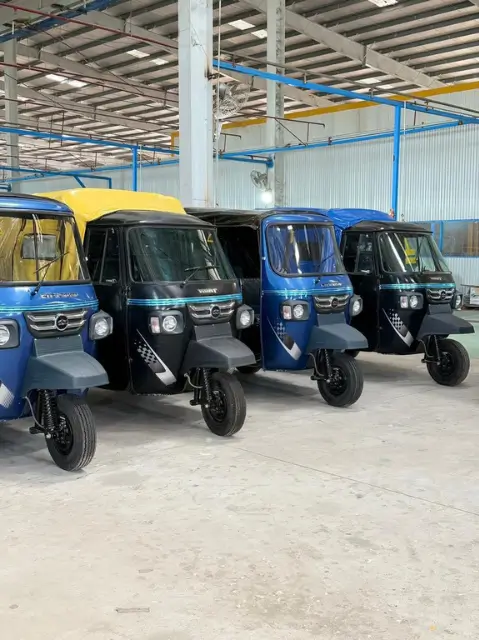
Dealer-Led Engine, North-Heavy Demand
Victory Electric’s growth model is dealer-led:
- B2B (through dealers): 94.26% of FY25 revenue
- Direct B2C: 5.74%
FY25 revenue concentration is strongest in Delhi and Uttar Pradesh, consistent with a North-heavy base and broader multi-state expansion intent.
Financial Scoreboard: Profitability & Margin Expansion
Victory’s FY23–FY25 trajectory shows a sharp improvement in margins and profits.
Financial snapshot (INR Cr)
| Metric | FY23 | FY24 | FY25 | H1 FY26 |
|---|---|---|---|---|
| Revenue | 51.91 | 48.44 | 50.86 | 16.81 |
| EBITDA | 1.80 | 6.99 | 7.79 | 2.60 |
| EBITDA Margin | 3.47 | 14.44 | 15.32 | 15.49 |
| PAT | 0.79 | 4.89 | 5.17 | 1.62 |
| PAT Margin (%) | 1.52 | 10.10 | 10.17 | 9.66 |
Key FY25 ratios disclosed: ROE 42.10%, ROCE 31.27%, Debt/Equity 0.62, Current Ratio 1.89, EPS INR 3.30, NAV/share INR 9.50.
NCLT Chapter Now in Rear View Mirror
No meaningful business survives without its ups and downs and Victory is no exception to this rule. The latest hiccup in Victory’s journey came in May 2025 when one of its creditors approached the National Company Law Board Tribunal (NCLT). Following the appointment of an Interim Resolution Professional (IRP), both parties reached an amicable settlement for a total sum of INR 40 Lacs which was arranged and paid by one of the directors of Victory. Consequently, the tribunal sat aside its earlier order and stopped CIRP proceedings.
While the matter is closed now and Victory management looks forward to focus on its core business, the incident had an impact on its operations which is also visible in the financial figures and parameters for the six months ended 30 September 2025.
The IPO Chapter: Working Capital as the Unlock
Victory’s IPO is scheduled for 7–9 January 2026 on NSE Emerge, priced at INR 41/share, with an INR 34.56 Cr fresh issue (no OFS).
Use of proceeds (INR Cr):
- Capex: INR 5.00 Cr
- Working capital: INR 18.00 Cr
- General corporate purposes: INR 6.78 Cr
In dealer-led manufacturing—especially as L5 scales—working capital is typically the binding constraint. The stated allocation is therefore consistent with the company’s process-and-distribution narrative.
A Process-First Story with Measurable Proof Points
Victory Electric Vehicles’ core claim is simple: build for Indian conditions with discipline—avoid shortcuts, protect quality, test thoroughly, and scale responsibly. The FY25 numbers give that story measurable form: a visible L5 mix contribution, expanding margins, and an IPO structured primarily to fund working capital and selective capacity support.
Very useful