












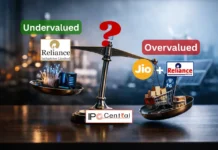






















Reliance Industries (RIL) has become a case study in “conglomerate valuation tension”: public markets assign one value to the parent, while brokerages and deal narratives ascribe eye-catching numbers to its consumer pillars – Jio Platforms and Reliance Retail. When those subsidiary valuations are placed next to RIL’s market capitalisation, a simple question emerges: Is Reliance Industries Undervalued Or Jio and Retail Overvalued?
In this article, we try to find out an answer to this intriguing question using a facts-and-figures reconciliation. In the process, we will explore what the market is valuing today, what established sell-side and what reports are implying for Jio/Retail, and what RIL’s own disclosures say about earnings mix, cash generation, and risk.
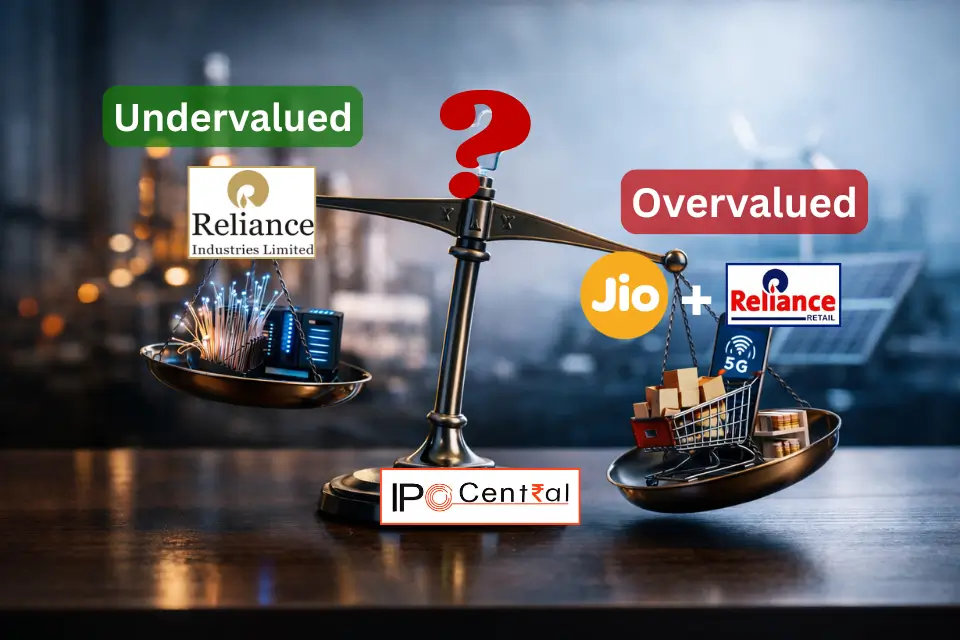
The “Implied Value” Paradox: Why the Math Looks Uncomfortable?
As on today, RIL’s market capitalisation is around INR 18.97 lakh crore. Now compare that with a widely-circulated JP Morgan framework that values the conglomerate’s subsidiaries:
- Reliance Retail is valued at USD 143 billion; accordingly, RIL’s 83% stake is valued at INR 13.1 lakh crore.
- Similarly, Reliance Jio valued at USD 135 billion would imply RIL’s 67% stake at INR 12.3 lakh crore.
Just those two stake values together add up to ~INR 25.4 lakh crore. If you stop there, it appears the listed market is assigning almost no residual value to RIL’s Oil-to-Chemicals (refining + petrochemicals), Upstream Oil & Gas, New Energy build-out and other investments/holdings.
But the key analytical point is this: headline subsidiary valuations and listed-parent market cap are not directly comparable without adjusting for what sits between them—net debt, holding-company costs, capex drag, minority interests, cyclicality, and the market’s confidence in when those subsidiary values can be “crystallised” via IPO or stake sale.
What RIL Valuation Says About the Earnings Mix?
RIL’s FY25 annual report shows a meaningful shift in the composition of profits:
- Consolidated revenue: INR 10,71,174 crore (up 7.1% YoY)
- Consolidated EBITDA: INR 1,83,422 crore (up 2.9% YoY)
- Consumer businesses contributing over 50% of consolidated EBITDA
- Net debt: INR 1,17,083 crore as of 31 Mar 2025
This mix shift matters because markets typically award higher multiples to consumer/tech cashflows than to cyclical refining spreads. Yet, RIL also discloses the other side of the story:
- The legacy Oil to Chemicals (O2C) EBITDA declined 11.9% in FY25 on weaker fuel cracks and lower petrochemical margins.
- Capex was INR 1,31,107 crore in FY25, directed across O2C projects, retail expansion, digital infra, and new energy manufacturing assets.
- While EBITDA shows resilience, the “quality” of net profit is currently under the weight of RIL’s massive investment cycle. In Q3 FY26, despite a ~6% growth in consolidated EBITDA, Profit After Tax (PAT) remained relatively flat (~1.7%). This disconnect is driven by higher depreciation and finance costs—the inevitable “interest burden” of the aggressive 5G rollout and retail expansion. For investors, the focus is shifting from pure EBITDA growth to when these interest costs will peak and subside.
So while consumer segments are rising in importance, the parent still carries large-cycle businesses and large capex ambitions—exactly the kind of combination that can sustain a “conglomerate discount” even when subsidiaries look richly valued on paper.
Jio Platforms Valuation Range is Wide Because “Right” Anchor Debated
Operating scale and monetisation indicators
RIL’s FY25 annual report for Jio Platforms highlights:
- Revenue from operations: INR 1,31,336 crore (up 16.0% YoY)
- EBITDA: INR 65,001 crore (up 14.7% YoY)
- EBITDA margin: 49.5%
RIL’s Q3 FY26 shows continued operating momentum for the connectivity business:
- Subscriber base: 515.3 million (Q3 FY26)
- ARPU: INR 213.7/month (Q3 FY26)
- Per-capita data usage: 40.7 GB/month (Q3 FY26)
These are the kinds of metrics that allow bulls to argue that Jio deserves a global-telco-plus multiple—especially if ARPU rises through tariff actions and 5G monetisation.
The Consensus on Jio IPO Valuation
Current market consensus from top-tier brokerages and investment bankers places Jio Platforms’ valuation in a broad range between USD 130 to 190 billion, depending on the projected timeline (FY27–FY28). Rather than viewing Jio as a traditional telecom utility, analysts are increasingly applying high-growth tech multiples to the business.
This valuation logic is anchored by three primary drivers:
- Listing Mechanics: Early discussions around Jio IPO suggest a potential narrow float (around 2.5%), which could create a “scarcity premium,” supporting a higher valuation through supply-demand dynamics in the public market.
- The Transition to Cash Generation: With the heavy 5G capex cycle nearing completion, expectations are shifting toward significant free cash flow (FCF) generation and aggressive deleveraging.
- EBITDA Expansion: Projections rely heavily on a rising ARPU (Average Revenue Per User) trajectory and the scaling of digital services beyond just data and voice.
Why such dispersion? Because Jio can be valued using:
- EV/EBITDA (traditional telecom lens), or
- Free cash flow yield (favoured by some global telecom comparisons when spectrum accounting differs), or
- a hybrid “telco + platform” narrative (where the market pays for optionality in enterprise, digital services, content, AI, etc.).
The Media & Content Multiplier
It is also important to note that by early 2026, Jio Platforms will no longer be just a connectivity business. The integration of the Disney-Star and Viacom18 merger has turned it into India’s largest media powerhouse. Analysts are now baking in a “Content Premium,” as this merger allows Jio to control the entire ecosystem—from the 5G pipe to the content (IPL, Movies, Shows) flowing through it. This synergy is a key reason why the USD 150B+ valuation is becoming the new baseline for many global investors.
Reliance Retail Valuation: Enormous Scale, But Margins and Competitive Intensity Drive the Multiple Debate
What RIL Discloses About Retail’s FY25 scale?
RIL’s annual report states that Reliance Retail in FY25 delivered:
- Gross revenue: INR 3,30,943 crore (up 7.9% YoY)
- EBITDA: INR 25,094 crore (up 8.6% YoY)
- Store count: 19,340 (after opening 2,659 stores during the year)
- Registered customer base: 349+ million
Those are unmatched domestic scale numbers, which support the case for Reliance Retail valuation premiums—if profitability scales cleanly.
What Operating Commentary Highlights?
The Reliance Retail Q3 FY26 dynamics reported:
- Gross revenue: INR 97,605 crore (up 8.1% YoY)
- EBITDA: INR 6,915 crore; EBITDA margin ~8.0%
- The Scale vs. Margin Trade-off: While Retail revenue remains robust, the entry into Quick Commerce (Q-Commerce) has introduced a new margin dynamic. With JioMart hitting 1.6 million daily orders (Q3 FY26), RIL is now a top-tier player in the hyper-local space. However, competing with pure-play Q-commerce giants (like Blinkit or Zepto) requires heavy investment in dark stores and last-mile logistics. Analysts are watching whether RIL can leverage its massive physical store network to win the “delivery war” without permanently diluting its 8.0% EBITDA margin floor.
It also shows the growth engine behind the omnichannel narrative:
- Hyper-local commerce exit daily orders: 1.6 million+
- Total stores: 19,979; Registered customers: 378 million (presentation metrics)
JP Morgan pegs Reliance Retail valuation at USD 143 billion, arguing consumer businesses will drive most of the group’s earnings growth; it also frames upside catalysts such as IPO/stake sale.
So the Retail debate is not about scale—it’s about:
- steady-state margin structure in a tightening competitive environment (especially quick commerce),
- and whether the market should pay a DMart-like multiple or apply a discount for format mix, execution intensity, and investment cycle. It is interesting to note that DMart itself is getting squeezed by these forces and the impact is visible in its stock price.
Reliance Industries Valuation: New Energy and “Capex Drag”
RIL is no longer just a three-pillar story (O2C, Jio, Retail) as the New Energy business ramps up. The INR 75,000 crore New Energy Giga-Complex in Jamnagar is now moving from “concept” to “commissioning” in 2026. Reliance aims to produce solar panels, batteries, green hydrogen, and fuel cells under this business.
- The Valuation Dilemma: Markets currently assign near-zero valuation to this segment because it isn’t revenue-generating yet.
- The Reality: This segment is the primary reason for RIL’s high capex (INR 1.3 lakh crore+). Until the first solar modules and battery packs roll out, the market treats this as a “risk” or a “cash sink.” Once production starts, this could be the primary catalyst for a conglomerate re-rating, independent of Jio or Retail.
The Answer: So… is RIL Undervalued?
In Indian markets, a 30% to 50% “Conglomerate Discount” is standard for holding companies. If we take the implied value of Jio and Retail stakes (~INR 25.4 lakh crore) and apply a conservative 30% discount, the value drops to ~INR 17.8 lakh crore. When you compare this to RIL’s current market cap of ~INR 19 lakh crore, it becomes clear that the market is actually pricing the O2C and New Energy businesses at a very slim residual value. This suggests that the “gap” isn’t necessarily a mispricing, but a structural market adjustment for complexity.
Here are the main “bridges” that explain why RIL valuation can sit uncomfortably close to implied stake values:
(i) Net Debt & Capex Gravity at Parent Level
RIL discloses net debt of INR 1,17,083 crore at FY25 end, and annual capex of INR 1,31,107 crore. Even when consumer segments compound, heavy capex programs can postpone “free cash flow visibility”—and public markets typically discount that.
However, it is vital to distinguish between “Debt for Survival” and “Debt for Growth.” While RIL’s net debt stands at INR 1.17 lakh crore, the company maintains a massive liquidity cushion and high cash reserves. The debt is a reflection of the INR 1.3 lakh crore annual capex being pumped into future engines. The market isn’t worried about RIL’s ability to pay; it is simply waiting for this capital to start generating Free Cash Flow (FCF).
(ii) Cyclical Earnings Risk Still Matters
O2C EBITDA declined 11.9% in FY25 due to weaker cracks/margins. When the largest legacy engine is volatile, it can compress the parent multiple even if consumer assets look premium.
(iii) IPO “Crystallisation Risk”
Broker valuations become real for parent shareholders only when:
- IPO timing is clear,
- listing valuations are achieved,
- and the parent’s retained stake is treated favourably by public markets.
The IPO planning is intertwined with evolving listing norms and float requirements.
Until then, the market assigns a probability-weighted value—often below headline estimates.
Key Signposts to Track
If you want to evaluate RIL valuation, focus on these measurable triggers:
- Jio’s FCF Inflexion: Watch if the gap between EBITDA and PAT narrows as 5G capex finally tapers off.
- The Q-Commerce Unit Economics: Can JioMart sustain 1.6m+ daily orders while moving the Retail EBITDA margin back toward 8.5%–9.0%?
- New Energy Operationalisation: The first revenue booking from the Jamnagar Giga-factories in mid-2026 will be a massive psychological trigger for the market.
- O2C Margin Recovery: Any stabilisation in global refining cracks will provide the “cushion” RIL needs to fund its consumer and energy bets without increasing net debt.
Bottomline
The question “Is Reliance Industries undervalued or Jio and Retail overvalued?” is compelling because, at first glance, the implied stake values from prominent brokerage narratives can nearly “explain” the entire listed market cap.
But markets are not blind to arithmetic—they are discounting the conversion of private/subsidiary valuation into parent shareholder value, factoring in:
- net debt and sustained capex,
- cyclicality in legacy cash engines,
- and timing/terms risk around IPOs.
So the real analytical question is narrower and sharper:
Do you believe Jio’s ARPU-led cashflows and Retail’s omnichannel scale will translate into predictable free cash generation quickly enough—and will capital markets allow that value to be crystallised at the subsidiary level without diluting the parent’s economics?
If yes, the case leans toward RIL undervaluation/conglomerate discount.
If no, then the more likely outcome is that headline valuations for Jio/Retail will be moderated as public-market comparables, listing terms, and cashflow reality set the clearing price.