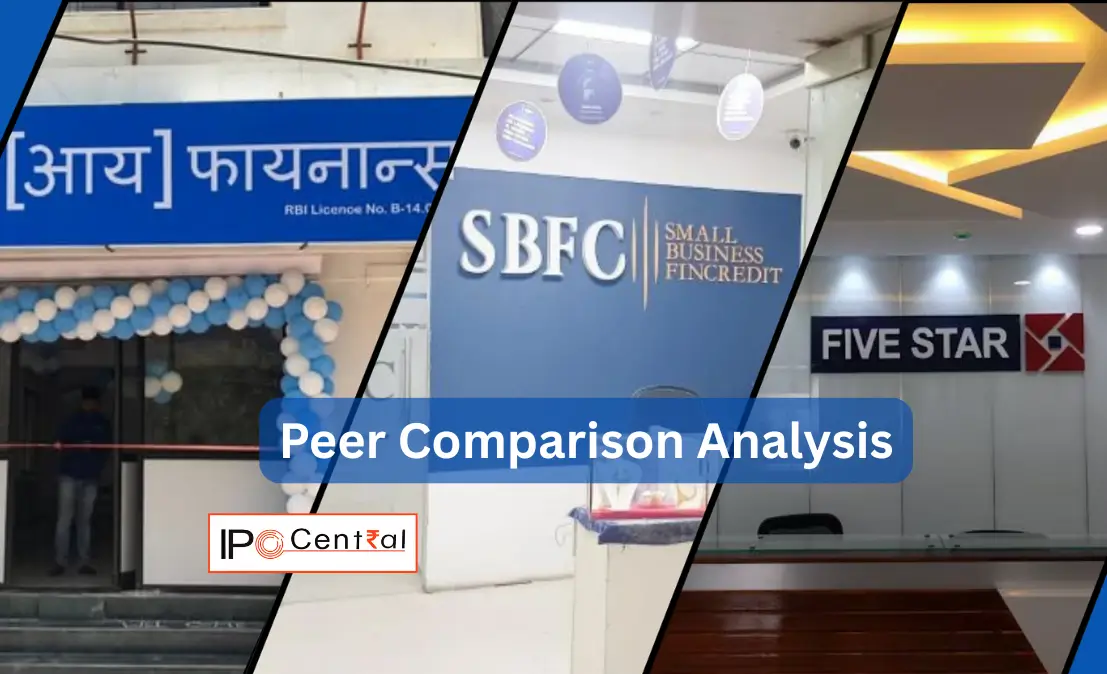
Aye Finance is positioning itself as a “phygital” MSME lender—using a wide branch network alongside analytics-led underwriting to serve micro and small enterprises that often sit outside formal credit rails. For investors, the most useful way to evaluate such a business ahead of an IPO is to compare its scale, growth, profitability, efficiency, leverage, and asset quality against close listed peers.
Aye Finance peer comparison analysis is designed to provide readers a clear, side-by-side view of how the company stacks up on the metrics that matter—helping investors make a more informed decision on the IPO with context from listed NBFC peers.
Table of Contents
Aye Finance Peer Comparison Analysis: Scale, Portfolio, and Productivity
KPI (FY25)
Aye Finance
SBFC Finance
Five-Star Business
Branches (Nos.)
526
205
748
States/UTs (Nos.)
21
18
11
AUM (INR Cr)
5,533.90
8,747.40
11,877.00
AUM Growth YoY (%)
23.99
28.23
23.20
AUM per Branch
10.52
42.67
15.88
Total Disbursements
4,291.34
2,670.70*
4,969.70
Disbursement Growth YoY (%)
8.95
(4.38)
1.81
Avg disbursal per branch
8.16
13.03
6.64
Figures in INR Crore until specified
Aye’s footprint is already “national-scale”: it operates across 21 States/UTs with 526 branches—a reach that is closer to a mature retail NBFC network than a niche lender.
AUM is lower than peers, but the distribution is different: despite having more branches than SBFC, Aye’s AUM per branch (INR 10.52 cr) is well below SBFC’s INR 42.67 cr. That typically signals smaller ticket sizes, younger branch vintages, and/or more granular sourcing—which can be strategically good, but demands strong operational execution.
Disbursements: Aye is competitive on origination volume: Aye’s FY25 disbursement base is solid and broadly comparable to Five-Star in absolute terms, while its YoY disbursement growth was positive (vs. SBFC’s negative growth in FY25).
Aye Finance vs SBFC vs Five-Star Business Finance: Profitability and Core Earnings
KPI (FY25)
Aye Finance
SBFC Finance
Five-Star Business
Total Interest Income
1,325.96
1,196.35
2,766.28
Total Income
1,504.99
1,306.11
2,866.02
Finance Cost
468.00
419.24
667.98
Net Interest Income
857.96
777.10
2,098.30
Operating Expense
519.53
354.63
678.48
Profit After Tax
175.25
345.17
1,072.49
Figures in INR Crore until specified
Aye’s earnings engine is clearly “high-yield”, but it sits in a cost-intensive operating model. Its interest income and NII are meaningful for its AUM size, reflecting a yield-rich segment.
Aye’s PAT is lower than SBFC and Five-Star, but context matters: Aye’s model (more branches, smaller tickets) often requires up-front operating investment.
Returns, Spreads, and Efficiency
Ratio (FY25)
Aye Finance
SBFC Finance
Five-Star Business
ROE (%)
12.12
11.57
18.65
RoTA (%)
3.13
4.41
8.22
NIM (%)
15.31
9.93
16.07
Yield on Net Advances (%)
29.10
17.50
25.20
Cost of Borrowings (%)
11.57
9.05
9.38
Operating Exp/Avg Total Assets (%)
9.27
4.53
5.20
Credit Cost/Avg Total Assets (%)
5.15
0.94
0.68
Cost-to-Income (%)
50.10
39.99
30.87
Aye’s standout is pricing power: NIM at 15.31% and yield on net advances at 29.10% are in the top tier of this peer set.
Five-Star is the “efficiency compounder”: strong NIM plus low cost ratios translate into superior RoTA and ROE.
Aye delivers a respectable ROE (12.12%), slightly above SBFC in FY25—despite the heavier cost structure. That suggests the high-yield model is doing real work.
Asset Quality and Risk Buffers
Asset Quality (FY25)
Aye Finance
SBFC Finance
Five-Star Business Finance
Gross NPA (%)
4.21%
2.74%
1.79%
Net NPA (%)
1.40%
1.51%
0.88%
PCR (%)
67.56%
45.69%
51.31%
Aye’s GNPA is higher than both peers, which is not unusual for deeper-informal MSME credit.
The balancing positive is provisioning discipline: Aye’s PCR at 67.56% is materially stronger than SBFC and Five-Star in FY25. That’s why despite higher GNPA, Aye’s NNPA (1.40%) is comparable to SBFC (1.51%) and not drastically far from the peer range.
In plain terms: Aye is taking more risk, but it is also carrying more buffer.
This section gives readers the “wide picture” they’ve always wanted—Aye Finance valuation analysis:
Metric
Aye Finance
SBFC Finance
Five-Star
P/E
24.62
23.9
11.8
P/B
1.46
2.97
1.95
P/S
2.18
6.39
4.14
Debt/Equity (X)
2.73
1.80
1.23
RONW (%)
12.12
11.6
18.6
Aye’s post-issue P/E (24.62) sits broadly around SBFC’s market snapshot P/E, and far above Five-Star’s P/E—reflecting how the market often discounts more mature, high-profit franchises with visible quality growth narratives.
Aye’s P/B (1.46) is lower than both peers in this snapshot set. In a capital-intensive lending business, that can become a key talking point: the market is not pricing Aye at a premium-to-book despite strong yields.
Aye’s P/S (2.18) is also lower, which may appeal to value-oriented investors if the company can demonstrate improving operating leverage and stable asset quality.
Bottom Line: Where Aye Looks Strong
Aye Finance vs Peers: Positives
High yield + strong NIM (Yield 29.10%, NIM 15.31%)—a clear competitive differentiator.
Wide geographic footprint (21 States/UTs) and a sizable branch network.
Higher GNPA and high credit cost: GNPA 4.21% and credit cost 5.15% are the biggest gaps vs peers.
Efficiency gap: cost-to-income 50.10% and opex/ATA 9.27% leave room for operating leverage, but also reflect the reality of granular MSME lending.
Higher leverage (D/E 2.73x) increases the need for consistently tight risk controls.
Aye Finance stands out for pricing power and deep MSME reach. As scale improves, AUM per branch and efficiency can rise, while strong provisioning discipline helps manage risk—supporting a credible, long-term public-market growth story.