



































Last Updated on February 23, 2026 by Rajat Bhati
PNGS Reva Diamond Jewellery is entering the public markets as a focused retail player in the diamond-studded jewellery segment. Unlike traditional jewellers that derive the majority of their revenue from gold, PNGS Reva operates as a design-led, diamond-centric retail brand with 99% of its income coming from the sale of ornaments. The IPO is a INR 380 crore fresh issue, primarily aimed at funding 15 new brand-exclusive stores and marketing expansion.
This PNGS Reva IPO review focuses on one core theme: How sustainable is PNGS Reva’s business model?

PNGS Reva IPO Review: Industry Context
The Indian Gems & Jewellery (G&J) industry remains one of the pillars of the domestic economy, contributing roughly 7% to GDP and about 15% to merchandise exports. In CY24, the domestic market was valued at INR 8,80,900 crore and is expected to grow at a CAGR of 11.7% between CY24 and CY29.
However, material composition within the industry reveals structural realities:
| Material Type | Market Share (CY24) |
|---|---|
| Gold | 82% |
| Diamond | 10% |
| Silver | 4% |
| Others | 4% |
Gold continues to dominate due to cultural and investment demand. Diamonds, however, represent the premiumisation layer — increasingly preferred for weddings, gifting, and branded purchases, particularly in urban and Tier I markets.
PNGS Reva’s geographic footprint is concentrated in Maharashtra, Gujarat, and Karnataka — regions falling within the West & Central corridor, which accounts for 25% of India’s gold jewellery demand. Importantly, Maharashtra contributes approximately 97% of PNGS Reva’s revenue, highlighting both focus and concentration risk.
PNGS Reva IPO Analysis: Business Model Architecture
PNGS Reva Diamond Jewellery operates as a retail-focused jewellery brand specialising in diamond-studded ornaments crafted in hallmarked gold and platinum. The company does not manufacture in-house; instead, it procures finished products from domestic third-party manufacturers and karigars. Its revenue is almost entirely derived from the sale of ornaments, which accounted for over 99% of total income across FY23–FY25 and H1 FY26.
As of 30 September 2025, PNGS Reva operated 34 stores across 25 cities, aggregating 647.15 running feet of retail space. The store mix reflects a predominantly Shop-in-Shop (SIS) structure.
| Store Model | Count | Structure |
|---|---|---|
| FOCO (Franchisee Owned, Company Operated) | 32 | Infra by promoter, operations by company |
| FOFO (Franchisee Owned, Franchisee Operated) | 1 | Billing via promoter |
| COCO (Company Owned, Company Operated) | 1 | Fully company-operated |
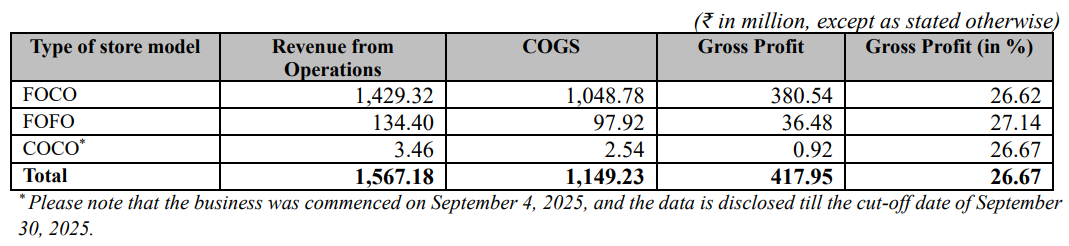
As of 30 September 2025, the break-up of revenue, cost of goods sold, and gross
profit between the company’s FOCO, FOFO, and COCO stores is set out as below:
However, the model is not entirely asset-light. Jewellery retail inherently demands significant inventory holding. Therefore, while fixed asset intensity remains low, working capital requirements are structurally high.
PNGS Reva Revenue Streams: Category Concentration and Domestic Focus
Revenue from operations rose to INR 258.18 crore in FY25 from INR 195.63 crore in FY24. For the six months ended 30 September 2025, revenue stood at INR 156.72 crore.
The category mix for FY25 provides clarity on revenue concentration:
| Product Category | Revenue (INR Cr) | % of Revenue from Operations |
|---|---|---|
| Rings | 61.62 | 23.86 |
| Mangalsutra | 58.30 | 22.58 |
| Others | 38.06 | 14.74 |
| Earring | 35.71 | 13.83 |
| Precious Stones | 16.21 | 6.28 |
| Necklace | 14.16 | 5.48 |
| Bracelet | 10.45 | 4.05 |
| Bangles | 9.48 | 3.67 |
| Nose Pins | 8.23 | 3.19 |
| Pendent | 3.82 | 1.48 |
| Chain | 2.16 | 0.84 |
| Total Revenue | 258.18 | 100.00% |
The top two categories together account for approximately 42% of total revenue, indicating moderate concentration risk.
Key structural characteristics:
- Over 99% revenue from ornaments.
- No in-house manufacturing.
- No international sourcing.
- No standalone e-commerce revenue during reported periods.
The business is therefore a pure-play domestic retail brand with sourcing entirely through third-party manufacturers and karigars.
Financial Performance
| Particulars | FY23 | FY24 | FY25 | H1 FY26 |
|---|---|---|---|---|
| Revenue from Operations | 198.85 | 195.63 | 258.18 | 156.72 |
| Adjusted EBITDA | 68.73 | 56.14 | 79.61 | 30.79 |
| Adjusted EBITDA Margin | 34.56 | 28.70 | 30.83 | 19.65 |
| Net Profit | 51.75 | 42.41 | 59.47 | 20.13 |
| Net Profit Margin | 26.02 | 21.68 | 23.04 | 12.85 |
Revenue accelerated sharply in FY25. However, H1 FY26 reflects visible margin compression, with EBITDA margin declining to 19.65%.
PNGS Reva IPO Review: Store Productivity & Operational Efficiency
| Metric | FY25 | H1 FY26 |
|---|---|---|
| Revenue per Running Feet (INR lakh) | 43.1 | 24.2 |
| Average Order Value (INR lakh) | 0.85 | 1.20 |
| Number of Bills | 30,378 | — |
Average bill value has increased, indicating stronger ticket size. However, revenue per running feet moderated in H1 FY26, suggesting either seasonality or expansion-related adjustments.

Conclusion
PNGS Reva’s business model is structured but not without clear limitations. It benefits from legacy sourcing, brand recall in Maharashtra, and a focused diamond positioning in a largely gold-driven market. However, the model remains inventory-heavy, regionally concentrated, and dependent on third-party manufacturing. Margin compression in H1 FY26 also signals operating sensitivity during expansion. Sustainability will depend on disciplined store rollout, inventory management, and geographic diversification. Without improving scale efficiency and reducing regional dependence, long-term margin stability could face pressure despite strong category positioning.