





























The Indian IPO market continues to see strong activity in 2025, and one of the most talked‑about issues this month is All Time Plastics. Known for its export‑driven plastic consumerware manufacturing, the company is now tapping the public markets to raise funds for debt reduction, capacity expansion, and growth initiatives.
With Sunil Singhania’s Abakkus Asset Manager LLP holding a 7.29% pre‑IPO stake, investor curiosity is high. But the question remains — how strong is the company’s business foundation, and what opportunities or risks lie ahead? All Time Plastics IPO SWOT analysis will clear all your doubts.
All Time Plastics IPO Snapshot
- IPO Size: INR 394–400 crore
- Price Band: INR 260–275 per share
- Issue Dates: 7–11 August 2025
- Lot Size: 54 shares
- Listing: NSE, BSE
- Fresh Issue: INR 280 crore
- Offer for Sale: 43,85,562 shares (INR 120.6 crore)
- Promoters: Kailesh Punamchand Shah, Bhupesh Punamchand Shah, Nilesh Punamchand Shah
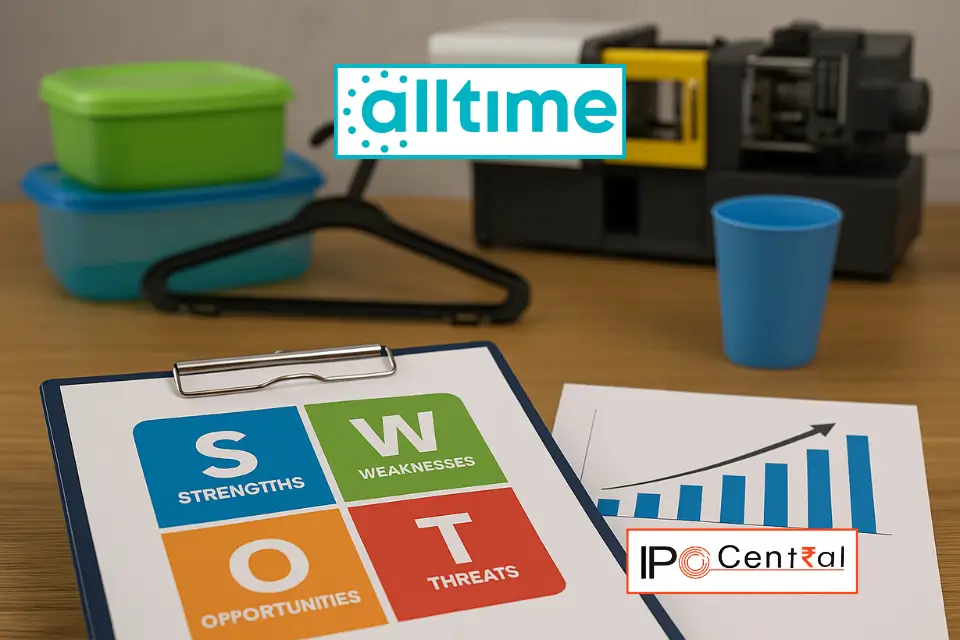
All Time Plastics SWOT Analysis
Below is the detailed SWOT analysis of All Time Plastics IPO
All Time Plastics IPO SWOT Analysis: Strengths
#1 Deep, Long‑Term Global Retailer Relationships
One of the company’s most valuable assets is the depth and longevity of its customer relationships in the global retail landscape.
- IKEA has been a customer for 27 years.
- Tesco for 17 years.
- Asda for 14 years.
- Michaels for 4 years.
These are not just transactional links — they are embedded partnerships involving co‑development of SKUs, product quality consistency, and logistical alignment. Once a retailer integrates All Time Plastics into its supply chain, switching costs — in terms of mould compatibility, product testing, and supplier onboarding — are high.
In FY25, IKEA alone contributed 59.29% of revenue. Combined, the top 4 customers accounted for 78.42% of total sales. While this concentration is a risk (discussed under Weaknesses), it also underlines the trust and stickiness the company commands.
#2 Large‑Scale, Strategically Located Manufacturing Base
The company operates three manufacturing facilities in Daman, Silvassa, and Manekpur (Gujarat), placed near ports and petrochemical hubs.
- Installed capacity: 33,000 tonnes per annum.
- Capacity utilisation: FY25 – 79.48%; FY24 – 84.59%.
- Technology edge: Over 70% of its injection moulding machines are all‑electric imports from Japan, enabling faster cycle times, high‑precision manufacturing, and lower energy consumption.
This manufacturing capability gives All Time Plastics a competitive cost advantage in high‑volume production and allows it to meet large‑scale export orders without capacity bottlenecks.
#3 Export‑Led Stability with Global Market Reach
All Time Plastics is a net exporter, with 85.23% of FY25 revenue coming from overseas markets.
- Serves 29 countries, including high‑income, stable retail markets like the European Union, UK, and US.
- Export orientation means foreign currency inflows and a hedge against sluggish domestic demand cycles.
- Relationships with large international retailers provide visibility into global product trends before they penetrate the Indian market.
#4 Diversified Product Portfolio and Innovation Capability
The company offers 1,848 stock‑keeping units (SKUs) across 8 major product categories:
- Kitchen Tools (Prep Time) – 35.77% of FY25 revenue.
- Food Storage Containers – 34.91%.
- Organisation Products – 9.00%.
- Hangers – 6.92%.
- Meal Time Products – 5.41%.
- Cleaning Products – 3.10%.
- Bath Products – 2.39%.
- Junior Range – 1.74%.
In FY25 alone, 598 new SKUs were launched — a testament to the company’s product innovation speed and responsiveness to customer requirements.
All Time Plastics IPO SWOT Analysis: Weaknesses
#1 Heavy Customer Concentration
While deep, long‑term relationships with global retailers are a strength, they also pose a dependency risk.
- In FY25, the top customer (IKEA) accounted for 59.29% of total revenue.
- The top 4 customers together contributed 78.42% of revenue.
This level of reliance means that any loss, reduction, or delay in orders from a key customer could materially impact financial performance. Large retailers also have negotiating leverage over pricing, payment terms, and order volumes.
#2 Limited Branded (B2C) Revenue Share
All Time Plastics earns just 7.56% of FY25 revenue from its own branded products (All Time Branded Products).
- The domestic brand has low consumer recall compared to market leaders like Cello, Milton, Princeware.
- The bulk of domestic sales happen through B2B and general trade, not via strong brand‑led retail distribution.
This limits the company’s ability to enjoy premium pricing and makes it more dependent on OEM/white‑label margins, which are thinner.
#3 Export Dependency
With 85.23% of FY25 revenue coming from exports, the company’s fortunes are closely tied to foreign market demand and currency fluctuations.
- Slowdowns in key markets such as the EU or the US could lead to reduced order volumes.
- Appreciation of the Indian rupee could erode export competitiveness and margins.
While export dominance is a strength in stable periods, it creates vulnerability in times of global economic uncertainty.
#4 Lower Profit Margins vs Premium Peers
Although margins are healthy in an absolute sense, they lag behind consumer brand‑driven peers:
- FY25 PAT Margin: 8.46% vs Shaily Engg. Plastics (11.8%) and Cello World (17.1%).
- OEM‑heavy revenue mix limits pricing power and makes the company more sensitive to input cost fluctuations.
#5 Raw Material Cost Sensitivity
The company’s primary raw material is polypropylene and other petrochemical derivatives.
- Price movements are closely linked to crude oil prices and global supply dynamics.
- Inability to pass on cost increases quickly can compress margins.
Although this is a challenge for the entire industry, companies with higher brand equity or differentiated products often pass on costs more effectively than a white‑label manufacturer.
All Time Plastics IPO SWOT Analysis: Opportunities
#1 Capacity Expansion to Unlock Scale Economies
All Time Plastics is in the midst of a major capacity build‑out at its Manekpur facility.
- Current capacity: 4,000 TPA (as of Dec 2024).
- Planned expansion:
- FY26: Increase to 16,500 TPA.
- FY27: Increase to 22,500 TPA.
- Investment: INR 113.71 crore from IPO proceeds.
Strategic Benefits:
- Ability to handle higher volumes from existing clients like IKEA and Asda.
- Scope to take on new global retail customers without overloading current capacity.
- Lower unit manufacturing costs due to higher economies of scale.
#2 Branded (B2C) Retail Expansion in India
While currently only 7.56% of revenue, the domestic branded segment represents a high‑margin opportunity.
- Distribution network already covers 22 modern trade retailers, 5 super distributors, and 38 direct distributors across 23 states & 6 UTs.
- Expanding brand visibility through e‑commerce and organised retail could:
- Increase domestic market share.
- Improve pricing power.
- Reduce dependence on OEM contracts.
Given India’s rising middle‑class consumption and kitchenware modernisation trend, brand‑led growth could be a significant value driver.
#3 Rising Global and Domestic Demand for Consumerware
- Global Trend: Increasing focus on home organisation, food storage, and premium kitchenware post‑pandemic.
- Domestic Market:
- Organised retail penetration is growing.
- Urban households are shifting towards branded, durable plastic consumerware.
According to industry estimates (Technopak report), India’s plastic consumerware market is expected to grow at a high single‑digit CAGR in the medium term, creating demand both for OEM and branded products.
#4 Product Innovation and Diversification Potential
With 1,848 SKUs and a proven track record of 598 new SKUs launched in FY25, the company can:
- Quickly adapt to changing consumer tastes.
- Enter adjacent product categories (e.g., eco‑friendly utensils, premium glass‑plastic hybrids).
- Use the domestic B2C segment as a testing ground for innovations before rolling them out to export clients.
All Time Plastics IPO SWOT Analysis: Threats
#1 Forex Volatility and Global Demand Risk
With 85.23% of FY25 revenue coming from exports, All Time Plastics is heavily exposed to currency fluctuations and overseas retail cycles.
- Currency Risk: A sharp appreciation of the Indian rupee against the US dollar, euro, or pound could erode export margins.
- Demand Risk: Slowdowns or recessions in key markets such as the European Union, United Kingdom, and United States could lead to reduced orders from large retail customers.
- Given the concentration of revenue in a handful of major clients, even a modest pullback in purchase orders could have a disproportionate impact on earnings.
#2 Raw Material Price Volatility
The company’s key input, polypropylene and other petrochemical derivatives, is directly linked to crude oil prices.
- Volatility in crude markets can cause sudden swings in input costs.
- In a B2B OEM model, passing on cost increases to customers is not always immediate or fully possible.
- Persistent raw material inflation could compress the current PAT margin of 8.46% if not carefully managed.
#3 Regulatory Pressures on Plastic Usage
The global movement against single‑use plastics is accelerating:
- Several countries have implemented bans or heavy restrictions on certain plastic products.
- While All Time Plastics primarily produces durable consumerware, regulatory interpretations or stricter recycling mandates could increase compliance costs.
- Adapting products to meet differing environmental standards across multiple countries could require ongoing R&D investment.
#4 Intense Competitive Landscape
The plastic consumerware market is highly competitive, both domestically and internationally.
- Domestic B2C Rivals: Cello, Milton, Princeware dominate retail brand visibility and enjoy stronger consumer pull.
- Specialised B2B Manufacturers: Export‑oriented peers like Shaily Engineering Plastics compete for large retail contracts.
- Competition can lead to price undercutting in order to secure or retain high‑volume orders, putting pressure on margins.

Final Words
We hope that this All Time Plastics IPO SWOT analysis clears all your doubts regarding the company’s export‑driven model, long‑term global partnerships, capacity expansion, and sustainability. While customer concentration and export reliance remain watchpoints, its expansion plans and brand potential make it a promising medium‑to‑long‑term investment story.
For more details related to IPO GMP, SEBI IPO Approval, and Live Subscription stay tuned to IPO Central.