

































FlySBS Aviation is set to make its debut on the public markets with an INR 45.57 lakh equity share offering under the NSE Emerge platform. The company is aiming to raise fresh capital to fund aircraft purchases and working capital needs, amid strong tailwinds in India’s premium aviation sector. The IPO, slated to open from 1 to 5 August 2025.
While FlySBS Aviation may not be a household name like commercial airlines, it occupies a focused niche in India’s aviation ecosystem: high-end, non-scheduled air charter services. Its ability to scale revenue nearly 6x from FY23 to FY25 and maintain healthy profit margins sets it apart from many SME IPO candidates. But does this growth story have wings in the long term — or is it simply a well-marketed hop? Lets explore in FlySBS Aviation IPO analysis:
1. FlySBS IPO Snapshot: Key Details at a Glance
| Parameter | Details |
|---|---|
| IPO Opening Date | 1 August 2025 |
| IPO Closing Date | 5 August 2025 |
| Issue Type | 100% Fresh Issue |
| Equity Shares Offered | 45,57,000 shares |
| Face Value | INR 10 per share |
| Price Band | INR 210 – 225 per share |
| Issue Size | 45,57,000 shares (INR 95.70 – 102.53 crore) |
| Lot Size | 600 shares (INR 1,35,000) |
| Listing Platform | NSE Emerge |
| Anchor Book Opens | 31 July 2025 |
| Lead Manager | Vivro Financial Services |
| Registrar | MUFG Intime India |
| Market Maker | Nikunj Stock Brokers |
Investor buzz is reinforced by potential anchor investor participation worth INR 4–6 crore, primarily from SME-focused AIFs and HNIs, suggesting institutional confidence in the story.
2. Company Overview
FlySBS Aviation is a DGCA-licensed, non-scheduled air operator offering bespoke air charter services primarily to high-net-worth individuals (HNIs), corporate executives, celebrities, and diplomatic delegations. Unlike scheduled airlines, FlySBS operates on an on-demand basis, providing flexibility, privacy, and point-to-point luxury travel — often to destinations not served by commercial routes.
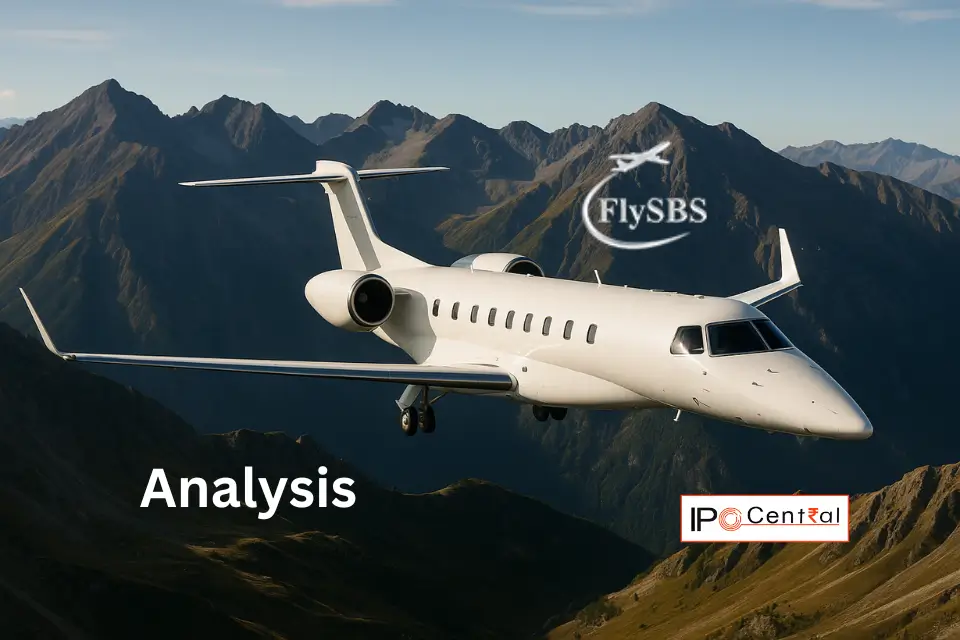
As of 31 March 2025, the company operated a 13-seater Embraer Legacy 600 aircraft under a dry lease model and had a lean team of 22 permanent employees, supported by two aviation professionals on a retainership basis. Maintenance is outsourced to Air Works India Engineering, one of the most established third-party MRO (Maintenance, Repair & Overhaul) providers in India.
Beyond India, FlySBS Aviation has already expanded operations across six continents, with documented charter missions to Japan, New Zealand, Europe, and Africa — a significant feat for a company planning to list on the SME board. This global reach strengthens its positioning as a premium, full-service charter solutions provider.
3. FlySBS Business Model Analysis: Asset-Light, Demand-Driven, and Margin-Focused
FlySBS Aviation operates on a non-scheduled charter service model, targeting elite clientele who demand privacy, flexibility, and time efficiency. The company’s business model is designed around three strategic pillars: on-demand customisation, asset-light operations, and high-yield international charters.
🔍 FlySBS Revenue Streams
- Private Jet Charters (Core Revenue)
- 94%+ of FlySBS’s revenue is generated from B2B and corporate charter contracts
- Primary customer segments include CXOs, diplomats, celebrities, and HNIs
- Revenue is booked per flight-hour with additional value-adds for customisation, crew, and route flexibility
- Medical Evacuation (Medevac) Services
- Emergency airlift and evacuation services, often booked by hospitals or governments
- High-margin, mission-critical niche
- International Missions
- Long-range flights to destinations in Europe, Japan, New Zealand, and Africa
- Higher pricing power, low competition from domestic peers
- Contributed over 70% of flying hours in FY25
- Ad-hoc High-Security Movements
- Missions involving government delegations or critical logistics often earn premium charges
✈️ Operating Model: Dry Lease Efficiency
- Aircraft Ownership: None (as of FY25)
- FlySBS Aviation operates on a dry lease model, currently flying a 13-seater Embraer Legacy 600
- This reduces capex intensity and depreciation burden
- Fleet Strategy:
- Operates a single-aircraft fleet but aims to expand post-IPO using INR 25 crore toward aircraft acquisition
- Outsourced maintenance via Air Works India, ensuring flight-worthiness without in-house technical overhead
- Scalability:
- Business is scalable without a proportional increase in fixed costs
- Crew, ground handling, and routes can be adapted per mission — a variable cost model
⚙️ Cost Structure & Margins
- Major Costs:
- Aviation Turbine Fuel (ATF)
- Airport handling charges (especially international)
- Crew salaries, navigation, and lease rentals
- Margin Drivers:
- High pricing flexibility due to premium clientele
- Better yields on international charters vs domestic missions
- Efficient asset utilisation: Load factor at 62%, on-time performance at 94%
💡 Unique Positioning in Indian Aviation
| Feature | Scheduled Airlines | FlySBS Model |
|---|---|---|
| Flight Schedule | Fixed routes | Fully customizable per client |
| Revenue Model | Ticket sales | Time/hour-based charter pricing |
| Regulatory Load | High (slots, pricing) | Moderate (DGCA NSOP compliance) |
| Asset Ownership | High (aircraft owned) | Low (dry lease) |
| Customer Base | Mass market | HNIs, corporates, government |
| Yield per Seat | Low to moderate | High |
🔁 Repeat Business & Moats
- ~40% repeat customer ratio suggests growing brand trust among corporate fliers
- Entry barrier: Few operators in India with international reach, approvals, and charter flexibility
- Strong word-of-mouth and white-glove reputation are intangible but defensible assets
FlySBS’s business model is revenue-dense but capex-light, giving it a structural advantage in managing profit margins. While limited scale poses risk, its flexibility, low fixed costs, and high-value clientele allow it to remain resilient even during aviation sector turbulence.
4. Operational Growth: Skyward Trajectory
Few SME IPO candidates demonstrate the kind of operating scale-up that FlySBS Aviation has managed in just three years:
✈️ Key Operating Metrics
| Metric | FY23 | FY24 | FY25 |
|---|---|---|---|
| Total Flying Hours | 522 hours | 1,486 hours | 2,600 hours |
| International Flying Hours | 375 hours | 1,166 hours | 1,812 hours |
Over 70% of flying time in FY25 was attributed to international charters, indicating FlySBS’s appeal among global business and diplomatic clients. The strong repeat business ratio (~40%) reflects customer satisfaction, essential in the charter aviation segment, where referrals and loyalty often dictate revenue.
In addition to high-profile business trips, FlySBS has diversified its offerings into:
- Multi-destination missions
- Medical evacuation (medevac) services
- Inaccessible destination coverage
- High-security, priority charters
This service diversification provides resilience in case of macroeconomic headwinds in any one customer segment.
5. Industry Tailwinds: Winds Beneath Their Wings
The Indian private aviation space, while still small compared to global markets, is entering a phase of structural expansion.
📈 Market Insights (Source: CareEdge Ratings):
- Indian private jet market expanded from USD 187 million (~INR 1,615 crore) in FY2019 to USD 274 million (~INR 2,370 crore) in FY2024, implying a CAGR of ~8%
- The market is projected to grow at a 13–15% CAGR over the next five years, fueled by:
- Doubling of India’s HNI population (projected to reach 10 lakh by 2026)
- Post-COVID shift toward sanitised, exclusive travel
- Underserved regional airports enabling point-to-point connectivity
- Time-critical business travel demands across sectors
FlySBS’s fleet flexibility and mission customisation align well with these macro themes. Charter flight demand in India surged over 30% YoY in FY24, and FlySBS appears to be riding this wave with a targeted, asset-light approach.
Unlike full-service commercial carriers burdened with price wars and high fixed costs, non-scheduled operators enjoy pricing power and asset agility — both crucial during economic uncertainty or regulatory shifts.
6. Financial Performance: Profit Takes Flight
FlySBS Aviation has delivered a rare trifecta for an SME IPO: strong revenue growth, high margins, and consistent profitability.
📊 Revenue & Profit Growth
| Fiscal Year | Revenue | Expenses | Net Profit | Net Margin (%) |
|---|---|---|---|---|
| FY2023 | 34.11 | 30.57 | 3.44 | 10.08% |
| FY2024 | 106.49 | 92.81 | 11.25 | 10.57% |
| FY2025 | 193.90 | 156.39 | 28.41 | 14.65% |
- Revenue CAGR (FY23–FY25): ~130%
- Net Profit CAGR (FY23–FY25): ~187%
- FY25 net margin improved to 14.65%, showing operating leverage and better cost absorption.
📈 Return Ratios, Margins & Leverage
| Metric | FY2023 | FY2024 | FY2025 |
|---|---|---|---|
| EPS (INR) | 5.64 | 14.41 | 25.47 |
| RONW (%) | 45.02 | 38.35 | 32.25 |
| ROCE (%) | 45.00 | 45.58 | 41.80 |
| EBITDA Margin | 15.07% | 14.04% | 21.20% |
| NAV (INR) | 17.57 | 49.14 | 101.08 |
| Debt/Equity | 0.30 | 0.05 | 0.14 |
The company maintains a lean balance sheet, with debt levels consistently low, critical in aviation, a capital-intensive sector. FY25 EBITDA margins expanded significantly to 21.20%, signalling improved asset utilisation and international charter yield.

Verdict
The FlySBS Aviation IPO presents a rare mix of niche business exposure and financial strength— a trifecta that is unusual even among well-followed SME listings.
What Stands Out
- Business Niche with Entry Barriers: Operating as a DGCA-licensed non-scheduled charter operator, FlySBS is not directly exposed to the fare wars and regulatory volatility faced by commercial airlines. It targets a premium clientele — HNIs, corporates, diplomats — and fills a unique void in India’s rapidly formalising luxury travel segment.
- Robust Financials: With FY25 revenue at INR 193.90 crore and net profit at INR 28.41 crore, FlySBS is delivering both scale and profit — and doing so with an EBITDA margin of 21.2% and ROE of over 32%.
- High Operating Efficiency: FY25 flying hours more than quintupled from FY23 levels. The international share of operations has crossed 70%, highlighting global traction.
- Debt-light & Asset-smart Model: The company runs a dry lease model, minimising capital risk, and maintains a modest debt/equity ratio of 0.14.
⚠️ Where the Risks Lie
- Limited Fleet Scale: With just one aircraft (Embraer Legacy 600) under operation, any downtime could disrupt revenue flow. Scaling will require capital and execution discipline.
- Client Concentration: With over 94% of revenue from corporate clients, any slowdown in B2B demand could impact the top line.
- Aviation Sector Risks: Despite its non-scheduled model, FlySBS is still exposed to aviation-specific cost pressures like ATF price spikes, maintenance cycles, and regulatory licensing risk.
- Limited Operating History: Established in 2020, FlySBS has just a three-year financial history. While the trajectory is impressive, it lacks long-cycle data for risk modelling.
- SME Listing Platform Consideration: Stocks listed on NSE Emerge may experience lower liquidity and higher volatility, and may not be suited to conservative or long-only retail portfolios.
For more details related to IPO GMP, SEBI IPO Approval, and Live Subscription stay tuned to IPO Central.