































In a country that has historically defined itself by its booming population, a quiet demographic reversal is underway. India’s Total Fertility Rate (TFR) has slipped to 2.0—dipping below the replacement level of 2.1 for the first time in history. What sounds like a social alarm for some is, for the strategic investor, the dawn of a high-stakes, high-margin industry.
Gaudium IVF & Women Health to hit the bourses on 20 February 2026, the company is not only selling medical services; It is providing a specialized engine designed to turn “biological challenges” into “predictable unit economics.” But as the company seeks to raise capital through its 2.08 crore share issue, a critical question remains for serious investors: Is Gaudium’s 40% EBITDA margin a sustainable fortress, or will the “single-node” dependency on its Delhi hub and a staggering 63% staff attrition rate pull the brakes on its pan-India ambitions?
Gaudium IVF IPO review peel back the clinical layers to analyze the data, the DNA, and the real risks behind the public offer.
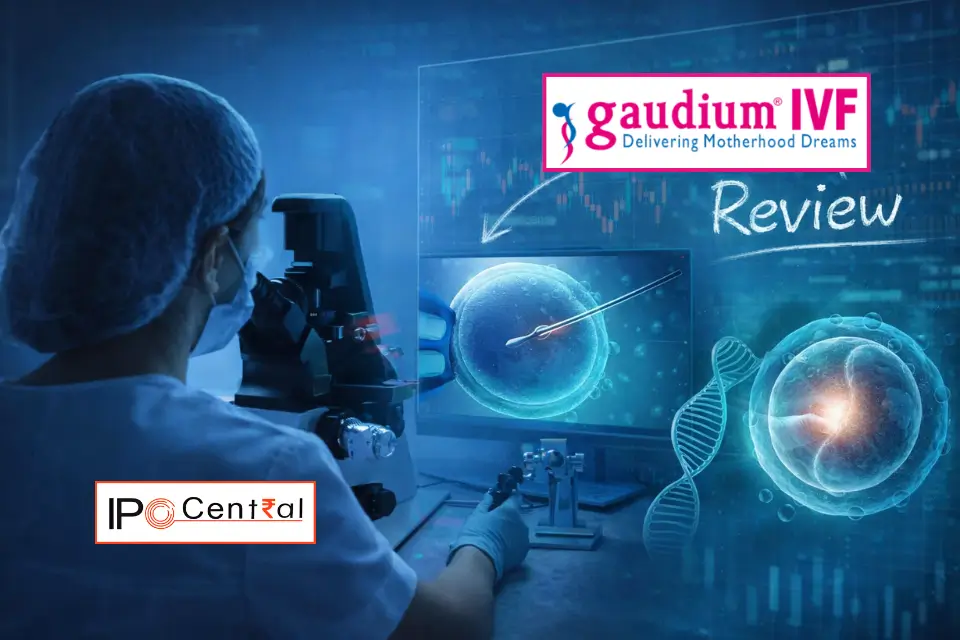
Table of Contents
Gaudium IVF IPO Review: An INR 41,000 Cr Market Opportunity
To understand Gaudium’s potential, one must first look at the demographic shift in India. The Total Fertility Rate (TFR) in India has seen a precipitous drop, falling from 3.1 in 2003 to 2.0 in 2023, according to World Bank and Infomerics data. With the replacement level at 2.1, India is now in a state of structural fertility decline, primarily driven by urbanization, delayed marriages, and lifestyle shifts.
The Market Gap
The Indian IVF market is projected to grow at a robust CAGR of 13.13%, expanding from USD 1.32 billion in 2024 to USD 4.54 billion (~INR 41,000 Cr) by 2034. This growth trajectory places India as one of the fastest-growing IVF markets globally, with its global share expected to nearly double from 4.8% to 8.3% in the next decade.
Global Cost Arbitrage
Gaudium is planning to tap into medical tourism. The cost of an IVF cycle in India ranges between USD 3,000 to 4,000 (~INR 3.60 lakh), compared to USD 15,000 to 20,000 (~INR 18 lakh) in the United States. This 80% cost advantage has already translated into a global footprint for Gaudium, attracting patients from 30+ countries, including the UK, USA, Canada, and various African nations. In the first half of FY2026 (Sept 2025), the company serviced 76 international patients, signaling a growing reliance on the global “reproductive tourism” trend.
Guadium IVF Business Model Analysis
Gaudium operates on a scalable Hub-and-Spoke model, a strategy designed to balance high-end clinical excellence with localized patient access.
- Hubs (7 Locations): Located in Tier-1 cities like Delhi (Janakpuri, Kailash Colony), Mumbai, Bengaluru, and Patna. These are Level-2 ART Clinics equipped with advanced laboratories, surgical suites, and specialized equipment like the INTEGRA Ti™ for ICSI procedures.
- Spokes (28 Locations): These are strategic alliances with infertility experts that act as consultation and preliminary care centers. They handle the “Leads” and routine follow-ups, referring complex procedures (OPU/ET) back to the hubs.
This model allows Gaudium to remain Asset-Light. By centralizing advanced laboratory infrastructure (which requires heavy Capex) in hubs and utilizing spokes for wider reach, the company optimizes its Return on Capital Employed (RoCE). Instead of building massive hospitals everywhere, they build specialized “nodes” that feed into high-tech centers.
Gaudium IVF Operational Efficiency: Success Rates and Cycles
In the IVF business, the ultimate KPI is the Success Rate. Gaudium has maintained a remarkably consistent success rate of 58.74% (as of 30 Sept 2025), up from 57.01% in FY2023. In an industry where 40-45% is often the benchmark for older players, a near-60% success rate provides a significant marketing edge.
Gaudium employs a unique financial reporting method where they treat Ovum Pick-Up (OPU) and Embryo Transfer (ET) as two distinct cycles.
- FY 2025 Performance: 3,476 total cycles performed.
- OPDs: Growing from 4,218 in FY23 to 8,145 in FY25, reflecting a 93% jump in patient inquiries and brand awareness.
- ARPP (Average Revenue Per Patient): Stood at INR 3.55 Lakhs in FY25, indicating high-ticket realizations per successful patient journey.
Gaudium IVF IPO Review: Technological Moat
Investors should pay close attention to GAAT (Gaudium Advanced Analysis and Treatment). This is a proprietary, genome-based treatment module developed by Dr. Manika Khanna.
- R&D Focus: GAAT uses genome sequencing to improve outcomes for “high-risk” patients (those with recurrent implantation failure or maternal age above 42).
- Intangible Assets: As of 31 March 2025, the development costs for GAAT amounted to INR 7.39 crore, recorded as intangible assets under development.
- The Advantage: By offering genetic screening (PGT) and personalized hormone therapy through GAAT, Gaudium moves away from the “one-size-fits-all” IVF approach, allowing it to charge a premium and handle complex cases that other clinics might reject.
Gaudium IVF IPO Analysis: Financial Dashboard
The financial story of Gaudium is one of aggressive margin expansion and clever vertical integration.
The Pharmacy Pivot
The most striking data point in Gaudium’s financials is the growth of its pharmacy segment through its subsidiary, Gaudium International.
- FY 2023: Pharmacy contributed only 0.50% of revenue (INR 22 Lakhs).
- Sept 2025: Pharmacy contribution skyrocketed to 28.85% (INR 14.27 Crore). By capturing the high-margin medication spend associated with IVF cycles (hormonal injections, etc.) in-house, the company has effectively boosted its bottom line without needing a proportionate increase in patient footfall.
Key Financial Indicators (FY 2025)
| Metric | Value (INR Cr) | Analysis |
| Revenue from Operations | 70.72 | Strong 47.6% YoY growth from FY24. |
| EBITDA Margin (%) | 40.48 | Exceptionally high for the healthcare sector. |
| PAT Margin (%) | 26.96 | Healthy bottom-line conversion. |
| RoCE (%) | 39.37 | Efficient use of capital in asset-light model. |
| Debt/Equity (X) | 0.41 | Low leverage, further improving post-IPO. |
The IPO is structured to further clean the balance sheet and accelerate the Hub-and-Spoke rollout.
- Debt Repayment (INR 20 Crore): The company intends to repay/prepay borrowings, which will lower interest costs and boost future PAT margins.
- Expansion (INR 50 Crore): Funding Capex for establishing New IVF Centers. This is the core growth engine—taking the proven Delhi/Mumbai model into new underserved regions.
Gaudium IVF IPO Analysis: Risks to Watch
Gaudium IVF IPO analysis is incomplete without taking a look at the “Red Flags.”
Human Capital Attrition: The most concerning metric in the DRHP is the Attrition Rate.
- FY 2025 Attrition: A staggering 63%.
- H1 FY 2026 Attrition: 31% (non-annualized). In a service-oriented business where doctor-patient trust is paramount, such high turnover can lead to operational instability and loss of institutional knowledge. Managing a team of 122 professionals while expanding will be Gaudium’s biggest management challenge.
Regulatory Compliance (ART Act 2021): The transition from an unregulated to a regulated market under the ART (Regulation) Act, 2021 and Surrogacy Act, 2021 has increased compliance costs. Restrictions on commercial surrogacy and donor anonymity have also slowed down certain segments of medical tourism. Any further tightening of these norms could impact the “Global Hub” thesis.
Concentration Risk: While Gaudium has 30+ locations, a significant portion of its revenue still originates from its Janakpuri (Delhi) anchor hub, which generated INR 55.54 crore in FY25. This represents a 78.5% of the total revenue from operations. While the “Hub-and-Spoke” model is theoretically designed for a pan-India footprint, the current numbers reflect a single-node dependency. Diversifying this revenue stream into other hubs like Mumbai and Bengaluru is essential to mitigate regional dependency.
Gaudium IVF IPO Review: Competitive Landscape
Gaudium competes in a fragmented but rapidly consolidating market. Key competitors include:
- Indira IVF: Large scale, but more mass-market focused.
- Nova IVF (backed by Apollo): Premium positioning.
- Cloudnine: Primarily maternity-focused with IVF as a secondary vertical.
Gaudium’s edge lies in its specialized focus—unlike hospitals where IVF is one of 20 departments, Gaudium is a “Pure Play” IVF company with proprietary tech (GAAT) and a leaner cost structure.

Final Verdict
The company presents a compelling Growth-at-Reasonable-Price story. Gaudium IVF business model is theoretically sound, the financial margins are industry-leading (38-40% EBITDA), and the market tailwinds (TFR drop and USD 4.5B industry shift) are undeniable.
For investors with a long term investment horizon, Gaudium IVF is a high-conviction play on the “Science of Parenthood.” Its ability to blend technology (GAAT) with a low-capital business model makes it a standout player in the IVF segment.