




























India’s renewable energy revolution is no longer limited to big corporates—it’s reaching farmers in villages and powering a shift towards clean, sustainable solutions. At the forefront of this transformation is GK Energy, now stepping into the capital markets with its IPO. Backed by an asset-light EPC model and a strong presence in solar pump systems, the company has rapidly captured market share. For investors, this IPO isn’t just another listing—it’s a chance to participate directly in India’s renewable energy transition.
In this GK Energy IPO review, we’ll dive into the offer details, fund utilization, growth strategies, and valuation to help you decide whether this issue deserves a place in your portfolio.
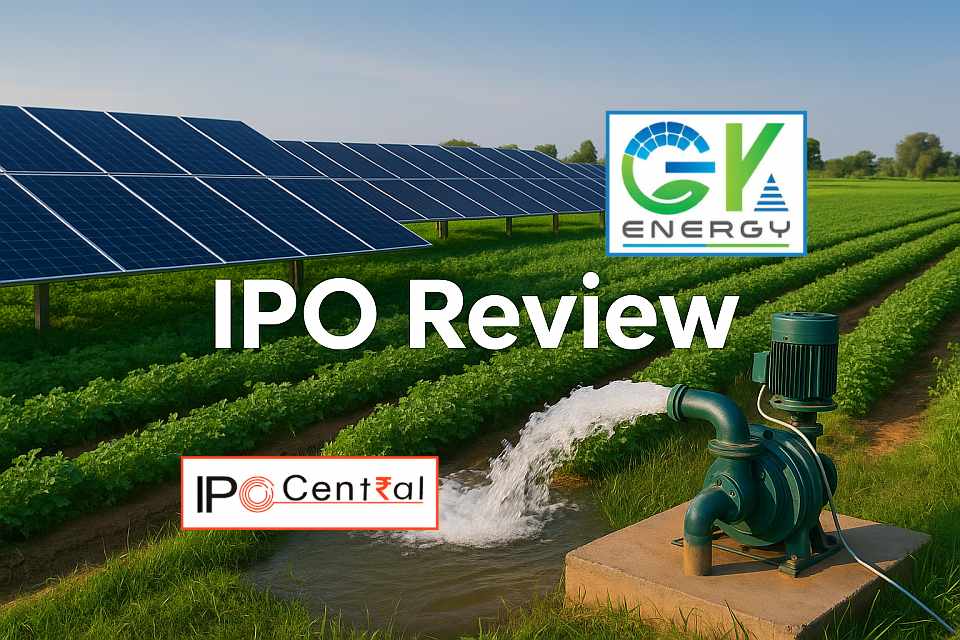
Table of Contents
GK Energy IPO: Offer Details & Fund Utilization
- IPO Dates: 19 – 23 September 2025
- Price Band: INR 145 – 153 per share
- Issue Size: INR 460.90 – 464.26 crore
- Fresh Issue: INR 400 crore
- Offer For Sale: 42,00,000 shares
- Lot Size: 98 shares (INR 14,994 minimum)
- Listing: NSE & BSE
- Retail Quota: 35%
- Listing date: 26 September 2025
- Promoters: Gopal Rajaram Kabra, and Mehul Ajit Shah
- Lead Managers: IIFL Capital, and HDFC Bank
- Registrar: MUFG Intime
Fund Utilization
The company proposes to utilize the Net Proceeds from the Fresh Issue towards funding the following objects:
- Funding its long term working capital requirements – INR 322.46 crore
- General corporate purposes
GK Energy IPO Review: Company Overview
GK Energy is primarily engaged in the Engineering, Procurement, and Commissioning (EPC) of solar-powered agricultural water pump systems. These systems replace conventional diesel and grid-electric pumps, providing farmers with a cleaner, cost-effective, and reliable irrigation solution.
- Core Segment – Solar Pump Systems (SPPS):
- Provides end-to-end EPC services: site survey, design, procurement, installation, testing, commissioning, and post-installation maintenance.
- Operates under government subsidy schemes like PM-KUSUM and state-specific programs (e.g., Mukhyamantri Saur Krushi Pump Yojana in Maharashtra).
- Offers both direct-to-beneficiary installations (farmers selecting GK Energy as vendor) and sales to other institutions (corporates, NGOs, local governments).
- Other Offerings:
- Rooftop Solar Systems: Both residential and commercial, revived in FY25 with orders worth INR 23.29 crore (5.28 MW).
- Water Storage & Distribution EPC: Contracts under the Jal Jeevan Mission, installing tanks, pipelines, and taps for rural drinking water projects.
- Solar Products for Government Agencies: Solar streetlights, high masts, heaters, and home-lighting systems.
- Trading Business: Sales of third-party photovoltaic cells, modules, and related solar equipment.
Scale Achieved:
- As of 31 July 2025, GK Energy had installed 97,098 solar pump systems across Maharashtra, Haryana, Rajasthan, Uttar Pradesh, Chhattisgarh, and Madhya Pradesh.
- It commands a 15% market share in Maharashtra under PM-KUSUM and completed 62,559 systems under the scheme nationwide (~7.4% share of total installations).
GK Energy Business Model Analysis
GK Energy’s model is asset-light and execution-driven, ensuring scalability while keeping capital intensity low.
Key Features of the Model
- Asset-Light EPC Approach
- The company sources panels, pumps, and controllers from third-party vendors under the GK Energy brand.
- Focuses resources on project execution, installation, and after-sales service rather than heavy manufacturing.
- This reduces upfront capital investment and allows rapid scale-up across geographies.
- Revenue Mix (FY25)
- 99.3% from EPC of solar pump systems (INR 1,087.36 crore).
- 0.6% from other operating revenue (maintenance, consultancy).
- 0.1% from trading activities (INR 1.0 crore).
- Rooftop solar orders are still a small share but present a diversification opportunity.
- Decentralized Infrastructure
- Operates 12 warehouses across 3 states, supported by 90 employees and 709 workmen.
- Uses local hiring and training to boost efficiency, reduce costs, and improve service quality.
- Flexible tie-ups with third-party installation partners provide surge capacity when demand spikes.
- Execution Cycle
- EPC project follows a structured 9-step process—from farmer application on government portals, through SNA/SIA verification, to installation and inspection.
- Typical timeline: 90–120 days per system after vendor selection.
- Payment is routed through SNAs/SIAs, creating working capital pressure (receivable days ~120 in FY25).
- Efficiency Levers
- Remote servicing: farmers share error codes via mobile app; many issues fixed digitally.
- Warranty + Insurance model: each installed system carries manufacturer warranty plus insurance cover.
- Buffer stock strategy: defective parts replaced quickly from spare inventory, ensuring high farmer satisfaction.
GK Energy IPO Analysis: Revenue Streams
GK Energy’s revenues are concentrated in solar pump EPC, but within this, the mix is evolving.
| Particulars | FY23 | % of Ops Rev | FY24 | % of Ops Rev | FY25 | % of Ops Rev | Trend & Notes |
|---|---|---|---|---|---|---|---|
| Direct-to-Beneficiary Sales | 253.72 | 89.02 | 305.82 | 74.39 | 921.70 | 84.19 | Core engine; reflects PM-KUSUM execution strength |
| Sales to Others (Corporate/Peers) | 4.37 | 1.53 | 68.55 | 16.68 | 165.66 | 15.13 | Fastest-growing; signals diversification beyond subsidy-driven demand |
| Other EPC Services (Jal Jeevan, Solar Infra) | 13.46 | 4.72 | 20.77 | 5.05 | – | – | Discontinued in FY25, possibly due to focus on pump EPC |
| Trading Activities | 12.01 | 4.21 | 13.55 | 3.30 | 1.001 | 0.009 | Deprioritized; almost phased out |
| Other Operating Revenue | 1.46 | 0.52 | 2.40 | 0.58 | 6.46 | 0.059 | Stable, service-led income |
| Total Revenue from Operations | 285.03 | 100 | 411.09 | 100 | 1,094.83 | 100 | 3.8x growth over FY23–25 |
Customers
GK Energy’s customer ecosystem is unique—a blend of thousands of farmers (end-users), government nodal agencies (funding bodies), and a growing base of private companies.
- Farmer Customers (Core Beneficiaries):
Each farmer who installs a pump under the PM-KUSUM scheme is essentially a customer. Farmers make a partial contribution, while the bulk of the cost is subsidized through state and central governments. This guarantees demand certainty as the government shoulders a majority of the financial burden. - State Nodal Agencies (SNAs/SIAs):
- SNAs act as the financial intermediaries, collecting funds from the Central Government + State Government + farmer contribution and then paying GK Energy.
- In FY25, SNAs like MSEDCL (INR 702.9 crore) and MEDA (INR 144 crore) together accounted for over 77% of total revenues.
- Corporate & Institutional Clients:
- GK Energy also sells directly to companies like Ecozen Solutions (INR 165.6 crore, 15.13% of FY25 revenue).
- Other names include Sunrisers Solar, Redren Energy, SG Enterprises, Mira Energy.
- These non-subsidy clients provide cash-based, faster-cycle revenues, reducing dependence on government schemes.
GK Energy IPO Analysis: Financial Performance
GK Energy’s financial performance demonstrates a clear transition from being a small EPC contractor to becoming a scaled and profitable renewable energy solutions provider.
| FY 2023* | FY 2024* | FY 2025 | Key Points | |
| Revenue from Operations | 285.03 | 411.09 | 1,094.83 | Explosive growth; 166% YoY in FY25 driven by KUSUM execution |
| EBITDA | 17.18 | 53.83 | 199.69 | Strong operating leverage as revenue base expands |
| PAT | 10.08 | 36.09 | 133.21 | Net profit grew 13x in 2 years |
| EBITDA Margin (%) | 6.03 | 13.09 | 18.24 | Efficiency gains and cost discipline |
| PAT Margin (%) | 3.53 | 8.75 | 12.12 | Clear shift towards higher profitability |
| ROE (%) | 50.73 | 64.49 | 63.71 | Among the best in the industry |
| ROCE (%) | 29.36 | 50.10 | 55.65 | Strengthening operating efficiency |
| Net Debt / Equity (x) | 1.93 | 0.94 | 0.74 | Deleveraging despite expansion |
| Receivable Days | 144 | 135 | 120 | High but gradually improving |
* All Standalone Data
Strengths of GK Energy
GK Energy’s rapid scale-up is backed by clear structural strengths:
- Market Leadership under PM-KUSUM Scheme
- Installed 97,098 solar pumps as of July 2025.
- Holds 7.37% market share of national installations.
- Maharashtra remains its strongest market, but expansion into Haryana, Rajasthan, UP, and MP enhances diversification.
- Robust Order Book & Revenue Visibility
- As of Aug 2025, order book stood at INR 934.18 crore (37,433 pumps).
- Majority comes from Maharashtra (Magel Tyala Yojana + PM-KUSUM), contributing over 97% of outstanding orders.
- Provides 12–18 months visibility, critical for investors evaluating growth certainty.
- Asset-Light, Scalable Model
- GK Energy does not manufacture pumps or panels (until backward integration begins).
- Outsourcing model allows faster capacity expansion without heavy fixed asset investment.
- Strong Financial Efficiency
- ROE at 63.71% and ROCE at 55.65% are among the highest in the renewable EPC space.
- Indicates that GK Energy converts capital into profits at an exceptional rate.
- Policy Tailwinds
- Benefiting directly from schemes like PM-KUSUM (pumps), PM Surya Ghar Yojana (rooftops), and Jal Jeevan Mission (water infra).
- Sector tailwinds reduce business risk and expand market opportunity.
GK Energy IPO Review: Growth Strategies
GK Energy is not only consolidating its pump business but also laying the groundwork to become a broader renewable energy EPC + manufacturing player. Its strategies are multi-pronged:
- Replication of Maharashtra Success in High-Potential States
- Maharashtra, Rajasthan, Haryana, UP, and MP together represent 86% of total PM-KUSUM allocations.
- GK Energy has already made inroads in each, with active operations in Haryana (since FY22), UP (since Sep 2023), Rajasthan (FY24), and MP (since Mar 2025).
- With irrigation power consumption concentrated in these states, GK Energy’s expansion aligns with natural demand hubs.
- Diversification into Rooftop Solar
- Rooftop solar market is expected to grow 10x between FY20–26, with a target of 40 GW by FY26.
- The PM Surya Ghar Yojana alone is expected to drive 12–13 GW additions by FY29, providing a major growth lever.
- Backward Integration into Solar Panel Manufacturing
- Setting up a 1 GW capacity plant in Maharashtra by Sep 2026.
- Will help reduce 40% module cost dependency (biggest EPC expense).
- Ensures compliance with DCR (Domestic Content Requirement) mandates, protecting supply chain risks.
- Expansion Beyond Agriculture
- EPC for water storage & distribution (Jal Jeevan Mission).
- Solar products for government agencies: street lights, high masts, heaters, and home lighting systems.
- This allows GK Energy to capture urban and rural non-farm demand.
- Vendor Ecosystem & Supply Chain Optimization
- Plans to build a dedicated vendor ecosystem organically and through acquisitions.
- Fixed-price contracts with suppliers help manage cost volatility.
- Backward integration + vendor ecosystem = stronger control over margins.
GK Energy – Peer Comparison
How does GK Energy stack up against its listed rivals?
| KPI (FY25) | GK Energy | Shakti Pumps | Oswal Pumps |
|---|---|---|---|
| Revenue | 1,094.8 | 2,516.2 | 1,430.3 |
| EBITDA Margin (%) | 18.24 | 24.0 | 29.4 |
| PAT Margin (%) | 12.12 | 16.2 | 19.6 |
| ROE (%) | 63.71 | 35.2 | 93.0 |
| ROCE (%) | 55.65 | 43.9 | 82.5 |
| P/E (IPO band vs market) | 22.07–23.29 | 24.11 | 29.00 |
Key Takeaway:
- Scale: GK Energy is ~40–50% the size of peers but growing at 2x their pace.
- Margins: Lower today, but backward integration (1 GW panel plant by FY26) should close the gap.
- Efficiency: ROE above 60% is a big positive, showcasing how well GK Energy sweats its equity base.
- The IPO values GK Energy at a P/E of 22–23x FY25 earnings, a discount to Oswal (29x) and Shakti Pumps (24x).
- Valuation: At IPO price band, GK Energy trades cheaper than peers, despite superior growth and ROE—a valuation comfort zone for investors.

Conclusion
GK Energy, India’s top EPC player in solar pump systems, is expanding rapidly into rooftop solar and water distribution projects. Supported by schemes like PM-KUSUM and PM Surya Ghar, it benefits from strong demand, improving margins, and robust returns. While execution and policy risks exist, its growth trajectory makes the IPO a compelling bet on India’s renewable energy transition. For more details related to IPO GMP, SEBI IPO Approval, and Live Subscription, stay tuned to IPO Central.