
































India’s renewable energy journey has entered a transformative phase, extending far beyond large corporates and power utilities. Today, the spotlight is shifting towards rural India, where clean and sustainable irrigation solutions are beginning to replace traditional diesel and grid-powered pumps. At the center of this transformation is GK Energy, a company preparing to make its stock market debut through an IPO scheduled between 19 to 23 September 2025.
Having installed more than 97,000 solar pumps across India as of July 2025, GK Energy holds close to 7.4% of the scheme’s completed installations, making it one of the most significant players in the segment. Its order book of over INR 1,000 crore underscores both its execution capacity and future growth visibility. The IPO, therefore, comes at a time when the company is not only scaling rapidly but also looking to widen its presence in the clean energy ecosystem.
This raises an important question for investors and industry observers alike: how does GK Energy stack up against other established players in the space? A peer comparison of GK Energy vs Shakti Pumps vs Oswal Pumps doesn’t just highlight competitive positioning — it also offers insights into market dynamics, financial strength, and the evolving role of solar pump manufacturers in India’s rural energy revolution.
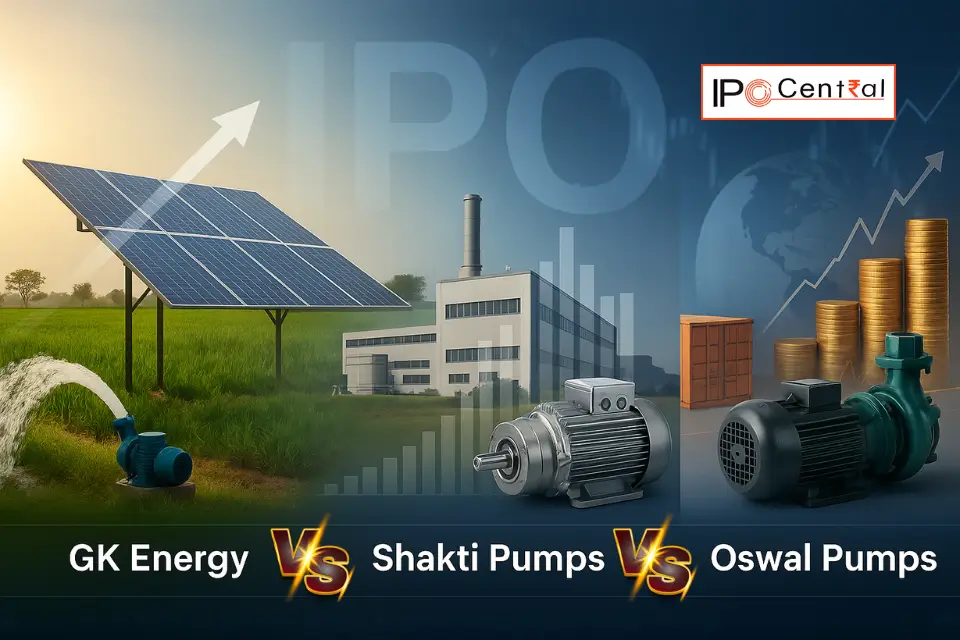
Table of Contents
Industry Context
The demand for solar-powered pumps and motors is not just a reflection of government incentives—it represents a structural shift in how India’s rural economy manages energy and irrigation. Diesel pumps are costly, grid electricity is unreliable, and farmers are increasingly turning towards solar solutions as a sustainable, long-term alternative.
Within this landscape, two listed peers — Shakti Pumps (India) and Oswal Pumps — have already established themselves as household names in the pumps and motors industry. Both companies have diversified product lines ranging from submersible pumps to solar motors and turnkey EPC solutions, with strong domestic and international footprints.
It is into this competitive environment that GK Energy is stepping in. But unlike its peers, GK’s strength lies in its asset-light EPC model — sourcing components from third-party vendors while focusing on execution and service delivery. This approach has allowed the company to scale aggressively without the burden of heavy capital expenditure. The result: while GK Energy may still be smaller in absolute size compared to Shakti and Oswal, its growth velocity is unmatched.
GK Energy Peer Comparison Analysis: Financial Performance & Profitability
| Metrics (FY25) | GK Energy | Shakti Pumps | Oswal Pumps |
|---|---|---|---|
| Revenue | 1,094.8 | 2,516.2 | 1,430.3 |
| Revenue Growth (%) | 166.3% | 83.6% | 88.5% |
| PAT | 133.2 | 408.4 | 280.6 |
| EBITDA | 199.6 | 603.0 | 419.9 |
| EBITDA Margin (%) | 18.2% | 24.0% | 29.4% |
| PAT Margin (%) | 12.1% | 16.2% | 19.6% |
GK Energy closed FY25 with INR 1,094.8 crore in revenue and INR 133.2 crore in profit, still behind Shakti and Oswal in absolute size. But with a 166% revenue growth, it clearly outpaced its peers, nearly doubling their pace.
Profitability remains relatively lower at 18.2% EBITDA margin and 12.1% PAT margin, compared with Shakti’s 24%/16.2% and Oswal’s 29.4%/19.6%. However, the trend is sharply upward for GK, driven by scale benefits and operational efficiency. With its planned backward integration into solar panel manufacturing, GK Energy is well placed to narrow the margin gap with industry leaders.
In short, GK Energy is a fast-growing challenger, combining exceptional growth velocity with improving profitability.
GK Energy vs Shakti Pumps vs Oswal Pumps: Returns & Valuations
| Metrics | GK Energy | Shakti Pumps | Oswal Pumps |
|---|---|---|---|
| ROE (%) | 63.7% | 42.6% | 87.5% |
| ROCE (%) | 55.6% | 55.3% | 77.9% |
| P/E Ratio (X) | 23.3 | 26.0 | 32.3 |
| P/B Ratio (X) | 12.4 | 9.0 | NA |
| P/S Ratio (X) | 2.8 | 4.2 | 6.3 |
| Debt-to-Equity (X) | 0.74 | 0.14 | 0.72 |
| Current Ratio (X) | 1.54 | 2.27 | 1.61 |
On returns, GK Energy delivers exceptional efficiency with ROE of 63.7% and ROCE of 55.6%, comfortably ahead of Shakti Pumps and competitive with Oswal Pumps, which remains the benchmark with 87.5% ROE. This indicates that GK Energy has been able to sweat its equity base effectively, despite being a smaller player.
Valuations also tilt in its favor. At an IPO price band of INR 145–153, GK Energy is valued at 22–23x FY25 earnings, which is at a discount to Shakti (26x) and Oswal (32x). Similarly, its P/S ratio of 2.8 is meaningfully lower than peers, signaling relative attractiveness. Although the P/B ratio (12.4) is higher, this reflects its high return metrics and growth profile.
On leverage, GK Energy’s D/E ratio of 0.74 is higher than Shakti but comparable to Oswal, while its Current Ratio of 1.54 shows a reasonable liquidity position. With IPO proceeds aimed at strengthening working capital, financial flexibility is likely to improve further.
In essence, GK Energy offers a combination of high returns, lower relative valuations, and strong growth visibility, making its IPO proposition appealing compared to listed peers.
GK Energy Peer Comparison Analysis: Balance Sheet & Liquidity
| Metrics | GK Energy | Shakti Pumps | Oswal Pumps |
|---|---|---|---|
| Debt-to-Equity (D/E) | 0.74 | 0.14 | 0.72 |
| Current Ratio | 1.54 | 2.27 | 1.61 |
| Net Debt / EBITDA | 0.78 | NA | 0.77 |
| Receivable Days | 120 | 152 | 111 |
GK Energy peer comparison analysis highlights that the company’s balance sheet shows a steady deleveraging trend, with its D/E ratio improving to 0.74 in FY25 from 1.93 just two years ago. While this is higher than Shakti Pumps (0.14), it is broadly in line with Oswal Pumps (0.72). The company’s Current Ratio of 1.54 also reflects a comfortable liquidity position, though slightly behind peers. Importantly, the company maintains a low Net Debt/EBITDA ratio of 0.78, underlining healthy debt-servicing ability.

Conclusion: A Strong Peer, A Promising IPO
Who wins: GK Energy vs Shakti Pumps vs Oswal Pumps? GK Energy peer comparison analysis makes one thing clear: The company is not yet the largest player in its space, but it is undoubtedly the fastest-growing. With revenue growth of 166% in FY25, improving profitability, and stellar return ratios, the company stands out as a high-growth challenger to established peers Shakti and Oswal.
At its IPO price band, GK Energy is also being offered at a relative valuation discount — trading at 22–23x earnings, below Shakti (26x) and Oswal (32x), despite comparable or superior return metrics. For investors, this creates a rare mix of growth visibility, efficiency, and valuation comfort.
While margin levels are currently lower than peers, the trajectory is upward, and backward integration into solar panel manufacturing promises to close the gap. Moreover, its improving balance sheet and strong order book provide additional confidence in its scalability.
In short, GK Energy IPO presents an opportunity to invest in a fast-scaling renewable EPC company, well positioned at the intersection of policy tailwinds, rising rural demand, and efficient capital utilization. Among peers, it emerges as a smaller but sharper contender, with the potential to reward investors as it grows into its valuation.
For more details related to IPO GMP, SEBI IPO Approval, and Live Subscription stay tuned to IPO Central.
Excellent company comparison
Interested
Good
Very good.comparative analysis
Very good analysis
Excellent analysis and comparison of financial figures.