














We have conducted a deep analysis of the GSP Crop Science RHP and financial disclosures. While you may see the headline growth and improved margins as a compelling story, our GSP Crop IPO analysis reveals significant structural risks that every investor must evaluate.
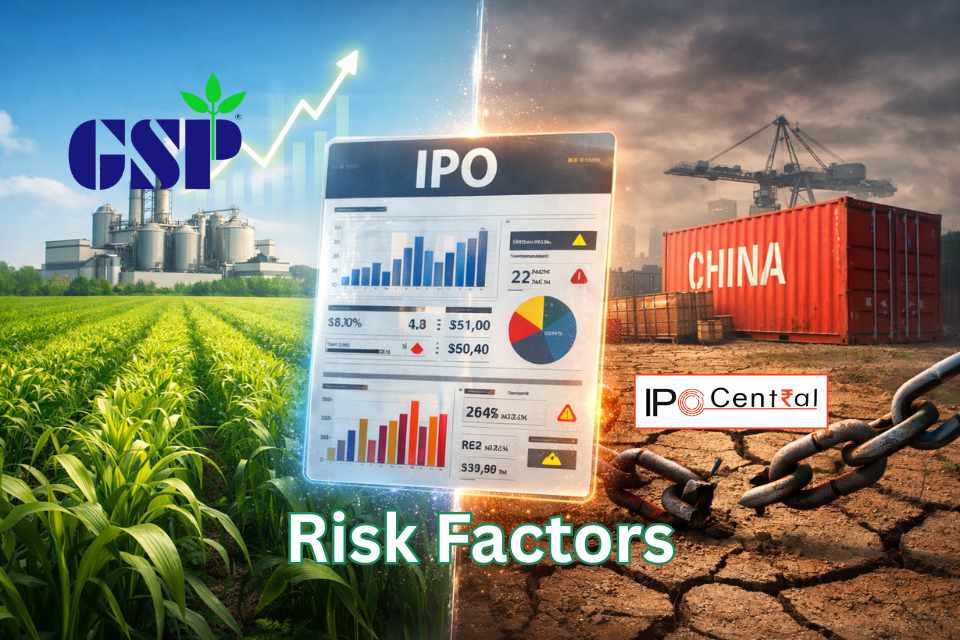
GSP Crop Science IPO Risks
GSP Crop Science is entering the public market with an INR 400 crore IPO (INR 240 crore fresh and INR 160 crore OFS). While the company’s expansion from technicals to formulations and its 102 patents highlight a research-oriented approach, the “Devil is in the Details.”
For investors seeking to understand the sustainability of GSP Crop Science’s business, here are the key risk factors to be aware of.
1. Extreme Supply Chain Vulnerability
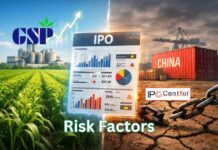
GSP’s manufacturing stability is heavily tied to trade relations with China.
- For the six months ended 30 September 2025, imports of raw materials from China accounted for 42.08% of the company’s total purchases.
- The Risk: Any geopolitical friction, trade embargo, or supply chain disruption in China could instantly paralyze GSP’s production facilities across Gujarat and J&K. Furthermore, the company relies on a limited number of suppliers, with the top 10 contributing 38.2% of total purchases. This high concentration leaves the company with virtually zero bargaining power against global price fluctuations.
2. Working Capital Stress: The “Profit vs. Cash” Gap
A growing profit on paper is meaningless if it doesn’t translate into cash in the bank. GSP’s balance sheet reveals a high level of capital blockage.
- As of 30 September 2025, Trade Receivables stood at INR 645.33 crore. Considering the company earned INR 844.29 crore in revenue during the same six-month period, nearly 76% of its half-yearly revenue is stuck in the credit cycle.
- The Risk: High receivable days indicate that the company is providing long credit periods to distributors to push sales. This creates a liquidity crunch, forcing the company to rely on interest-bearing debt to fund day-to-day operations. Any delay in collection from the agricultural sector (often hit by crop failures) could lead to significant bad-debt write-offs.
3. Revenue Moat: The Generic Concentration Trap
Despite holding 102 granted patents, the company’s current revenue generation is heavily commoditised.
- As of H1 FY26, 82.9% of revenue is derived from Generic products, while Patented products contribute only 17.1%.
- The Risk: Generic products face intense competition from both domestic and international players. Without a majority share in specialised, high-margin patented molecules, GSP is a “price-taker” rather than a “price-maker.” This lack of pricing power makes the company vulnerable to price wars.
4. Debt Repayment vs. Growth Expansion
A key indicator of an IPO’s quality is how the company plans to use the new capital.
- Out of the INR 240 crore fresh issue, INR 170 crore (~71%) is allocated for the repayment or pre-payment of existing borrowings.
- The Risk: When over 70% of the public’s money is used to pay off old debt rather than setting up new plants or funding R&D, it indicates that the company is currently over-leveraged. While reducing debt will save interest costs, it does not directly contribute to the “top-line” revenue growth that long-term investors seek.
5. Cyclicality and Revenue Volatility
The company’s past performance shows that it is not immune to the inherent volatility of the agriculture sector.
- Revenue from operations dropped from ₹1,203 crore in FY23 to ₹1,152 crore in FY24—a contraction during a period when many peers were growing.
- The Risk: This volatility is a direct result of “seasonal vagaries” and adverse weather conditions. Since GSP’s business is entirely linked to agricultural demand cycles, one bad monsoon or a shift in government pesticide regulations can wipe out an entire year’s growth.
6. GSP Crop Valuation Analysis
At a 15x–18x P/E, GSP Crop IPO valuation appears “at a discount” against peers like PI Industries (33x), but benchmarking suggests a different story. A thin 6.26% PAT margin (vs. industry average 14–20%) leaves zero “Margin of Safety” against price shocks.
Structural risks remain high: 42% dependency on Chinese imports and a bloated 117-day working capital cycle that strains liquidity. With 83% revenue from low-moat generics, GSP lacks the pricing power of its Tier-1 peers. Unless the recent 16% EBITDA spike is sustainable and not “pre-IPO window dressing,” the valuation discount is entirely justified.
GSP Crop IPO Analysis: Verdict
The GSP Crop Science IPO review presents a classic case of high-risk, moderate-reward. On one hand, the company is successfully cleaning its balance sheet by using IPO proceeds to pay down debt. On the other hand, the H1 FY26 margin spike looks like a cyclical peak.
A conservative investor should wait 2-3 quarters (post-listing) to see if the company can maintain double-digit margins. However, risk-takers may find GSP a “Value Play” (15x P/E), if they are comfortable with its heavy dependence on China and high trade receivables.
Our View: In the agrochemical world, cash is king. Until GSP demonstrates better cash flow conversion from its massive receivables, we will remain cautious.

Rajat Bhati has a strong technical background and 5 years of experience in the stock market. He focuses on equity research, technical analysis, IPO valuations, and risk management, helping investors make clearer, data-backed decisions. Today, he works full-time to educate people about the opportunities in IPO market.