




























Ola Electric Mobility is once again in the spotlight after its board approved a plan to raise up to INR 1,500 crore through a combination of equity shares and convertible securities. The move, announced following a board meeting held on 25 October 2025, aims to bolster the company’s financial flexibility as it navigates an increasingly competitive electric vehicle (EV) market and expands into adjacent clean energy sectors.
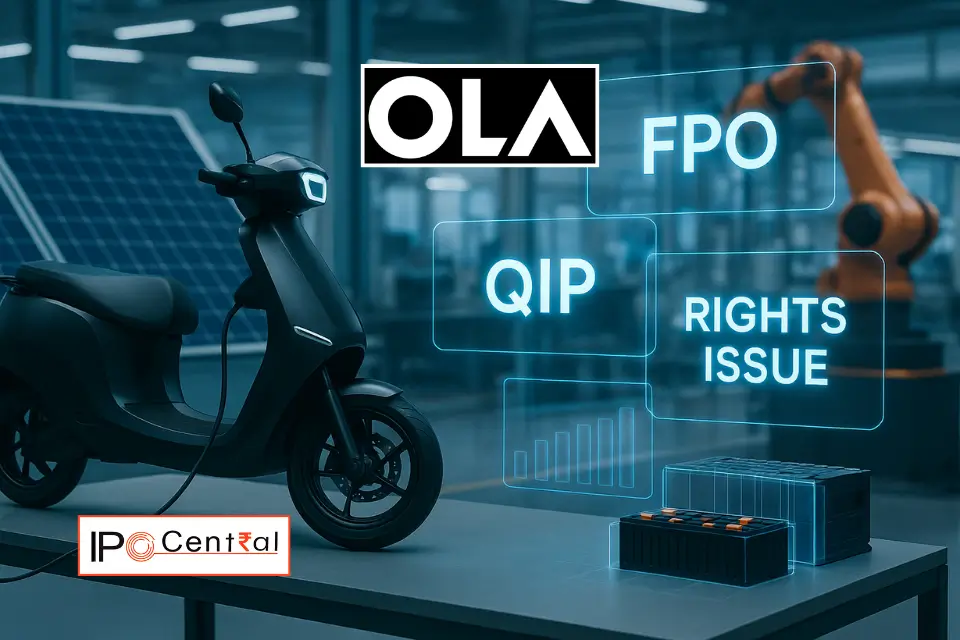
Ola Electric Fundraising Approval & Structure
According to the company’s filing, the proposed capital raise could be executed through multiple routes — including a further public offer (FPO), rights issue, qualified institutional placement (QIP), private placement, or any other regulatorily permitted mode. The instruments may include equity shares, warrants, American Depository Receipts (ADRs), or Global Depository Receipts (GDRs), with pricing and other details to be determined by the board at a later stage. The plan remains subject to shareholder and regulatory approvals, likely via a postal ballot.
Ola Electric’s fundraising marks the company’s second major equity raise since its IPO in August 2024, through which it collected INR 5,500 crore. In May 2025, the company also approved a plan to raise INR 1,700 crore via non-convertible debentures (NCDs), signalling a mixed approach to financing expansion through both equity and debt.
Market Reaction & Share Price Movement
Following Ola Electric’s fundraising approval market’s initial response was muted, with Ola Electric shares sliding 3.52% to INR 50.99 on the BSE on 27 October, and later hovering around INR 51.35, down 2.78% from the previous close. This dip follows a broader downward trend — the stock has fallen over 40% from its IPO price of INR 76, reflecting investor caution amid rising competition and operational headwinds.
Ola Electric’s market capitalisation stands at approximately INR 23,311 crore, compared to Ather Energy’s INR 26,857 crore, highlighting the growing challenge from its peers in the EV segment.
Strategic Context: Expansion and Restructuring
The capital infusion is expected to support Ola Electric’s expansion of manufacturing capacity, charging infrastructure, and R&D initiatives, especially as it works to strengthen its foothold in India’s EV ecosystem.
The company’s Gigafactory in Tamil Nadu remains a cornerstone of its strategy to achieve domestic battery manufacturing self-sufficiency. Simultaneously, Ola Electric is undergoing organisational restructuring and changes in its shareholder base. In June 2025, Hyundai Motor and Kia Corporation exited the company, divesting their stakes worth around INR 690 crore through block deals. Major investors such as SoftBank and Z47 also trimmed holdings earlier this year.
Operational Challenges & Market Share Erosion
Despite its early lead, Ola Electric has faced mounting challenges. According to VAHAN data, the company’s market share in the electric two-wheeler segment fell to 13.2% in September 2025, down sharply from 18.7% in August.
The decline coincides with growing dominance by TVS Motor, which retained the top spot, and Ather Energy, which overtook Ola in September. Operational issues — including sales data discrepancies, missing trade certificates, and customer complaints about vehicle quality — have compounded the pressure.
Financially, the picture has been mixed. In Q1 FY26, Ola Electric reported revenues of INR 828 crore, nearly half of the previous year’s figure, while net losses widened by 23% to INR 428 crore from INR 327 crore year-on-year, though still narrower than the INR 870 crore loss posted in March.
Diversification into Energy Storage
Notably, Ola Electric is also broadening its focus beyond mobility. Earlier this month, the company launched “Ola Shakti”, a portable battery energy storage system (BESS) — marking its entry into the INR 1 lakh crore battery energy storage market. This strategic pivot underscores founder Bhavish Aggarwal’s ambition to position Ola Electric not just as an EV manufacturer but as an end-to-end energy and technology company.
Balancing Ambition with Execution
Analysts view Ola Electric’s fundraising approval as a necessary liquidity move amid cash burn pressures and an evolving competitive landscape. The fresh equity will likely help bridge funding gaps, de-risk ongoing projects, and restore investor confidence, provided the company can stabilise operations and regain market share.
However, with investor sentiment still cautious and the stock trading well below its IPO price, Ola Electric’s next few quarters will be critical. Success will depend on execution discipline, product reliability, and progress in the new energy segment.

Conclusion
Ola Electric’s fundraising reflects the company’s ambition to balance aggressive growth ambitions with the realities of a challenging EV market. As the firm pushes deeper into energy infrastructure and renewables, its ability to execute effectively will determine whether this capital raise becomes the turning point for a revival or merely another chapter in its volatile market journey.
For more details related to IPO GMP, SEBI IPO Approval, and Live Subscription stay tuned to IPO Central.
