

































The Indian financial services landscape is entering an exciting phase, with the upcoming Tata Capital IPO poised to become one of the most significant listings in the NBFC sector. Backed by the century-old Tata Group, the company brings not just a legacy of trust and stability but also a proven record of aggressive growth in retail, SME, and vehicle finance.
As India’s credit demand expands—fueled by rising consumer aspirations, SME growth, and infrastructure development—investors are keenly eyeing NBFCs that can scale without compromising on risk management. In this context,Tata Capital IPO peer comparison analysis becomes vital. It helps investors understand not just where Tata Capital stands today, but how it stacks up against industry leaders like Bajaj Finance, Shriram Finance, Cholamandalam Investment & Finance, and HDB Financial Services.
Unlike many NBFCs that are specialized or dependent on one vertical, Tata Capital offers a diversified lending portfolio, backed by low-cost funding and a rapidly expanding physical-digital distribution network. This positions it uniquely as a strong contender in India’s booming credit market.
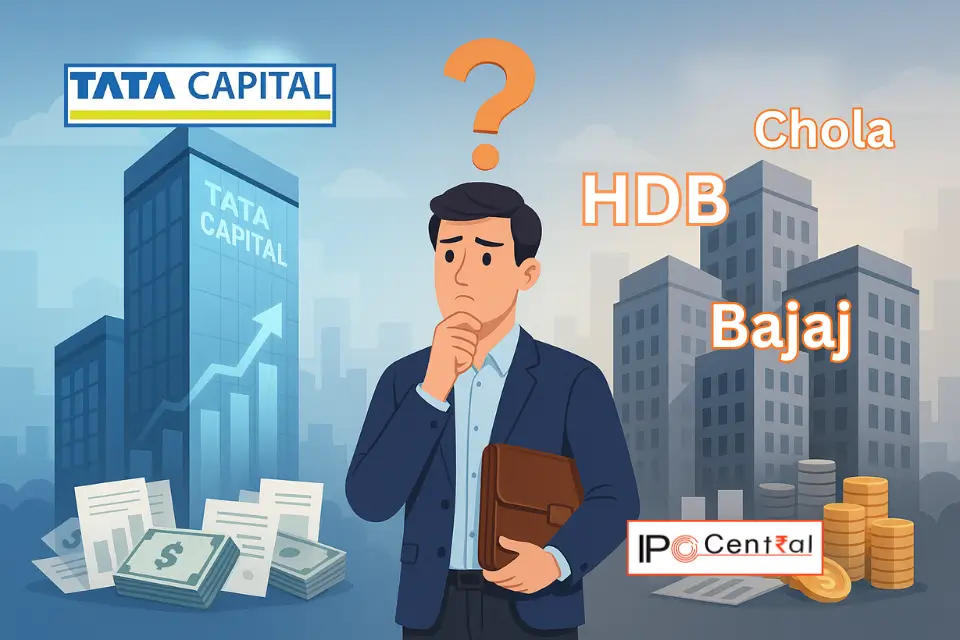
Table of Contents
Tata Capital at a Glance
Founded in 2007 as the financial services arm of Tata Sons, Tata Capital has grown into India’s third-largest diversified NBFC. As of 30 June 2025, the company boasts:
- Loan Book: INR 2.33 lakh crore, growing at a remarkable 37.3% CAGR (FY23–FY25).
- Branches: 1,516 across 27 states and union territories.
- Customers: Serving 73 lakh customers through retail, SME, corporate, and vehicle loans.
- Employees: 28,813 people, supported further by the recent TMFL merger.
- Disbursements: INR 1.42 lakh crore in FY25, reflecting 35.5% YoY growth.
🚀 The TMFL Merger Advantage
A landmark event in FY25 was Tata Capital’s merger with Tata Motors Finance (TMFL). This added:
- 6,351 employees and 353 new branches.
- Dominance in commercial and passenger vehicle loans – TMFL contributes 92.5% of CV loans, 16.8% of car loans, and 12.8% of supply chain finance.
This strategic integration not only widened Tata Capital’s distribution network but also diversified its lending mix, making it a multi-engine NBFC with strong presence in retail, SME, and vehicle financing.
Snapshot of Tata Capital
| Particulars | Data |
|---|---|
| Loan Book | INR 2.33 lakh crore |
| CAGR (FY23–FY25) | 37.3% |
| Disbursements (FY25) | INR 1.42 lakh crore |
| Branches | 1,516 |
| Customers | 73 lakh |
| Employees | 28,813 |
| Gross Stage 3 Loans | 2.1% |
| Net Stage 3 Loans | 1.0% |
| Provision Coverage Ratio | 53.9% |
| ROE (FY25) | 12.6% |
| ROA (FY25) | 1.8% |
Tata Capital enters the IPO not as a stressed lender in need of a bailout, but as a growth-driven NBFC leveraging brand credibility, digital capability, and sectoral tailwinds to cement its leadership.
Tata Capital IPO Peer Comparison Analysis: Financials & Operations
When assessing an NBFC, investors must look at both financial metrics (revenue, PAT, margins) and operational scale (branches, customers, employees, disbursements, loan book). Below is how Tata Capital stacks up against its closest peers.
A. Financial Performance
| Particulars | Tata Capital | Bajaj Finance | Shriram Finance | Cholamandalam Finance | HDB Financial Services |
|---|---|---|---|---|---|
| Revenue from Operations | 28,313 | 69,684 | 41,834 | 25,846 | 16,300 |
| Net Profit (PAT) | 3,664.6 | 16,637.8 | 9,761.0 | 26,437 | 21759.2 |
| ROE (%) | 12.6% | 19.2 | 15.6 | 19.7 | 14.7% |
| ROA (%) | 1.8% | 4.00 | 3.0 | 2.4 | 2.2% |
📌 Analysis:
- Revenue & Profitability: Tata Capital’s revenue (INR 28,313 Cr) and PAT (INR 3,664.6 Cr) are lower compared to Bajaj Finance (INR 16,637.8 Cr PAT) and Shriram Finance (₹9,761 Cr PAT), but the company has delivered one of the highest loan book CAGRs (~37%), underscoring its high-growth trajectory.
- Margins: Net margin is slimmer than peers due to higher finance costs, yet the company’s diversification across retail, SME, corporate and vehicle finance provides resilience. The increasing contribution of fee income is also expected to support profitability.
- Returns: Tata Capital’s ROE (12.6%) and ROA (1.8%) are below Bajaj and Shriram, but the IPO capital infusion will de-leverage the balance sheet, reduce funding costs, and likely lift return ratios closer to peer benchmarks.
B. Operational Scale
| Particulars | Tata Capital | Bajaj Finance | Shriram Finance | Cholamandalam Finance | HDB Financial Services |
|---|---|---|---|---|---|
| Branches | 1496 | 4,192 | 3,220 | 1,110 | 1,771 |
| Employees | 29,397 | 64,092 | 79,872 | 12,041 | 60,432 |
| Customers (Mn) | 70 | 101.8 | 9.6 | 4.4 | 19.2 |
| Disbursements (₹ Cr) | 1,42,302 | NA | NA | 1,00,869.0 | 66,107.5 |
| Total Gross Loans (₹ Cr) | 2,26,552.96 | 4,16,661.0 | 2,63,190.2 | 1,84,746.0 | 1,06,877.6 |
📌 Analysis:
- Scale: Tata Capital, with 1,496 branches and ~70 million customers, has built a strong distribution base. While Bajaj Finance and HDB are larger in terms of customer base, Tata Capital is catching up rapidly thanks to its retail expansion and merger synergies.
- Disbursements: With disbursements of ₹1.42 lakh crore in FY25, Tata Capital is already among the top NBFCs in terms of origination volumes. This strong flow of new loans demonstrates its ability to capture demand across retail and SME segments.
- Loan Book: The company’s loan book at ₹2.26 lakh crore reflects consistent growth, supported by secured lending (~80% of the book). The merger with TMFL has not only expanded the vehicle loan portfolio but also given Tata Capital a strategic edge in commercial and passenger vehicle financing.
Tata Capital vs HDB vs Bajaj Finance vs Chola vs Shriram: Valuation & Balance Sheet
Valuations are the lens through which markets judge both current strength and future scalability.
Valuation Ratios (FY25)
| Particulars | Tata Capital | Bajaj Finance | Shriram Finance | Cholamandalam Finance | HDB Financial Services |
|---|---|---|---|---|---|
| P/E Ratio | 37.8 | 35.4 | 13.6 | 30.0 | 28.1 |
| P/B Ratio | 4.1 | 6.3 | 2.1 | 5.7 | 3.9 |
| P/S Ratio | 18.1 | 8.44 | 2.63 | 4.9 | NA |
| EPS (INR) | 9.3 | 28.1 | 51.5 | 53.0 | 27.4 |
📌 Analysis:
- Premium Valuation: Tata Capital’s P/E of 37.8x is at par with Bajaj Finance (35.4x), signaling that the market already places it in the high-growth, premium NBFC category. This premium is justified by its strong CAGR growth (37% in loan book) and the Tata Group credibility.
- Balanced P/B: With a P/B ratio of 4.1x, Tata Capital is more reasonably priced than Bajaj (6.3x) and Cholamandalam (5.7x). This provides investors with valuation comfort, leaving room for upside as profitability strengthens.
- High P/S Ratio: Tata Capital’s P/S ratio (18.1x) appears elevated compared to peers, but this reflects its smaller revenue base combined with high investor expectations. As revenues expand in coming years, this multiple is expected to normalize.
Balance Sheet Strength
| Particulars | Tata Capital | Bajaj Finance | Shriram Finance | Cholamandalam Finance | HDB Financial Services |
|---|---|---|---|---|---|
| Debt-to-Equity | 6.1 | 3.74 | 4.2 | 7.4 | 5.5 |
| CRAR (%) | 16.9 | 21.9 | 20.7 | 19.8 | 19.2 |
📌 Analysis:
- Balanced Leverage: Tata Capital’s Debt-to-Equity of 6.1x is well within sector norms—comfortably lower than Cholamandalam (7.4x) and only marginally higher than Bajaj (3.7x). Given Tata Capital’s AAA-rated parentage, it enjoys access to low-cost funding, making this leverage level sustainable.
- Capital Adequacy: With a CRAR of 16.9%, Tata Capital is already maintaining a solid capital cushion. Importantly, the upcoming IPO will further strengthen Tier I capital, providing the company significant headroom to expand its loan book aggressively without depending excessively on fresh borrowings.
- Investor Comfort: Together, its prudent leverage and healthy CRAR highlight a well-capitalized balance sheet, ensuring resilience while the company continues its high-growth trajectory.
Tata Capital IPO vs Peers: Asset Quality & Risk Metrics
For NBFCs, asset quality is as critical as growth. Tata Capital has kept credit costs under control while scaling aggressively.
Asset Quality
| Particulars | Tata Capital | Bajaj Finance | Shriram Finance | Cholamandalam Finance | HDB Financial Services |
|---|---|---|---|---|---|
| Gross Stage III Loans (%) | 1.9 | 1.0 | 4.6 | 4.0 | 2.3 |
| Net Stage III Loans (%) | 0.8 | 0.5 | 2.6 | 2.6 | 1.0 |
| PCR (%) | 58.5 | 53.7 | 43.3 | 34.6 | 56 |
📌 Analysis:
- Tata Capital’s GNPA of 1.9% is higher than Bajaj but far better than Shriram Finance, Chola, and HDB, underscoring disciplined underwriting.
- Provision Coverage (~58.5%) is highest among peers but is expected to improve with IPO capital infusion.
- Importantly, with 80% of its book secured, the company enjoys a structural cushion against credit shocks.

Key Takeaways
Tata Capital IPO positions it uniquely in the NBFC landscape:
- Growth: With a loan book CAGR of 37% (FY23–FY25), it is one of the fastest-growing players, outpacing most peers.
- Profitability: Current margins are thinner, but fee income and capital infusion will lift ROE closer to sector leaders.
- Valuations: Pricing shows investor trust, yet relative to Bajaj and Chola, there’s still room for upside as operating leverage plays out.
- Asset Quality: Better than Shriram, comparable to HDB and Chola, with secured lending adding resilience.
- Strategic Edge: Post the TMFL merger, Tata Capital has strengthened its foothold in vehicle finance while continuing to expand retail and SME lending.
👉 In essence, Tata Capital IPO peer comparison highlights that the company is emerging as the “third giant” in India’s NBFC sector — combining the scale of Shriram, the growth DNA of Bajaj, and the trust of the Tata brand. For investors, this IPO is not just about buying into numbers, but about participating in the rise of a systemically important, diversified lender built for India’s next credit cycle.
For more details related to IPO GMP, SEBI IPO Approval, and Live Subscription stay tuned to IPO Central.
Tata Capital’s much-anticipated Rs 15,512-crore IPO is priced at Rs 310-326 per share, significantly below its unlisted market value of Rs 735. ameya jaywant narvekar