



























One of India’s leading Tier-I automotive component suppliers, Tenneco India, has filed its DRHP with the Securities and Exchange Board of India (SEBI). Tenneco India IPO is a pure OFS of INR 3,000 crore.
Promoter entities, including Tenneco Mauritius Holdings, Tenneco LLC, and Federal-Mogul Investments B.V., are offloading part of their holding. JM Financial, Citi Global, Axia Capital, and HSBC Securities are appointed as merchant bankers while MUFG Intime is the registrar to the issue.
This is not a typical capital-raising IPO. It’s a calibrated monetisation event by global private equity parent Apollo Global Management, which owns Tenneco LLC (acquired in 2022 in a USD 7.1 billion Leveraged Buyout).
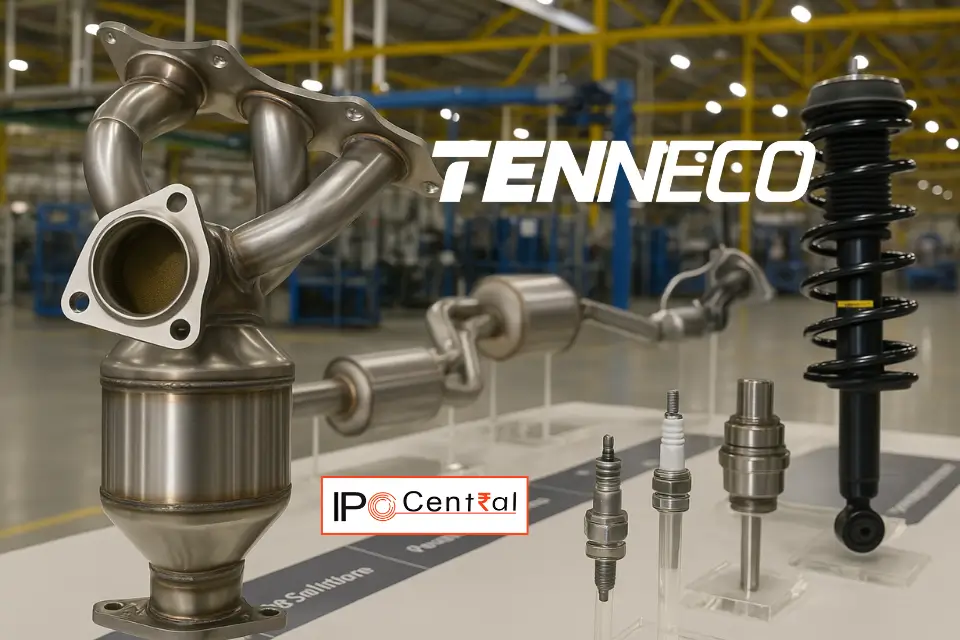
🏭 The Business: Quietly Integral to India’s Automotive Backbone
Since setting up business in Parwanoo in 1979, Tenneco India has grown into a mission-critical supplier to virtually every major vehicle manufacturer in the country. The company operates across three major divisions:
1. Clean Air Solutions
- Exhaust aftertreatment systems (catalytic converters, mufflers, DPFs)
- Used in commercial vehicles (CVs), off-highway (OH), and PVs
- Market Leader:
- 60% market share in the CT segment
- 42% in OH vehicles (excluding tractors)
- 20% in PV segment (Source: CRISIL)
2. Powertrain Solutions
- Bearings, sealing systems, and spark plugs
- Sold under the Champion brand
- Among the top 2 in bearings and the top 5 in ignition components (PV)
3. Advanced Ride Technologies
- Shock absorbers, struts, semi-active suspensions
- Supplied under the Monroe brand
- 48% market share in PV shock absorbers
Together, these make Tenneco a foundational supplier to names like Maruti Suzuki, Mahindra & Mahindra, Tata Motors, Hyundai, Ashok Leyland, and Daimler India.
💹 Financials: Capital-Efficient, Debt-Free, High-Margin Play
In a sector where capex often erodes margins, Tenneco’s discipline stands out:
📊 FY25 Snapshot:
- Revenue from operations: INR 4,890.43 crore
- PAT: INR 553,14 crore (up 33% YoY)
- EBITDA Margin: 16.67% (vs 11.19% in FY24)
- ROCE: 56.78%
- FCF/EBITDA: 61%
- Net Debt: Negative INR 266.20 crore (net cash position)
“Tenneco India is among the rare breed of auto ancillaries with double-digit EBITDA and PAT margins, a clean balance sheet, and very low working capital days,” says a Mumbai-based analyst.
📌 Peer Comparison – FY25:
| Metric | Tenneco India | Peer Avg (Top 8) |
|---|---|---|
| EBITDA Margin (Ops) | 16.67% | 16.06% |
| ROCE (%) | 56.78% | 27.51% |
| ROE (%) | 42.65% | 22.20% |
| Net Debt/Equity | (0.17) | (0.06) |
| Cash Conversion (Days) | -24 | +29 |
🌐 Global-Local Synergy: The Tenneco Advantage
Tenneco India leverages a powerful synergy: Global innovation + Indian localisation.
🔬 R&D & Tech Highlights
- 2 domestic R&D centres, supported by Tenneco Group’s 39 global centres
- Developed India’s first continuously variable electronic suspension for Mahindra EVs
- Localised Euro 6 emission systems into BS6 within 13 months
- Patents include ignition coil geometry, coated bearings, and lightweight suspensions
“We take global systems and modularise them for Indian cost structures. This hybrid R&D model is core to our execution,” said an internal Tenneco engineering lead.
🌏 India as an Export and Innovation Hub
Tenneco India is not just Made in India—it’s Designed for the World.
- In FY25, Tenneco exported to 20 countries including the U.S., Germany, South Korea, Brazil, and Japan
- Exports formed 6.46% of FY25 Value Added Revenue (VAR), with potential to scale further
- Supplies engine bearings, DPFs, and suspensions to global OEMs and internal Tenneco units
Apollo is reportedly backing a strategy to increase India’s share of Tenneco Group’s global manufacturing, given India’s cost advantage and IP transferability.
🔧 Manufacturing Excellence: Scale + Lean
- 12 manufacturing plants across 7 states and 1 union territory
- Plants located close to OEM hubs—Maharashtra, Tamil Nadu, NCR, Gujarat
- Certified under IATF 16949, ISO 14001, ISO 45001, and TISAX
- Average capacity utilisation (FY25):
- Clean Air “hot end” (catalytic converters): 80.57%
- Advanced Ride Tech: 83%
The company follows a “just-in-time plus” model—driven by SAP-based forecasting, zero-defect delivery (99%+ on-time), and supplier co-location strategy.
🔍 Risks to Watch: Concentration, Cyclicality, EV Transition
While Tenneco India checks many boxes, a few concerns stand out:
- High client concentration: Top 3 customers = >50% VAR
- Export volatility: External shocks (Red Sea, energy prices) could impact routes
- ICE exposure: Though pivoting to EVs, a large share of Powertrain is still tied to combustion tech
- IPO is OFS-only: No fresh proceeds means growth will be funded internally
🚘 Macro Tailwinds: Regulation, Premiumization, Electrification
According to CRISIL Intelligence:
- PV volumes are set to grow at 4–6% CAGR till FY30, led by SUVs and EVs
- CT volumes to grow at 3–5% CAGR with strong infra demand
- Export CAGR of 7–9% driven by global OEMs localising Indian production
Regulatory Tailwinds:
- BS6 Phase II already implemented; BS7, TREM V, CPCB+ coming
- These require higher CPV: more sensors, filters, ECUs, and emission components
🎯 Strategic Roadmap: What Lies Ahead
Tenneco India’s post-IPO strategy centres on:
- Growing export share to 10–12% of VAR
- Localisation of high-value components like ceramic spark plugs and IROX bearings
- EV-ready ride tech: semi-active suspensions, modular damping systems
- Capturing the hybrid engine opportunity with compact powertrain systems
- Deeper aftermarket reach through Motocare India
Conclusion
Tenneco India’s DRHP may be an exit route for Apollo, but it could be an entry point for investors seeking:
- A clean balance sheet
- Strong free cash flow
- Tailwinds from regulation, EV, and localisation
- Cross-border strategic advantage
What remains to be seen is the IPO pricing. If the valuation stays in line with peers like Sharda Motors or Sona BLW (at 30–35x earnings), it could attract long-term institutional interest.