


































The government announces 7 new railway corridors and a budget of INR 2.93 lakh crore in the FY26-27 for the modernisation of Railways. Railway-focused EPCs may see another wave of growth. To capitalise on this, TrenZet Infra has filed DRHP with the Securities and Exchange Board of India (SEBI). TenZet Infra IPO is looking to tap the capital markets through a mix of Fresh+OFS aggregating up to 1.23 crore shares. The IPO is being managed by Unistone Capital, and Bigshare Services is appointed as the registrar of the issue.
TrenZet Infra IPO: Business Overview
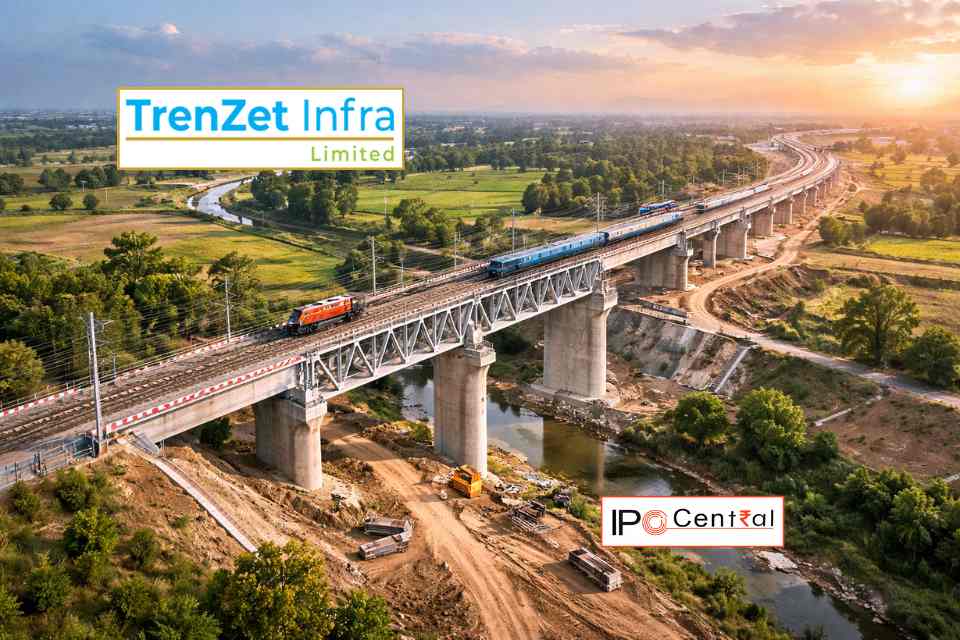
TrenZet Infra operates as a railway-focused EPC contractor with capabilities spanning bridge construction, earthworks, track development, and select electrification projects. As of January 2026, the company has executed 40 projects across seven states with an aggregate executed value of INR 1,497.02 crore. The company is maintaining an order book worth INR 1,600.97 crore that gives a revenue visibility for upcoming quarters.
However, TrenZet’s order book is heavily skewed towards government projects, mainly Indian Railways, which contributes nearly 68% of the order book. This concentration reflects both a strength in domain expertise and a risk of client concentration.
The macro backdrop will also remain supportive as the railway bridge segment is expected to grow at a CAGR of ~9%, expanding from INR 6,011 crore in CY24 to INR 10,081 crore by CY30. Simultaneously, ongoing investments in ROBs and RUBs—over 10,800 constructed between CY14 and CY23—highlight sustained government focus on rail infrastructure modernisation.
Read Also: Check All Upcoming IPO Status Here
TrenZet Infra IPO: Financial Performance
| Particulars | FY23 | FY24 | FY25 | H1 FY26 |
|---|---|---|---|---|
| Revenue from Operations | 269.47 | 308.36 | 333.41 | 151.12 |
| EBITDA | 22.20 | 25.20 | 35.53 | 19.37 |
| EBITDA Margin (%) | 8.24 | 8.17 | 10.66 | 12.82 |
| Profit After Tax | 12.78 | 15.90 | 26.95 | 10.58 |
| PAT Margin (%) | 4.74 | 5.14 | 8.05 | 6.97 |
| EPS (INR) | 3.68 | 4.59 | 7.70 | 3.02 |
As you can see in the above table, revenue has grown at a slower pace, but profitability has seen a sharper uptick. Its PAT has more than doubled between FY23 and FY25. This signals a better project execution, improved cost controls, and a higher contribution from EPC contracts. EBITDA margins also expanded from ~8% to over 12% in the same period.
Revenue Mix and Client Concentration
The company’s revenue profile highlights a heavy reliance on railway-linked projects.
| Segment | FY25 Contribution |
|---|---|
| Indian Railways | 60.45% |
| Private Sector | 24.94% |
| PSUs | 8.14% |
| Others (AAI, Govt, NHAI) | <7% combined |
The top 5 customers contribute nearly 69% of revenue in FY25, while the top 10 account for over 89%, underscoring client concentration risks despite a diversified project base.
From a contract perspective, the business is dominated by BOQ (Bill of Quantities) contracts, which contributed ~78% of revenue in FY25, while EPC contracts contributed ~18%. EPC contracts, however, typically carry better margins, which partly explains the improving profitability trend.
TrenZet Infra Order Book Bifurcation
The company’s order book is nearly 4.8x of FY25 revenue, offering multi-year revenue visibility.
| Order Book Split | Value (INR Cr) | Share (%) |
|---|---|---|
| EPC Contracts | 878.29 | 54.86 |
| BOQ Contracts | 722.69 | 45.14 |
Geographically, Assam, Odisha, and Jharkhand together account for over 75% of the order book, with a growing presence in the North-East—a region seeing increasing railway infrastructure investments.
Use of IPO Proceeds
TrenZet Infra IPO proceeds are likely to deploy towards working capital and capacity expansion.
| Purpose | Amount (INR Cr) |
|---|---|
| Working Capital | 41.60 |
| Capex (Equipment) | 17.61 |
| General Corporate Purposes | Not disclosed |
Final Words
TrenZet Infra IPO presents a classic mid-sized EPC story transitioning to public markets at a phase where execution scale and margin profile are both improving and government policies is acting as a catalyst for growth. The key positives lie in its strong order book, increasing EPC mix, and improving profitability metrics. However, investors will need to closely monitor execution risks, client concentration, and working capital intensity, which are structural characteristics of the sector.
