






























As Budget 2026 draws closer, industry leaders across sectors are pinning high hopes on it. Business heads and experts are looking for fresh reforms and targeted policy measures that can accelerate growth, improve affordability and ease of doing business, and strengthen investor and consumer confidence. In this article, we bring you the voices from corporate India—what industry leaders want to see in Budget 2026 so that businesses can scale faster and contribute more meaningfully to India’s development journey. Below is a detailed look at Union Budget 2026 expectations:
Union Budget 2026 Expectations | Health Insurance and Retirement Security | Shilpa Arora, Co-Founder & COO, Insurance Samadhan
Healthcare costs in India are rising at 12–14% annually, but tax incentives around health insurance have not kept pace. Currently, under Section 80D, the limits for self, family, and preventive check-ups no longer reflect today’s medical and diagnostic realities.
The budget should consider raising the health insurance deduction to INR 1–1.25 lakh and increasing the preventive health check-up limit to INR 20,000. Incentivising early detection is not just good healthcare policy—it reduces long-term hospitalisation costs and claim severity.
Additionally, retirement planning must account for healthcare inflation. Since annuity income is fully taxable today, it discourages retirees from choosing stable income products. Providing tax relief on annuity payouts or enhanced deductions at the time of purchase would strengthen post-retirement income security and help households manage rising healthcare expenses.
Union Budget 2026 Expectations | Renewable Energy | Manan Thakkar, Co-Founder & MD, Prozeal Green Energy
While India’s solar and wind tariffs rank among the most competitive globally, new challenges are emerging. Curtailment, grid congestion, and power variability are imposing hidden costs that undermine the economic advantages of renewable energy. Strategic budgetary support for battery energy storage systems (BESS), pumped hydro storage, and green hydrogen infrastructure can transform intermittent renewable power into dispatchable, industrial-grade energy—making clean power a reliable baseload alternative.
India currently imports a substantial proportion of critical components—electrolyzers, battery cells, and power electronics—that will form the backbone of future energy infrastructure. Targeted production-linked incentives and sustained policy certainty can catalyse domestic manufacturing ecosystems, reduce foreign exchange vulnerabilities, and generate high-skilled employment opportunities across the value chain.
Union Budget 2026 Expectations | Renewable Energy | Shobit Rai, Co-Founder & MD, Prozeal Green Energy
India continues to import a significant share of electrolysers, battery cells, and power electronics—components that will define the next decade of energy infrastructure. Targeted incentives and long-term policy clarity can accelerate local manufacturing, reduce foreign exchange risks, and generate high-quality employment.
As renewable penetration deepens, the budget must recognize that the energy transition is no longer about generation alone; it is about reliability. A budget that aligns power, industry, and infrastructure will define India’s ability to lead, not just participate, in the global energy transition.
Union Budget 2026 Expectations | Renewable Energy | Arun Lakhani, Chairman and Managing Director, Vishvaraj Environment Ltd.
As India prepares itself for a sustainable and climate-resilient growth, water infrastructure should become a national policy.
- Mandatory treated wastewater reuse for cities, industries and utility clusters to reduce freshwater stress
- A structured policy framework enabling institutional reforms and capital market participation for PPP–HAM–based projects in treated wastewater reuse and irrigation modernisation to elevate water infrastructure
- Provide incentives for green bond issuance by Urban Local Bodies and enhance budgetary allocations to key sewerage schemes to support National Green Tribunal compliance
Union Budget 2026 Expectations | Consumption and Direct Tax Relief | Ram Medury, Founder & CEO, Maxiom Wealth
For salaried Indians, Budget 2026 expectations centre on “tax fairness”—talk includes raising the 30% slab threshold, smoothing slab steps, and even linking slabs to inflation so bracket creep doesn’t quietly raise tax burdens over time. This matters because Indian households spend heavily out-of-pocket on health, education and retirement, making taxes feel heavier than headline ratios suggest. The broader ask is a simpler New Tax Regime with clear savings incentives, GST simplification, and sustained spending on infrastructure, green energy and MSMEs. Predictable policy can lift confidence, planning and long-term wealth creation.
Union Budget 2026 Expectations | Infra Push | Arun Patel, Founder & Partner at Arunasset Investment Services
The upcoming Budget should stay focused on supporting demand through a mix of targeted spending, a steady infrastructure push, and measures that help keep consumption on an even keel, without losing sight of fiscal discipline. A gradual move to bring the fiscal deficit down to around 4.2% of GDP, from about 4.4% earlier, fits well with the government’s broader effort to steadily reduce debt over the coming years.
With inflation easing sharply in recent months, the policy focus has naturally shifted away from price control toward demand support. CPI inflation was 1.3% in December, far below expectations at the start of the year. The RBI’s FY25 inflation forecast has been cut steadily from about 4.2% to closer to 2%, underscoring the need for growth-oriented support.
Union Budget 2026 Expectations | Real Estate and Affordable Housing | Tanuj Shori, Founder & CEO, Square Yards
India’s housing cycle is shifting from luxury-led to a more value-driven phase, with mid-income buyers expected to anchor demand. For Union Budget 2026, the ask is clearer affordability support—stronger tax relief for mid-income homebuyers, higher home-loan interest deduction limits, and continued investment in urban infrastructure. Policy should also incentivise supply in affordable and mid-market segments, where recent launches have skewed toward higher ticket sizes. A budget aligned to these realities can improve price-to-income dynamics and enable more balanced, sustainable urban housing growth.
Union Budget 2026 Expectations | Manufacturing, MSMEs, Duties and Trade Protection | Imran Kagalwala, Co-Founder, Unix India
Manufacturing wants continuity, but Budget 2026 should prioritise domestic value creation—deeper localisation, supply-chain resilience, and competitiveness in mid-value categories like electronics and consumer devices. MSME brands often miss PLI benefits due to eligibility criteria; the expectation is expanded PLI coverage or equivalent support for MSMEs. The sector also seeks duty rationalisation on critical components with limited domestic availability, measures to manage input cost volatility (semiconductors, displays, memory), and a level playing field via anti-dumping action. Infra, skilling, automation and Industry 4.0 support are key.
Union Budget 2026 Expectations | Energy Transition and Grid Reliability | Arif Aga, Director, SgurrEnergy
With India pursuing 500GW renewables by 2030, Budget 2026 must shift focus from pure capacity addition to reliability—grid readiness, storage integration, domestic manufacturing and execution quality. The industry expects strong support for transmission infrastructure (including the Green Energy Corridor), and incentives for FDRE and hybrid projects to improve system stability. Greater clarity on long-term storage market mechanisms, streamlined approvals and faster execution timelines can materially improve project bankability. Continued investment in data-driven planning, resource assessment and independent technical oversight will reduce risk, improve performance outcomes and attract long-term capital.
Union Budget 2026 Expectations | EVs, Clean Mobility and Innovation | Anurag Choudhary, CMD & CEO, Himadri Speciality Chemical
Budget 2026 is a chance to strengthen the EV ecosystem’s innovation backbone. The key ask is higher allocation for R&D—advanced materials, high-performance battery components, and next-gen energy storage—to build long-term competitiveness. With foundations already laid through schemes like FAME and the ACC Battery PLI, the next phase should align fund disbursements with targeted outcomes, enable industry–academia collaboration, and earmark dedicated innovation budgets. Higher outlays for programmes such as PM E-DRIVE can accelerate adoption, especially in public and commercial mobility, alongside continued infrastructure and demand-side incentives.
Union Budget 2026 Expectations | Insurance, Medical Inflation and Consumer Protection | Rakesh Goyal, Director, Probus
As medical inflation outpaces income, the insurance promise often collides with claims friction—policyholders get stuck between insurers seeking clarity and hospitals following inconsistent billing and treatment practices. Budget 2026 is seen as the right moment to push for a proactive healthcare regulator to improve standardisation and consumer protection, alongside the idea of a single, more coordinated regulator to improve clarity across the financial ecosystem. The ask also includes stronger tax benefits for health and term insurance, recognition of preventive healthcare and OPD in the tax framework, and clarity on GST exemptions to support efficient, tech-led distribution.
Union Budget 2026 Expectations | Healthcare, Genomics and Research Ecosystem | Surajit Chakrabartty, CFO, MedGenome Labs
Healthcare is moving toward proactive, integrated care, and genomics/multiomics are increasingly enabling early detection, prediction and targeted treatment. Budget 2026 should build on existing government genome sequencing initiatives and disease-focused programmes by improving awareness, affordability and access. The sector seeks stronger support for research, enabling infrastructure, and public–private partnerships—especially collaborations with Indian companies—to translate omics advances into practical clinical outcomes. Additional budgetary backing for research and on-ground initiatives can strengthen India’s healthcare ecosystem, help domestic players compete globally, and contribute to broader economic growth.
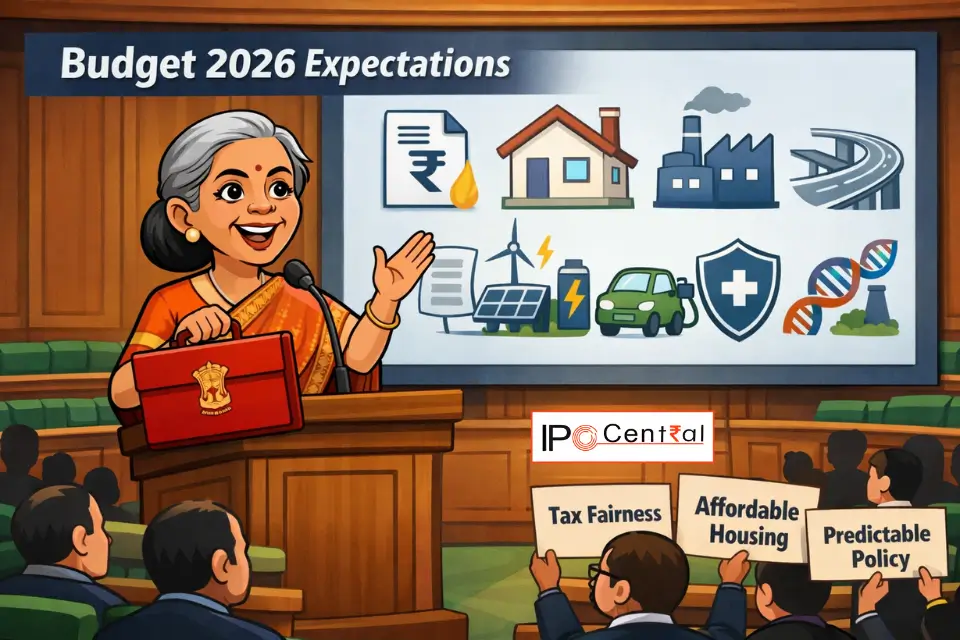
Union Budget 2026 Expectations: Key Highlights
- Direct tax relief & fairness: higher 30% slab threshold, smoother slabs, inflation-linked brackets
- Housing affordability: higher home-loan interest deduction limits, mid-income tax relief, urban infra push
- MSME manufacturing support: wider PLI-style incentives, duty rationalisation, anti-dumping safeguards
- Renewables system readiness: transmission, storage market clarity, faster approvals, execution discipline
- EV innovation: R&D in advanced materials and battery components, outcome-linked disbursements
- Insurance & healthcare protection: stronger tax benefits, OPD/preventive care recognition, regulatory clarity
- Healthcare innovation: genomics/multiomics research, infra and PPP support
- Simplification: GST simplification, compliance ease, predictable policy for confidence and planning
Bottomline: Across sectors, the consistent message is predictability + simplification + targeted incentives: tax policy that feels fairer to households, affordability measures that widen participation (housing/health), and execution-focused spending that improves competitiveness (infra, MSMEs, energy transition). If Budget 2026 balances fiscal discipline with clear growth levers, it can strengthen confidence for both investment and consumption.
For more details related to IPO GMP, SEBI IPO Approval, REIT, InvIT and Live Subscription stay tuned to IPO Central.