

































India’s largest tech-driven home services marketplace, Urban Company, is stepping into the capital markets with its much-anticipated INR 1,900 crore IPO scheduled for 10–12 September 2025. The offer consists of a fresh issue of INR 472 crore and an offer for sale of INR 1,428 crore.
Founded in 2014 by Abhiraj Singh Bhal, Varun Khaitan, and Raghav Chandra, Urban Company has transformed itself from a startup experiment into a scaled consumer-tech platform. With a business model that seamlessly connects consumers seeking reliable services and trained professionals seeking predictable earnings, Urban Company has become the face of the organized home services sector in India. As it prepares to list, the key question for investors is: how strong is its foundation, and what lies ahead?
That’s where a Urban Company SWOT analysis becomes critical. So, without wasting time, let’s jump straight into the analysis
Table of Contents
Urban Company IPO SWOT Analysis
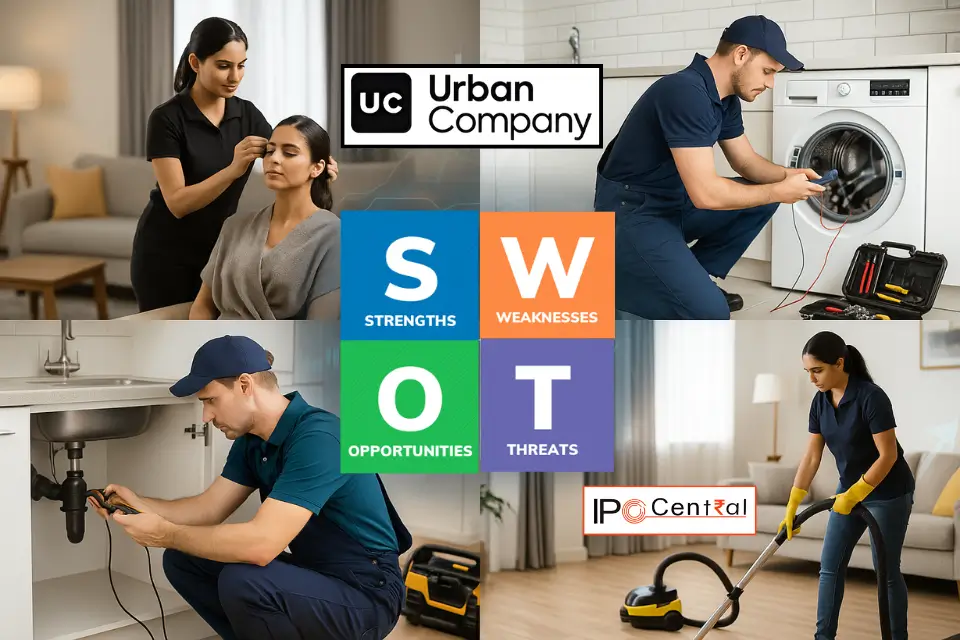
The company’s IPO journey is best understood through Urban Company SWOT analysis—unpacking its strengths, exposing weaknesses, and exploring opportunities alongside looming threats.
Urban Company SWOT Analysis: Strengths
Urban Company’s rise to prominence is anchored in a set of strong internal levers that position it as the undisputed leader in India’s organized home services market.
- 1. Scale and Market Leadership: With operations across 51 cities worldwide (47 in India, plus Singapore and UAE), and having delivered over 9.75 crore service orders till June 2025, Urban Company has achieved scale that no peer can match. Its consumer base has deepened rapidly: 65.4 lakh annual transacting users in FY25, up from 47.6 lakh in FY23, reflect not just growth but also consumer stickiness in a traditionally fragmented market.
- 2. Growing Consumer Engagement: The company is not merely acquiring customers but also driving higher spend. The average annual spend per customer increased from INR 3,786 in FY23 to INR 4,079 in FY25. This growth in wallet share shows Urban Company’s ability to expand service penetration and cross-sell effectively.
- 3. Technology-Driven Operations: At the core of its model is the UC Partner App, which standardises workflows, has in-app guidance, digital invoicing and proof-of-work (like photo evidence of cleaning tasks). This structured tech enabled approach ensures consistency, builds trust and differentiates UC from unorganised competition.
- 4. Training and Skill Development Moat: The company has built a robust supply side ecosystem. With a tie up with National Skill Development Corporation (NSDC), UC delivered 12.3 lakh training hours in Q1 FY26 alone. Certified professionals get higher ratings, creating a virtuous cycle of consumer trust and repeat bookings. This training infrastructure is not replicable and creates a long term competitive moat.
- 5. Financial Turnaround: Perhaps the biggest strength going into its IPO is profitability. Urban Company went from a loss of INR 312.5 crore in FY23 to a profit of INR 239.8 crore in FY25 – its first full year profit since inception. Revenue grew to INR 1,144 crore in FY25 with net margin improving to 20.9%.
- 6. Diversified Revenue Streams: Its B2B supply chain (tools and consumables sold to professionals) clocked INR 229 crore in Q1 FY26, with nearly 65% of professionals sourcing via UC. The Native brand appliances (IoT-enabled water purifiers, smart locks) integrate seamlessly with UC’s service model, creating hardware-plus-service stickiness. Seasonal categories such as AC servicing in summer, salon during weddings, provide cyclical stability.
- 7. Brand Equity and Consumer Trust: Over a decade, UC has become synonymous with reliable, standardized home services. Its emphasis on warranties (10–180 days depending on service), background verification, and SOP-driven delivery builds consumer trust—critical in a category plagued by fears of unreliability.
Urban Company SWOT Analysis: Weaknesses
While Urban Company has achieved scale and profitability, several internal challenges underline the fragility of its success.
- 1. High Cost Structures: The company’s business model demands heavy upfront costs. Service professional onboarding alone cost INR 1,580.6 crore in FY25, equivalent to 22.8% of India revenue, and INR 513 crore in Q1 FY26 (23% of revenue).
- 2. Dependence on Service Professionals: Urban Company’s platform thrives only as long as its service professionals remain engaged and satisfied. Attrition or dissatisfaction—driven by ratings-based algorithms, earnings volatility, or protests over employment terms—can directly impact service supply.
- 3. International Losses Dragging Overall Performance: While India operations are profitable, overseas units remain a drag. In FY25, the UAE, Singapore, and Saudi JV reported a combined adjusted EBITDA loss of ~INR 368 crore. Scaling internationally requires heavy marketing and operational costs, creating a persistent burden on consolidated results.
- 4. Operational and Supply Chain Vulnerabilities: UC relies on third-party warehouses across six locations in India. Any improper handling, fire, or termination of warehouse contracts could disrupt operations. For instance, in May 2025, a fire at a third-party warehouse in Bhiwandi led to an inventory loss claim of INR 89.4 crore. Similarly, reliance on third-party installers in smaller cities creates risks of damage, consumer dissatisfaction, and warranty claims.
- 5. Dependency on Technology Ecosystem: While tech is its strength, it’s also a weakness. Heavy reliance on cloud infrastructure and digital acquisition channels (search engines, social media) makes UC vulnerable to outages, algorithm changes, or higher ad costs. These risks could inflate CAC (customer acquisition costs) and reduce visibility.
Urban Company SWOT Analysis: Opportunities
Urban Company’s IPO comes at a time when structural tailwinds in India’s urban economy and global service consumption patterns create strong growth opportunities.
- 1. Expanding Urban Middle-Class Demand: India’s urban households are spending more on convenience, lifestyle, and quality services. According to the Redseer Report (2025), discretionary spending on beauty, home improvement, and repair services is projected to grow at double-digit rates over the next five years. As India’s cities urbanize and dual-income households rise, Urban Company is well-positioned to capture a larger share of this wallet.
- 2. Low Penetration of Organized Home Services: The market remains heavily fragmented and dominated by informal providers. Urban Company, with 65.4 lakh transacting consumers in FY25, has only scratched the surface of a potential user base running into hundreds of millions of urban households. The scope to onboard first-time users into an organized ecosystem is massive.
- 3. Growth of Native Brand and IoT Appliances: Urban Company’s expansion into consumer appliances under the “Native” brand is a significant opportunity. Its IoT-enabled water purifiers and smart locks integrate directly into the UC app for monitoring and servicing. With the board approving a dedicated assembly facility in Aug 2025, UC signals its intent to scale this business. Hardware sales also create recurring revenue opportunities through filters, repairs, and AMC contracts, locking consumers into its ecosystem.
- 4. Cross-Selling to Service Professionals: UC has already built a B2B marketplace inside its app, selling tools, kits, and consumables. In Q1 FY26 alone, this vertical generated INR 229 crore, with 46% from exclusive UC-owned brands (Native, Elysian, Crave). With 65% of professionals already sourcing supplies via UC, deeper penetration can boost margins and further entrench professionals into its ecosystem.
- 5. International Expansion Potential: Though currently loss-making, international operations offer long-term upside. In FY25, they contributed INR 1,470 crore. Strategic moves, such as the tie-up with Noon (a leading Middle East e-commerce giant) in July 2025, can accelerate consumer acquisition and discovery in UAE and KSA. With rising affluence in these regions, UC’s premium service positioning has a natural audience.
- 6. Policy and Digital Tailwinds: India’s push for formalization, skill development, and digital adoption works in UC’s favor. Its partnership with the National Skill Development Corporation (NSDC) ensures alignment with government priorities. As regulations tighten around quality, safety, and consumer rights, organized players like UC stand to benefit versus fragmented local providers.
Urban Company SWOT Analysis: Threats
Even with strong fundamentals and growth levers, Urban Company operates in an environment where several external risks could challenge its trajectory.
- 1. Regulatory Risks in Gig Economy: One of the most significant external risks is the potential reclassification of gig workers as employees. Unionization pressures and legal petitions have already emerged, arguing that UC’s service professionals deserve employment benefits. If courts or regulators mandate Provident Fund, insurance, or statutory benefits, UC’s asset-light contractor model could face cost inflation, hurting margins and scalability.
- 2. Competitive Pressures: While UC is the market leader, the barriers to entry are not insurmountable. Traditional offline providers, new-age startups, and even OEMs (original equipment manufacturers) are strengthening their own service arms. For example, appliance makers increasingly offer direct servicing and extended warranties, which could reduce UC’s repair business volumes.
- 3. Consumer Behavior Shifts: External trends could also disrupt demand. For instance, the rise of laser hair removal may reduce demand for waxing services. Similarly, product innovations like self-cleaning appliances could lower the need for third-party servicing. UC’s ability to continually launch relevant categories will be tested by these shifts.
- 4. International Uncertainties: UC’s overseas operations bring foreign exchange risk, geopolitical tensions, and compliance exposure. Its tie-up with a training center in Myanmar to source professionals for Singapore, for example, introduces vulnerability to international sanctions and AML laws. Additionally, the Saudi JV (50% ownership) constrains UC’s autonomy—strategic decisions require partner approval, limiting flexibility in expansion or restructuring.
- 5. Macroeconomic Volatility: As a large share of UC’s services fall under discretionary spending (beauty, wellness, home décor), demand is vulnerable to downturns in consumer confidence. Factors like inflation, job losses, or declining disposable incomes could lead consumers to opt for cheaper, informal alternatives.

Final Words
Urban Company’s journey to IPO is the evolution of a startup into a structured, profitable platform redefining India’s home services ecosystem. They have shown remarkable resilience – from losses to profits. This is a sign of operational maturity and investor confidence.
At the same time, the Urban Company SWOT analysis shows a dual reality – their strengths and opportunities give them huge room to grow but their weaknesses and threats are fragile.
Urban Company’s business model is built on trust, standardization and consumer experience – areas where they have a clear edge over unorganized competition. In the broader macro context, Urban Company will benefit from India’s increasing discretionary spending, digital adoption and push for skill formalization. But they also have to navigate geopolitical compliance risks abroad, algorithm driven visibility challenges and consumer behavior changes that can change demand patterns.
Overall, Urban Company SWOT analysis paints the picture of a high-potential, category-defining company that has crossed critical inflection points but remains exposed to external risks. For long-term investors, this IPO offers entry into a unique platform business with strong upside potential.
For more details related to IPO GMP, SEBI IPO Approval, and Live Subscription stay tuned to IPO Central.