























Bengaluru-headquartered Contract Research, Development and Manufacturing Organisation (CRDMO), Anthem Biosciences, filed its DRHP for a public offering of up to INR 3,395 crore through an OFS. Anthem Biosciences IPO marks a critical inflection point for the company, reflecting its maturity, credibility in global pharma circles, and a strategic push towards biologics and next-gen modalities. Founded by a team of accomplished technocrats and professionals, Anthem has evolved into a fully integrated player in the pharmaceutical outsourcing space.
This article provides an exhaustive and analytical breakdown of Anthem Biosciences business model—how it earns money, what differentiates it from peers, its scalability and sustainability, and how it aligns with macro and industry trends. We’ll also touch upon its financials, growth levers, risks, peer comparisons, and strategic outlook.
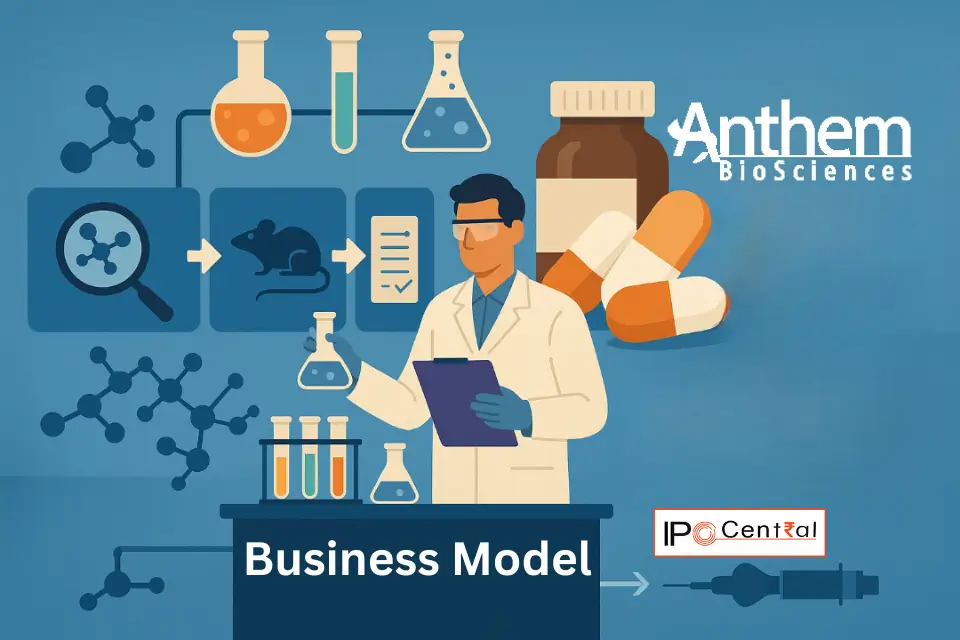
Anthem Biosciences Business Model: How Does Anthem Make Money?
Anthem functions as a full-service CRDMO, providing end-to-end solutions for pharmaceutical and biotech companies. Its integrated value chain allows a single client to engage with Anthem across multiple development phases, reducing fragmentation, compliance hurdles, and transfer costs. Anthem makes money by offering research, development, and manufacturing capabilities under flexible commercial models, including fixed-fee, milestone-linked, and revenue-sharing formats.
#1 Revenue Streams
- Contract Research Services:
- Drug discovery services accounted for INR 200 crore in FY24, growing 21% YoY.
- Offerings include target validation, medicinal chemistry, and preclinical safety studies.
- Development Services:
- Includes process optimisation, scale-up, and formulation R&D.
- Earned INR 130 crore in FY24 and contributed significantly to repeat business.
- Manufacturing Services:
- APIs made up 40% of overall revenue. Anthem also manufactures formulations and biologics.
- Manufacturing income reached INR 580 crore in FY24.
- Licensing and Royalties:
- Royalty-based revenue from co-developed intellectual property.
- Licensing income was INR 35 crore in FY24, with room for high-margin expansion.
#2 Revenue Model Structure
- Fee-for-service (FFS): milestone-based, predictable revenue
- Per-batch pricing: scalable manufacturing output for commercial clients
- Royalties: recurring income from partnered molecules
#3 Client Profile
- Over 80 clients globally, primarily mid- and large-cap pharma companies.
- 65% revenue from regulated markets, especially the US and Europe.
- Repeat business rate exceeded 75% in FY24, showing deep customer engagement.
#4 Integrated Value Chain Positioning
| Phase | Role Played by Anthem |
|---|---|
| Drug Discovery | ✓ Medicinal chemistry, ADME profiling |
| Pre-clinical Development | ✓ GLP toxicology, stability testing |
| Clinical Trial Material | ✓ GMP-compliant batches for trials |
| Regulatory Filing Support | ✓ Data and documentation for IND/NDA |
| Commercial Manufacturing | ✓ APIs, Biologics, Oral Solid Dosage |
📌 Anthem earns money by offering pharma clients a one-stop shop—from early drug research to final production—across both small and large molecule domains.
Manufacturing and Infrastructure Strengths
Infrastructure is critical to a CRDMO’s success, especially when clients demand consistent regulatory compliance, speed, and scalability. Anthem operates two campuses—Bommasandra and Harohalli—spanning 4,00,000 sq. ft., equipped with high-end equipment and modular manufacturing lines. Both facilities are approved by global regulators like the US FDA, EMA, PMDA, and WHO.
- 1,000+ employees, including 300+ scientists, ensure technical and operational agility.
- The company operates 42 commercial-scale reactors, with bioreactors supporting recombinant DNA work and fermentation capabilities.
- Technology platforms include flow chemistry, biosynthesis, and biologics.
- The company plans a CAPEX cycle of INR 450 crore over the next three years to double capacity.
📌 Global certifications allow Anthem to serve high-value clients from the US, EU, and Japan—an important driver for premium billing and sustainable contracts.
Financial Performance
Anthem Biosciences has consistently delivered strong financial results, with high margins and capital efficiency.
| Metric | FY22 | FY23 | FY24 |
|---|---|---|---|
| Revenue from Operations | 1,231.26 | 1,056.92 | 1,419.37 |
| EBITDA | 421.67 | 400.52 | 519.95 |
| EBITDA Margin (%) | 33.5% | 35.3% | 36.6% |
| PAT | 405.54 | 385.19 | 367.31 |
| RoNW (%) | 39.48% | 24.93% | 20.03% |
| EPS (INR) | 7.11 | 6.75 | 6.48 |
- H1 FY25 revenue at INR 863.55 crore (up 47% YoY)
- Net asset value per share: INR 34.43
- PAT margin of 25.9%, outperforming industry peers
📌 Anthem’s increasing margins and strong return on net worth show it’s running an efficient and profitable business—key signals for investors.
Industry Context and Growth Outlook
The global CDMO sector is booming as pharma and biotech companies increasingly outsource research and manufacturing. This shift allows them to remain asset-light and agile.
#1 Global Pharma & CDMO Trends
- Global pharma market: USD 1.45 trillion (2023) → USD 1.96 trillion (2028)
- CDMO industry CAGR: 10.2%, driven by biologics, speciality drugs, and advanced therapies
- Over 70% of new drug sponsors are emerging biotechs with no internal manufacturing
- Regulatory harmonisation is accelerating CDMO cross-border scalability
#2 Indian Pharma/CDMO Landscape
- India is the world’s largest generics supplier and ranks among the top five API manufacturers globally.
- PLI scheme of INR 15,000 crore incentivises API, KSM, and bulk drug production
- CRAMS market: Expected to reach USD 20.5 billion by FY28 (12.5% CAGR)
📌 The global shift toward outsourcing and India’s emergence as a CRDMO hub work in Anthem’s favour for long-term growth.
Strategic Levers for Anthem’s Future Growth
Anthem is investing in multiple forward-looking areas:
| Growth Lever | Description |
| Biologics Capacity | Expanding fermentation and cell culture platforms |
| Digitalization | Adopting LIMS, QbD tools, and predictive analytics |
| Licensing Partnerships | Co-developing assets with small biotech companies |
| US/EU Market Penetration | Expanding regulatory filings and submissions for ANDA and NDA support |
| R&D Productivity | Investing INR 200 crore in discovery engines and lab automation |
📌 Whether through digital R&D, biologics, or IP licensing, Anthem is preparing to tap into high-growth, high-margin opportunities of the future.
Anthem Biosciences Business Model Analysis: Peer Comparison
| Company | Revenue (INR Cr) | P/E (x) | EBITDA Margin (%) | RoNW (%) |
| Anthem Biosciences | 1,419.37 | TBD | 36.6 | 20.03 |
| Syngene Intl. | 3,579.2 | 67.2 | 28.3 | 12.95 |
| Divi’s Labs | 8,184.0 | 97.0 | 26.9 | 12.15 |
| Sai Life | 1,494.3 | 168.9 | 19.1 | 8.89 |
| Suven Life | 1,113.3 | 105.7 | 36.5 | 15.86 |
Challenges and Mitigating Strategies
| Risk | Impact | Mitigation Strategy |
| Client Concentration | 54% from top 5 clients | Broaden client mix, diversify regions |
| Regulatory Risks | Delays or rejections by US FDA, EMA | Redundant site validations, regular audits |
| Talent Attrition | Risk of IP leakage and delivery delays | ESOPs, academic tie-ups, internal upskilling |
| Tech Obsolescence | Missed pipeline shifts in CGT, mRNA | Active investments in new platform tech |
| Margin Pressure | Commoditization in APIs | Focus on specialty molecules and high-barrier products |
📌 Anthem acknowledges industry challenges and has clear strategies to stay competitive—an encouraging sign of seasoned leadership.
Final Words
Anthem Biosciences business model entails high scientific capability, compliance rigor, and business scalability. With a sharp focus on biologics, process innovation, and global regulatory alignment, it has established a differentiated niche. Anthem Biosciences IPO gives investors a chance to participate in India’s ascension as a global biopharma outsourcing powerhouse.