


































In a major tightening of listing norms to protect investors and improve the quality of companies on its main platform, BSE has introduced tough new eligibility criteria for small and medium enterprises (SMEs) looking to migrate from the SME platform to the mainboard. The rules are applicable to companies listed on other exchanges too, that are looking to list directly on the BSE Mainboard. This is one of the biggest changes in recent times.
This comes just over three months after NSE had raised similar hurdles for migration to its mainboard, indicating a broader regulatory push towards better market integrity and higher corporate governance standards.
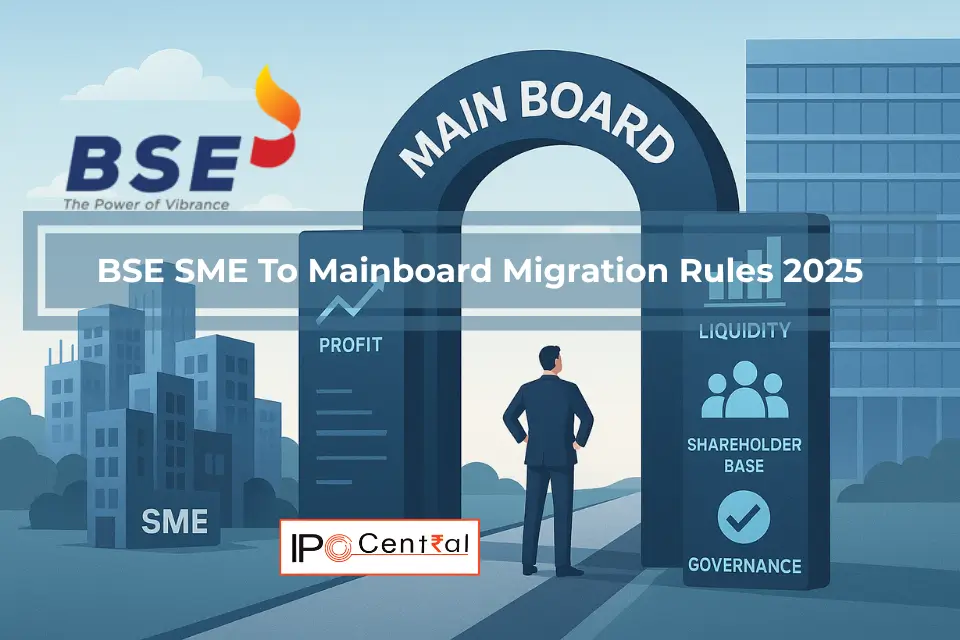
Key Changes in BSE SME to Mainboard Migration Rules 2025
1. Profitability Thresholds Sharply Raised
- According to the new BSE SME to mainboard migration rules 2025, companies must now have an average operating profit (EBITDA) of at least INR 15 crore over the preceding three full financial years, with a minimum of INR 10 crore in each year.
- This is a steep jump from the earlier requirement of merely having positive operating profit in at least two of the last three years.
- If the company has changed its name in the past year, at least 50% of revenue over the past year must come from the activity reflected in the new name.
2. Expanded Public Shareholder Base
- The minimum public shareholder count has been raised from 250 to 1,000 as per the latest shareholding pattern.
- This is aimed at ensuring broader investor participation and stronger liquidity before the mainboard migration.
3. Market Liquidity Requirements Introduced
According to the new BSE SME to mainboard migration rules, applicants must meet all of the following in the preceding six months:
- Trading of at least 5% of the weighted average number of equity shares.
- Trading on at least 80% of market days.
- Minimum average daily turnover of ₹10 lakh and minimum daily turnover of ₹5 lakh.
- Minimum average daily trades of 50 and minimum daily trades of 25.
4. Asset, Capital & Net Worth Requirement
- Paid-up capital: At least INR10 crore.
- Net worth: At least INR 1 crore in each of the last three financial years.
- Net tangible assets: At least INR 3 crore in each of the last three years, with not more than 50% in monetary assets unless committed for business use.
- Market capitalisation:
- SME migration: Minimum INR 100 crore average over the last 6 months.
- Direct listing: Minimum INR 1,000 crore average over the last 6 months.
5. Compliance, Governance & Regulatory Track Record
The new BSE SME to mainboard migration rules 2025 also includes:
- Minimum three-year listing history.
- Three years of compliance with SEBI (LODR) regulations with no pending non-compliance.
- Clean record:
- No SEBI debarment.
- Not a wilful defaulter or fraudulent borrower.
- Promoters/directors are not fugitive economic offenders.
- No insolvency/winding-up proceedings under IBC.
- Not suspended from trading for non-compliance in the past 12 months (except procedural reasons).
- Promoter holding: At least 20% at application (promoter group holding can be considered for shortfall), fully in dematerialised form.
- Lock-in: 6 months from listing on BSE for direct listing (not applicable for SME migration).
- No pending defaults on bonds, debt instruments, or fixed deposits.
- No ongoing enhanced surveillance categorisation such as ESM, ASM, GSM, or T-to-T; plus a 2-month cooling-off period after exiting such categories.
- No pending investor complaints on SCORES.
6. Other Compliance & Certification
- Certificate from a Credit Rating Agency confirming utilisation of IPO proceeds and subsequent issues (post-SME listing).
7. Business Stability & Audit Cleanliness
- The company must be in the same line of business for at least 3 years, with 50% of revenue from the continued activity.
- No audit qualifications relating to going concern or material financial matters at the time of application.
Why These Changes Matter
The BSE’s SME platform — home to over 600 listed companies with a combined market capitalisation of about INR 75,000 crore — has been the launchpad for many emerging businesses to access capital markets. Nearly 200 SMEs have already moved to the mainboard.
By increasing the profitability, liquidity, shareholder and governance thresholds, the exchange is saying only the most financially strong, transparent and liquid SMEs will graduate to the mainboard.
The changes in BSE SME to mainboard migration rules will also align BSE’s standards with global best practices, reduce the risk of illiquid stocks on the mainboard and build investor confidence.
Market Reaction and Outlook
Experts say that while these BSE SME to mainboard migration rules will certainly reduce the number of eligible candidates for migration, the long-term benefits will outweigh the short-term slowdown in SME-to-mainboard transitions. “Higher thresholds will act as a filter. Investors can expect better governance, higher transparency and stronger financials from companies that make it to the mainboard,” said a Gujarat-based capital markets analyst.
Some SME promoters, however, feel the INR 15 crore EBITDA threshold may be tough for companies in slower-growth sectors and may delay their mainboard plans. The new liquidity and market capitalisation requirements mean companies will have to focus on sustained investor engagement and secondary market activity well before their migration plans.

Conclusion
BSE’s new norms for the migration from SME to mainboard are the most comprehensive tightening of SME migration rules in years, combining financial performance with strict liquidity, governance and compliance conditions. For SMEs looking to move to the mainboard, the message is clear: robust profitability, wide shareholder base, consistent compliance and active market trading will be the pre-requisites. While the bar has been raised, the reward — access to deeper capital pools, greater investor visibility and stronger market positioning — remains as compelling as ever.
For more details related to IPO GMP, SEBI IPO Approval, and Live Subscription stay tuned to IPO Central.