




































India has rolled out its biggest tax overhaul since GST in 2017. Dubbed GST 2.0, it simplifies the earlier four-slab structure (5%, 12%, 18%, 28%) into a two-slab structure of 5% and 18% with a special 40% slab for sin and luxury goods. Compensation cess has been scrapped, a long-pending demand of businesses.
Effective from 22 September 2025, the timing of this reform is no coincidence. For households, it means lower prices on essentials, durables and vehicles. For companies, it means smoother compliance and working capital relief. And for investors, especially those looking at the IPO market, it changes the sectoral growth trajectory at the right time.
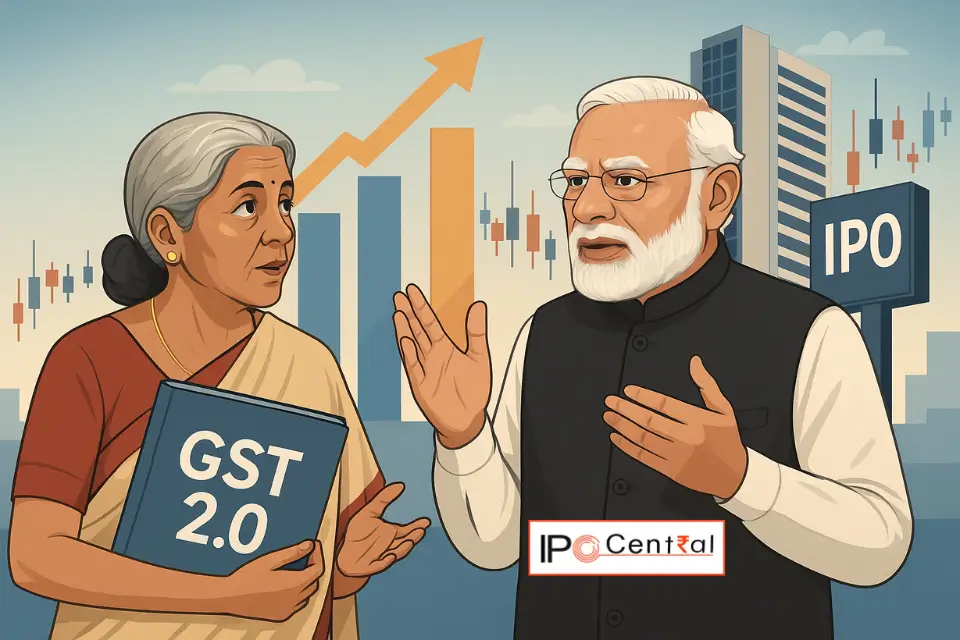
GST 2.0 Reforms: Macro & Policy Lens
At the macroeconomic level, GST 2.0 is a double-edged sword.
- Revenue arithmetic: While the Centre projects a net fiscal impact of INR 48,000 crore (based on FY24 consumption data), several states have flagged potential losses of INR 80,000–1.5 lakh crore. This tension underscores the balancing act between easing consumer burden and maintaining state revenues.
- Inflation effect: Analysts estimate the reforms could shave 20–30 basis points off CPI inflation, particularly as food, FMCG, and housing inputs become cheaper. This softening could give the RBI more flexibility in its monetary policy stance.
- Ease of doing business: Beyond rate cuts, the Council has promised faster refunds, automated registrations, and corrections of inverted duty structures, all of which reduce friction for corporates.
For investors, the signal is clear: the government is willing to trade near-term fiscal tightening for long-term demand revival, setting a favourable backdrop for capital markets.
Expert & Market Voices
The reforms have drawn near-unanimous approval from economists, industry veterans, and policymakers:
- Axis Securities: “GST 2.0 can reignite consumption and set off a multiplier effect across the economy.”
- SBI Card CEO, Salila Pande: “This directly increases disposable income, giving households more flexibility to spend, save, and plan ahead.”
- Confederation of Indian Industry (CII): Termed the two-rate structure a “masterstroke of simplification”, likely to cut disputes and encourage investment.
- PM Modi: Called the GST Council’s decision a “pro-people move” benefiting farmers, MSMEs, women, and youth.
- Commerce Minister Piyush Goyal: Linked GST 2.0 to the larger vision of “Viksit Bharat 2047”, underscoring its nation-building potential.
Together, these voices shape a consensus: GST 2.0 is more than a tax tweak—it is a demand stimulus.
4. GST 2.0: Sectoral Impact Analysis
Automobiles
- Small cars and two-wheelers: Tax cut from 28–31% to 18% is expected to revive demand in India’s largest consumer durable segment. Industry bodies like SIAM hailed the move as “timely and festive-friendly.”
- Luxury vehicles: Brought under the 40% slab (earlier 43–50%), providing some relief while keeping the high-tax principle intact.
- Electric vehicles (EVs): Retained at 5%—a crucial signal of long-term policy stability for green mobility.
Consumer Durables
- TVs, air-conditioners, refrigerators, washing machines: Slashed from 28% to 18%. Appliance makers estimate INR 3,000–5,000 savings per product, likely to boost festive demand, particularly in Tier-II and Tier-III cities.
FMCG & Packaged Foods
- Personal care products like shampoos, soaps, hair oil, and toothpaste are now taxed at 5% instead of 12–18%.
- Packaged foods such as biscuits, noodles, chocolates, and coffee also fell to 5%.
This is expected to improve rural demand recovery, a segment under stress for the past two years.
Healthcare & Insurance
- Insurance: Life and health policies are now GST-exempt, making premiums cheaper and expanding coverage.
- Medicines & medical devices: Brought down to 5% or nil, easing treatment costs. Industry leaders called this a “revolutionary shift” for affordability and insurance penetration.
Real Estate & Cement
- Cement’s rate cut from 28% to 18% reduces housing project costs, improving developer margins by an estimated 3–5%. Developer Sunteck Realty view this as a “game-changer” for affordable housing demand.
Renewables
- Solar panels, batteries, hydrogen fuel cells, and biogas units are now at 5% GST. Hindustan Power described this as “truly transformative” for green energy adoption.
- Coal’s rate was raised from 5% to 18%, but since cess was absorbed, the net impact is marginal.
Agriculture
- Fertiliser inputs (sulphuric acid, nitric acid, ammonia) cut from 18% to 5%.
- Agricultural machinery is also down to 5%, supporting mechanisation and lowering farm-level costs.
Neutral/Negative Segments
- Online education, coaching centres, gig services: Still taxed at 18%.
GST 2.0 Impact on IPO Market
The IPO pipeline in India is crowded, with over 70 companies receiving SEBI approval in the past year. The GST 2.0 reset adds a crucial layer to their valuation story. Companies in sectors aligned with consumer demand, housing, healthcare, and renewables are likely to find stronger subscription and post-listing momentum.
Below is a sector-wise mapping of IPOs and the expected GST 2.0 impact:
| Company | Sector | GST 2.0 Impact | Expected IPO Momentum |
|---|---|---|---|
| Metalman Auto | Auto components | Small cars/two-wheelers GST cut to 18% → volume recovery | Strong positive |
| Greaves Electric Mobility | EVs | EVs remain at 5% GST → policy stability, demand push | Very strong |
| Studds Accessories | Helmets/gear | Affordable mobility segment boost | Positive |
| Paras Healthcare, Veeda Clinical Research | Healthcare & hospitals | Insurance exemption + lower GST on devices/medicines improves affordability | Very strong |
| Hero FinCorp, Aye Finance, Avanse Financial, Veritas Finance | Financial services | Higher disposable income, insurance penetration → credit demand | Positive |
| LG Electronics India, Kent RO Systems, Imagine Marketing (boAt) | Consumer durables & electronics | TVs, ACs, appliances GST cut to 18% → festive demand uplift | Strong |
| Casagrand Premier Builder, Varindera Constructions, Runwal Enterprises, Pranav Constructions | Real estate & infra | Cement GST cut (28%→18%) reduces costs, aids housing demand | Strong |
| PMEA Solar Tech, Solarworld Energy, Continuum Green Energy, Juniper Green Energy, Saatvik Green Energy, GK Energy | Renewables | 12%→5% GST on solar/green tech → IRR improvement | Very strong |
| GSP Crop Science, SeedWorks International, Advance Agrolife | Agri & inputs | Fertiliser/machinery GST reduced → stronger rural demand | Positive |
| WeWork India, Physicswallah, Jaro Institute, Urban Company | Services/EdTech | Still taxed at 18% → no relief; compliance-heavy | Neutral to weak |
| Tobacco-related peers (if any) | Sin goods | Moved into 40% bracket | Negative |
Can GST 2.0 Offset Trump’s Tariffs?
The GST reforms are certainly not designed as a direct response to U.S. tariffs, but many experts see them as a buffer against the economic shock caused by the steep 50% import duties on Indian goods.
- Kotak AMC MD Nilesh Shah summed it up: “Ek teer kai nishaan”—with one reform hitting multiple targets. He said GST 2.0 not only boosts consumption and growth but also “partially offsets the negative effects of U.S. tariffs.”
- CII President Rajiv Memani was more optimistic, stating the combined effect of GST cuts, monetary easing, and fiscal measures will “help mitigate the impact of 50% American tariffs.”
- Studies from SBI Research and Elara Capital suggest GST 2.0 could add 100–120 basis points to GDP over 4–6 quarters—potentially neutralizing tariff-led slowdown.
However, not all are convinced it’s a complete panacea:
- Marcellus CEO Saurabh Mukherjea cautioned that while GST incentives will help, sectors such as textiles, gems & jewellery, and sports goods remain vulnerable to export demand erosion.
- Exporters like Nikkhil Masurkar (Entod Pharma) and Madan Sabnavis (Bank of Baroda) highlighted that GST relief cannot offset the loss in export competitiveness directly, though it may aid domestic absorption of surplus capacity.
Risks & Challenges
While optimism dominates the narrative, investors should remain mindful of challenges:
- Implementation frictions: Dealers’ cess balances and transitional compliance could cause short-term disruptions.
- Pass-through uncertainty: FMCG and consumer durable firms may choose to retain part of the tax benefit, limiting consumer impact.
- Global factors: FII flows depend heavily on U.S. interest rates, dollar strength, and oil prices, beyond India’s tax reforms.
- Excluded sectors: Education, detergents, and online services remain at 18%, leaving those IPOs with fewer direct tailwinds.
- Sin & gaming headwinds: Companies in high-GST brackets face valuation pressures.
Investor Takeaways
- IPO positioning: Investors should prioritise IPOs in autos, consumer durables, healthcare, renewables, and real estate, where GST 2.0 directly enhances affordability and growth.
- Financials: NBFCs and fintechs benefit indirectly from stronger consumption and credit demand.
- Timing sweet spot: With reforms effective 22 September, ahead of Diwali, IPOs hitting the market in late 2025 could ride a consumption-led rally.
- Q3–Q4 FY26 watch: Earnings will be the real test—volume spikes and margin expansions will confirm whether GST relief translates into sustainable growth.

Conclusion
GST 2.0 is more than a tax reshuffle; it is a structural demand stimulus. By cutting rates on everyday essentials, automobiles, appliances, healthcare, and housing inputs, the government has set the stage for a consumption-led economic cycle.
For the IPO market, this means a favourable re-rating environment. Companies in high-benefit sectors—auto, healthcare, renewables, consumer durables, and real estate—are likely to command stronger valuations and attract deeper investor interest.
As India marches toward its Viksit Bharat 2047 vision, GST 2.0 signals not just a simplified tax regime but a growth-aligned policy framework that directly fuels corporate earnings, boosts consumer sentiment, and reshapes the IPO landscape.
In short, IPO Street has found its festival tailwind—and smart investors will be watching closely. For more details related to IPO GMP, SEBI IPO Approval, and Live Subscription stay tuned to IPO Central.