
































OpenAI has made a big bet on India’s education sector, announcing a USD 5,00,000 research collaboration with IIT Madras as the centrepiece of its new India-first Learning Accelerator program. The program, launched in late August 2025, aims to transform learning outcomes, teacher training and institutional research across the country.
India is one of the fastest-growing AI adoption hubs, and OpenAI executives said over 50% of ChatGPT users in India are under 24. That’s a young, digitally savvy demographic eager to adopt AI-driven learning.
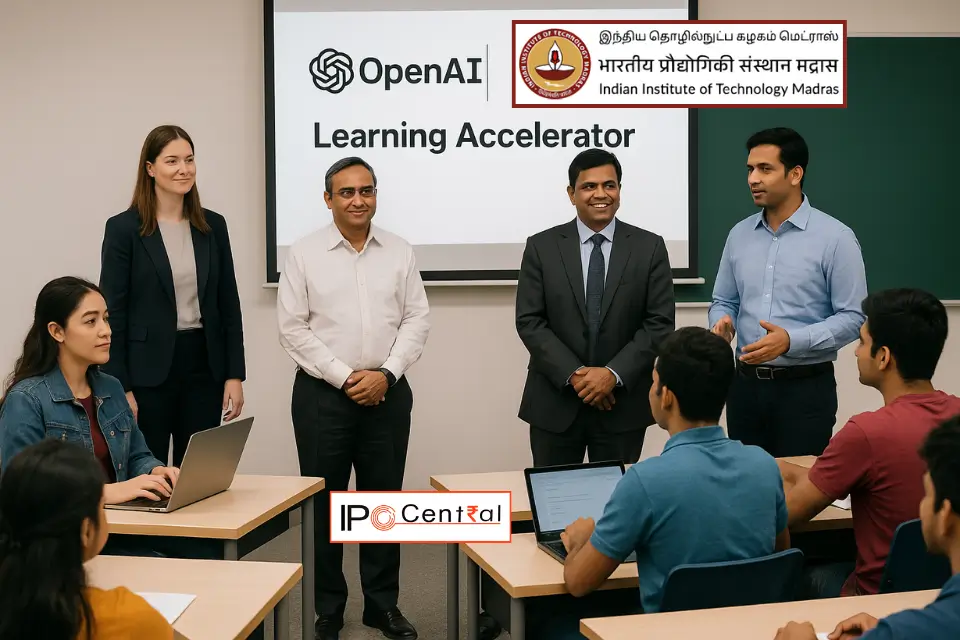
Learning Accelerator
The Learning Accelerator brings together IIT Madras, AICTE, Ministry of Education and ARISE schools, with a multi-pronged focus:
- Research funding: IIT Madras will use the USD 5,00,000 grant to conduct long-term studies on how AI can improve pedagogy, enhance cognitive learning outcomes and support innovative teaching. The results will be made public to guide product development and educational policy.
- Licensing & training: OpenAI will distribute half a million ChatGPT licenses and training modules to teachers and students across India to ensure grassroots-level adoption.
- AI Study Mode: Tailored to the Indian curriculum, including CBSE and IIT exam prep, this mode positions ChatGPT as a personal tutor, moving beyond rote answer generation to guided learning.
Voices from the Leaders
Leah Belsky, VP of Education at OpenAI, said: “AI can be a personal, lifelong tutor for students, free up time for teachers to focus on their art and become critical infrastructure for institutions”
Dr. Kamakoti Veezhinathan, Director at IIT Madras said: “Partnering with OpenAI allows us to explore how AI can reshape pedagogy and prepare the next generation of educators and technologists”
The move also comes as OpenAI is expanding in India, with plans to open its first office in New Delhi later this year.
Market implications & broader context
- EdTech disruption: By being in the Indian education system, OpenAI is competing directly with Byju’s, Vedantu and Coursera. Its ability to deliver free or subsidised AI tutors at scale can change the economics of EdTech.
- Policy alignment: With partnerships with the Ministry of Education and AICTE, OpenAI is positioning itself as a policy-aligned player and will have an edge in regulatory approvals and state-level rollouts.
- Workforce upskilling: India’s massive engineering and STEM student base will now have structured access to generative AI, creating an AI-skilled workforce pipeline for industries from IT services to manufacturing.
- Global strategy: The USD 5,00,000 funding is a testbed strategy. India, with 300+ million students, is the largest educational AI market, and success here will be a blueprint for expansion in other emerging markets.
Leadership & Next Steps
OpenAI has also appointed Raghav Gupta, former MD at Coursera (India & APAC), as its Head of Education for India and Asia Pacific. His job is to drive adoption among educators, engage with governments and scale the company’s AI tools for teaching and research.
Sam Altman’s upcoming India visit and the AI Action Summit 2026, where the partnership was announced, will give more clarity on OpenAI’s long-term India strategy.
Conclusion
This is more than a grant—it’s a foot in the door into India’s education economy. For investors and industry watchers, this is how OpenAI is not just exporting technology but getting into the local DNA. With India’s young population, rapid AI adoption and policy openness, this could be one of OpenAI’s biggest bets globally.
For more details related to IPO GMP, SEBI IPO Approval, and Live Subscription stay tuned to IPO Central.