


































In a game-changer for the fight against antimicrobial resistance (AMR), researchers at IIT Madras have developed a chip-based device that delivers antibiotic susceptibility test results in just three hours.
The device is called ‘ε-µD’ and provides rapid, accurate and low-cost Antimicrobial Susceptibility Testing (AST), which can revolutionise diagnostics in resource-poor healthcare settings globally.
A Global Health Crisis
Antimicrobial resistance is one of the biggest threats to global health. According to the WHO, nearly 4.95 million deaths in 2019 were due to bacterial AMR. The burden is highest in low and middle-income countries where diagnostic infrastructure is limited and delays in treatment force doctors to use broad-spectrum antibiotics, worsening the resistance trends.
Traditional AST methods take 48-72 hours to give results. This delay has been a major hurdle to timely and effective treatment.
The Innovation: ‘ε-µD’
The IIT Madras team’s solution is the ε-µD device that uses Electrochemical Impedance Spectroscopy (EIS) and screen-printed carbon electrodes in a simple microfluidic chip. Unlike conventional methods that use expensive metals or complex fabrication, this device is cost-effective and simple enough to be used in smaller clinics and rural healthcare centres.
The device supports bacterial growth through a specially formulated nutrient solution and tracks electrical signals that change as bacteria multiply. This dual function allows the system to monitor bacterial activity in real time and determine if the pathogen is susceptible or resistant to specific antibiotics.
IIT Madras Low-Cost Superbug Test: Features and Benefits
- Speed: Results in 3 hours, compared to 2-3 days for traditional methods.
- Affordability: Built with screen-printed carbon electrodes instead of expensive fabrication materials.
- Ease of Use: Designed for deployment in smaller healthcare facilities with limited resources.
- Accuracy: A new metric, the Normalised Impedance Signal (NIS), allows clear differentiation between resistant and non-resistant strains.
- WHO aligned: Meets global criteria of affordability, speed, reliability and accessibility.
Clinical Relevance and Validation
The team tested the device with E. coli (gram-negative) and B. subtilis (gram-positive) bacteria and antibiotics ampicillin (bactericidal) and tetracycline (bacterial growth inhibitor). ε-µD was able to distinguish between resistant and susceptible responses in hours.
In a real-world application, the device was also tested with urine samples spiked with E. coli and was able to detect tetracycline resistance, proving its clinical relevance.
Voices from the Research Team
Prof. S. Pushpavanam, Y B G Varma Institute Chair Professor, Department of Chemical Engineering, IIT Madras, said: “Our device uses a specially prepared nutrient solution that enhances both bacterial growth and our electrical detection method. This could be a lifesaver, especially for patients in ICUs where time is of the essence.”
Dr. Richa Karmakar, Assistant Professor, Department of Biotechnology, IIT Madras, explained: “If bacteria grow despite antibiotics the electrical signal changes. If they are killed the signal remains stable. The Normalised Impedance Signal allows us to see this within hours.”
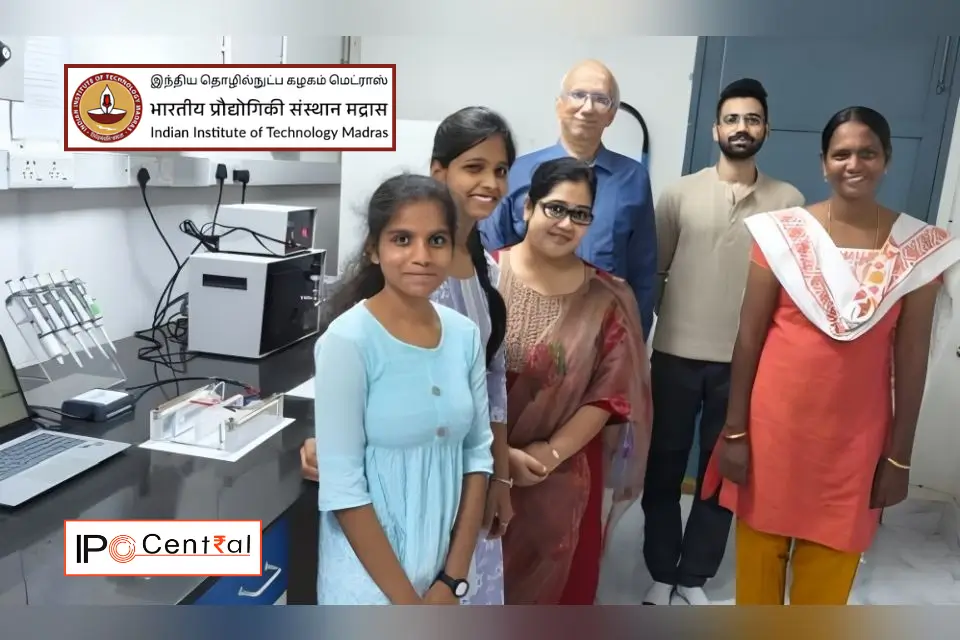
The team, which includes Saranya Gopalakrishnan (Kaappon Analytics India) and Diksha Mall, is currently doing clinical validation with the IITM Institute Hospital. Plans are to commercialise the technology through Kaappon Analytics India, a startup incubated at IITM Research Park.

Towards Accessible Healthcare
By combining affordability, speed and scientific rigour, the ε-µD device can reduce antibiotic misuse and improve patient outcomes. If widely adopted, it can be a game changer in the global fight against AMR — especially in regions where access to labs is scarce.
For more details related to IPO GMP, SEBI IPO Approval, and Live Subscription stay tuned to IPO Central.