



































The Indian textile sector is shifting from a generic commodity market to a high-value, tech-driven powerhouse. Gujarat-based cotton yarn manufacturer, Shree Ram Twistex, is stepping into the public market with an IPO on 23 February 2026. While the headline numbers suggest a compelling growth story, but Shree Ram Twistex IPO review reveals a business model that is operationally robust but strategically concentrated.
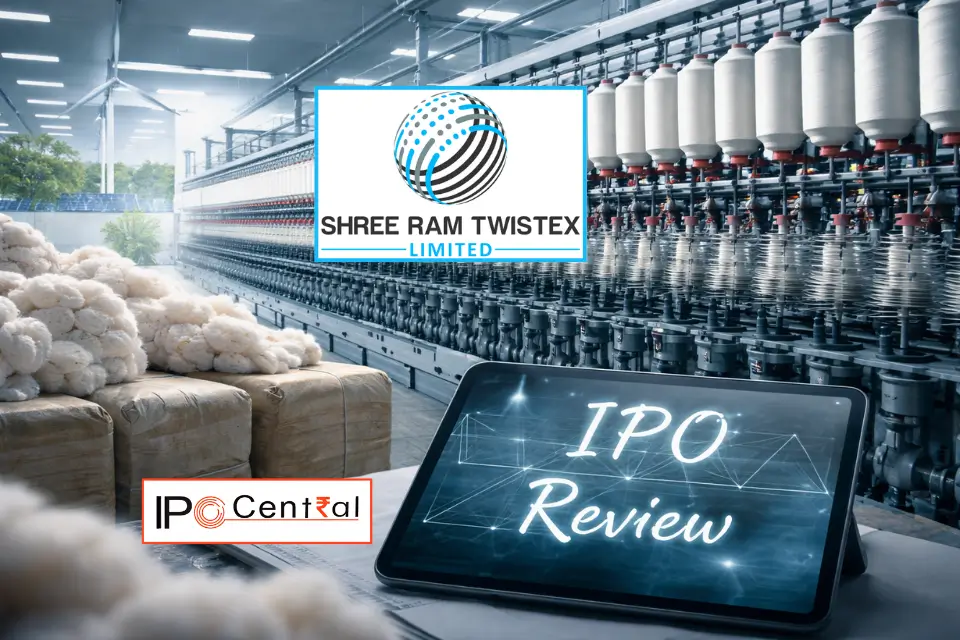
Table of Contents
Shree Ram Twistex IPO Snapshot
Shree Ram Twistex is opting for a 100% fresh issue of up to 1,06,00,000 equity shares.
| Parameter | Details |
| Bid/Issue Window | 23 – 25 February 2026 |
| Listing Date | 2 March 2026 |
| Fresh Issue Size | 1,06,00,000 Equity Shares |
| Listing Platforms | BSE & NSE |
| Objects of the Issue | Solar & Wind power projects, debt repayment, and working capital |
Shree Ram Twistex IPO Review: The Spinning Engine
At its core, Shree Ram Twistex is a Business-to-Business (B2B) player specializing in the manufacturing of high-quality cotton yarns. The company’s manufacturing unit in Gondal, Rajkot (Gujarat), houses 17 compact ring-spinning machines with a total spindle count of 27,744, translating to an annual capacity of 9,855 MT.
The Technology Moat: European Precision
Operational efficiency in spinning is determined by “yield”—the amount of finished yarn extracted from raw cotton. Shree Ram Twistex has deployed a machinery stack sourced from global leaders:
- Switzerland & Germany (Rieter and Trutzschler): The facility uses breaker draw frames and carding machines that ensure superior fiber alignment and zero impurity levels.
- Italy (Savio): Link coners with automated winding and electronic yarn clearers minimize manual defects and “hairiness,” allowing the company to command premium pricing for strength and consistency.
This technology moat is critical. While domestic competitors often use localized machinery with higher wastage rates, Shree Ram’s European tech-stack provides a distinct advantage in producing specialized counts (Ne 8 to Ne 40) required for premium shirting, sheeting, and sweaters.
Shree Ram Twistex IPO Analysis: Revenue Streams
An informed investor must look at what is being sold, not just how much. The company is transitioning from low-margin commodity yarns to specialized, value-added products.
Product Mix Shift
- Carded Yarn (51.34% of FY25 Revenue): Historically the mainstay, used in denim and home textiles.
- Eli Twist Yarn (29.60% of FY25 Revenue): A double-twisted compact yarn known for high durability.
- The “Organic” Surprise: The most pivotal data point in the RHP is the surge in Organic Yarn. In FY25, it contributed a mere 0.87% to the revenue. However, for the six months ending 30 September 2025 (H1 FY26), this skyrocketed to 21.52%.
This jump indicates a strategic realignment toward high-margin, sustainable textile segments. However, investors must verify if this growth is sustained by multiple clients or is the result of a single large order from their top customer.
Operational Moat: The Energy Transition
In energy-intensive industries like spinning, power accounts for 6% to 8% of total expenses. Shree Ram Twistex currently sources power at an average tariff of INR 8.92 per unit.
The company is utilizing IPO proceeds to achieve near 100% captive energy security:
- 6.1 MW Solar Plant: INR 7.34 crore allocated for expansion.
- 4.2 MW Wind Project: INR 39 crore allocated for captive wind power.
By shifting to captive “Green Energy,” the company anticipates a significant reduction in operational expenditure, which could potentially expand EBITDA margins by 200-300 basis points in the long term.+1
Shree Ram Twistex IPO Review: Financial Snapshot
In Shree Ram Twistex IPO analysis financials present a story of aggressive margin expansion.
| KPI | FY 2023 | FY 2024 | FY 2025 | H1 FY 2026 |
| Revenue (INR Cr) | 213.10 | 231.59 | 255.04 | 132.08 |
| PAT (INR Cr) | 2.05 | 6.55 | 8.00 | 7.00 |
| PAT Margin (%) | 0.96 | 2.83 | 3.14 | 5.30 |
| EBITDA Margin (%) | 8.16 | 8.72 | 8.57 | 12.90 |
| Working Capital Days | 52 | 71 | 34 | 44 |
The 97.46% PAT CAGR between FY23 and FY25 is staggering. However, this is partly due to a low base in FY23 (INR 2.05 Cr profit). The real strength lies in the EBITDA jump to 12.90% in H1 FY26, which brings the company’s efficiency on par with premium listed players like Ambika Cotton Mills.
Shree Ram Twistes IPO Review: Critical Risks
A. Extreme Client Concentration
Revenue is highly dependent on a limited number of institutional buyers
- Top 1 Client (Welspun Living Limited): Contributed 28.57% to revenue in H1 FY26.
- Top 10 Clients: Account for 79.74% of revenue.
- There are no long-term contracts; business is conducted on a purchase-order basis. If Welspun switches suppliers or reduces demand, Shree Ram’s profitability could evaporate instantly.
B. Negative Cash Flow History
In FY 2024, the company faced a Negative Operating Cash Flow of INR (4.91) crore. This indicates that despite doing business, the money was stuck in the market (Receivables). While it improved in FY25, the volatility in the cash conversion cycle is a point of concern for liquidity.
C. Geographic & Governance Risks
- Gujarat Concentration: 93.48% of FY25 revenue comes from Gujarat. Any local policy shift or labor unrest in the state could paralyze operations.
- Credit History: The company was tagged as “Issuer Not Cooperating” by CRISIL in the past (FY24-25), suggesting a potential lack of transparency with rating agencies.
Industry Overview
India’s textile industry is moving through a clear structural transition, supported by global supply-chain realignment and sustained policy support. As the sixth-largest exporter of textiles and apparel, India continues to gain from the “China + 1” sourcing strategy, which has already translated into a sharp recovery in cotton yarn exports during FY23–24.
The industry, currently valued at around USD 174 billion (~INR 15.78 lakh crore), is expected to grow to nearly USD 350 billion (~INR 31.74 lakh crore) by 2030. A strong domestic ecosystem—backed by the world’s largest cotton acreage, significant spinning capacity, and MSP-led price support—provides long-term stability. That said, the sector remains exposed to cotton price volatility, rising preference for artificial fibres, and demand softness in key export markets. Overall, players focusing on value-added products and cost efficiency are better placed to sustain margins and growth.
Outlook
The Bull Case:
- Aggressive pivot to high-margin Organic and Eli Twist yarn.
- Superior European technology Moat ensures high product quality.
- Moving toward 100% captive renewable energy will structurally lower costs.
The Bear Case:
- Excessive reliance on Welspun and a few other clients.
- Historical “Non-Cooperation” with credit rating agencies.
- Vulnerable to raw cotton price volatility, which accounts for 75% of revenue.
Shree Ram Twistex is a high-risk, high-reward play. It is an operationally efficient manufacturer that is currently “punching above its weight” in terms of profit growth.